Philippines accuses China of blocking supply boat in South China Sea

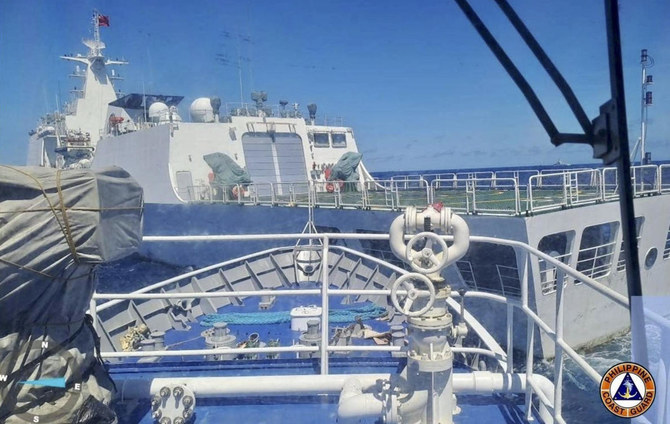
A Chinese Coast Guard ship, front, blocks the path of a Philippine Coast Guard ship near the Philippine-occupied Second Thomas Shoal, South China Sea during a re-supply mission on Saturday Aug. 5, 2023. (Philippine Coast Guard via AP)
Short Url
Updated 06 August 2023
Follow

Philippines accuses China of blocking supply boat in South China Sea

  • China claims sovereignty over almost the entire South China Sea, an assertion rejected internationally
  • Beijing often irks its neighbors with maritime actions they call aggressive and with longer-term activities

MANILA: The Philippines on Sunday accused China’s coast guard of blocking and water-cannoning a Philippine military supply boat in the South China Sea, condemning the “excessive and offensive actions” against its vessels.
China claims sovereignty over almost the entire South China Sea, an assertion rejected internationally, while Malaysia, Vietnam, Brunei, Taiwan and the Philippines have various claims to certain areas.
Beijing often irks its neighbors with maritime actions they call aggressive and with longer-term activities like building islands on reefs and equipping them with missiles and runways.
A Chinese coast guard vessel on Saturday blocked and water-cannoned the chartered Philippine boat on a routine troop rotation and resupply mission, “in wanton disregard of the safety of the people on board and in violation of international law,” the Armed Forces of the Philippines said.
It said in a statement the incident occurred near the Second Thomas Shoal, which Manila calls Ayungin Shoal, a submerged reef where a handful of its troops live on a rusty World War Two-era US ship that was intentionally grounded in 1999.
The Chinese coast guard’s “dangerous maneuvers” prevented a second boat from unloading the supplies and completing the mission, it said.
The Chinese embassy in Manila did not immediately respond to a request for comment.
“We call on the China Coast Guard and the Central Military Commission to act with prudence and be responsible in their actions to prevent miscalculations and accidents that will endanger peoples’ lives,” the armed forces said.
The Philippine Coast Guard said the Chinese actions violated laws including two international conventions and a ruling from a global tribunal.
The Permanent Court of Arbitration in The Hague concluded in 2016 that Beijing’s expansive claim to the South China Sea was groundless. China maintains it does not accept any claim or action based on the ruling.
The Philippine Coast Guard “calls on the China Coast Guard to restrain its forces, respect the sovereign rights of the Philippines in its exclusive economic zone and continental shelf, refrain from hampering freedom of navigation, and take appropriate actions against the individuals involved in this unlawful incident,” said a spokesman, Commodore Jay Tarriela.
After the incident, the US State Department said China’s “repeated threats to the status quo in the South China Sea (were) directly threatening regional peace and stability” and that Washington stands with its Philippine allies in the face of such “dangerous actions.”
“The United States reaffirms an armed attack on Philippine public vessels, aircraft, and armed forces – including those of its Coast Guard in the South China Sea – would invoke US mutual defense commitments under Article IV of the 1951 US Philippines Mutual Defense Treaty,” it said in a statement.


AI reshaping the battle over the narrative of Maduro’s US capture

Updated 7 sec ago
Follow

AI reshaping the battle over the narrative of Maduro’s US capture

  • Since the US captured Venezuelan leader Nicolas Maduro in early January, pictures and videos chronicling the events have been crowded out by those generated with artificial intelligence
CARACAS: Since the US captured Venezuelan leader Nicolas Maduro in early January, pictures and videos chronicling the events have been crowded out by those generated with artificial intelligence, blurring the lines between fiction and reality.
The endless stream of content ranges from comedic memes to dramatic retellings.
In one, a courtroom illustration of Maduro in a New York courthouse springs to life and announces: “I consider myself a prisoner of war.”
In another, an AI-generated Maduro attempts to escape a US prison through an air duct, only to find himself in a courtroom with US President Donald Trump, where they dance with a judge and an FBI agent to a song by American rapper Ice Spice.
Maduro was captured alongside his wife Cilia Flores during US strikes in the Venezuelan capital of Caracas on January 3.
They have since been taken to a prison in New York where they are being held on drug trafficking charges.
While some have celebrated Maduro’s ouster, the “Chavismo” movement he leads — named after his predecessor Hugo Chavez — has worked to reframe what his fall means for Venezuela’s future.
- ‘ Confuse, combat, and silence’ -
Leon Hernandez, a researcher at Andres Bello Catholic University, told AFP that with AI’s rapid creation of content, we see development of “disinformation labs” that flood social media platforms.
“There were things that circulated that were not real during the capture (of Maduro), and things that circulated which were real that generated doubt,” Hernandez said.
“That was the idea: to create confusion and generate skepticism at the base level by distorting certain elements of real things.”
The goal, he added, is for the content to overwhelm audiences so they cannot follow it.
Even legacy media such as the Venezuelan VTV television channel are in on it, with the broadcaster playing an AI-animated video narrated by a child recounting Maduro’s capture.
“AI has become the new instrument of power for autocrats to confuse, combat, and silence dissent,” said Elena Block, a professor of political communication and strategy at the University of Queensland in Australia.
- ‘Greatest threat to democracy’ -
Block pointed out the use of cartoons, specifically, had been a medium of propaganda used in both authoritarian and democratic states.
Long before his arrest, Maduro was depicted as the illustrated superhero “Super Bigote” or “Super Mustache,” donning a Superman-like suit and fighting monsters like “extremists” and the “North American empire.”
The cartoon’s popularity spawned toys that have been carried by Maduro’s supporters during rallies advocating for his return.
And much like his predecessor, Maduro continued a practice of “media domination” to stave off traditional media outlets from airing criticism of Chavismo.
“With censorship and the disappearance or weakening of news media, social media has emerged as one of the only spaces for information,” Block said.
Maduro is not the only leader to use AI propaganda — Trump has frequently posted AI-generated pictures and videos of himself with “antagonistic, aggressive, and divisive language.”
“These digital and AI tools end up trivializing politics: you don’t explain it, you diminish it,” Block said. “AI today is the greatest threat to democracy.”