Philippines summons Chinese ambassador over South China Sea incident

The Philippine military condemned the Chinese coast guard ship’s ‘excessive and offensive’ use of a water cannon to block a Filipino supply boat to the Philippine-occupied Second Thomas Shoal in the disputed South China Sea. (Philippine Coast Guard via AP)
Short Url
Updated 07 August 2023
Follow

Philippines summons Chinese ambassador over South China Sea incident

  • The Philippines has filed over 400 diplomatic protests against China since 2020
  • China claims sovereignty over almost the entirety of the South China Sea

MANILA: The Philippines summoned on Monday Beijing’s ambassador to Manila to protest the China Coast Guard’s use of a water cannon against a Filipino supply boat in the disputed South China Sea.

The Philippine Coast Guard said on Sunday that its Chinese counterpart had fired a water cannon and used “dangerous” moves to block a chartered Philippine vessel that was on a routine troop rotation and resupply mission near the Second Thomas Shoal, which Manila calls Ayungin Shoal.

“A note verbale … was issued during the summon of the Chinese ambassador by Undersecretary (Theresa) Lazaro,” Department of Foreign Affairs spokesperson Teresita Daza said during a press conference in Manila, referring to a DFA official.

“Lazaro conveyed to the Chinese ambassador this morning the strong protest of the Philippine government … The Philippines demands that China immediately stop its illegal activities in our maritime zones.”

Manila’s ambassador in Beijing has also handed a protest note to the Chinese Foreign Ministry on Monday morning, Daza added.

The Philippines has filed over 400 diplomatic protests against China since 2020, and nearly three dozen were filed so far this year.
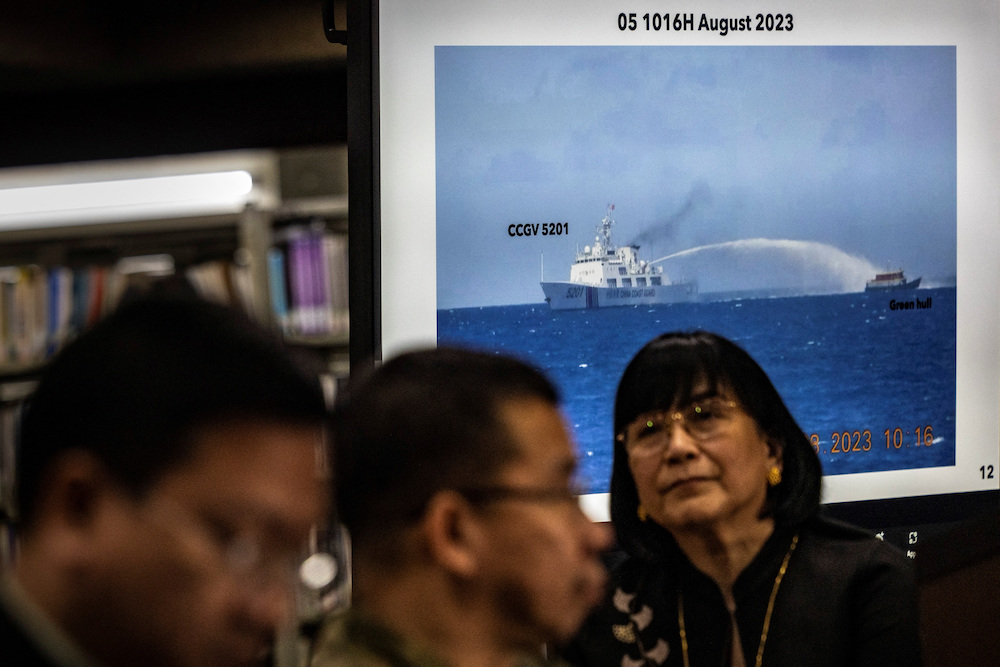


Philippines' foreign ministry holds a joint news conference on water cannon incident in the South China Sea on Aug. 7, 2023. (Supplied)

President Ferdinand Marcos Jr. said on Monday that the Philippines will continue “to assert our territorial rights in the face of all of these challenges and consistent with the international law.”

Last month, the Philippines stepped up patrols in its part of the South China Sea after recording dozens of “Chinese maritime militia” in the contested, resource-rich waterway.

China claims sovereignty over almost the entirety of the South China Sea based on its so-called “nine-dash line” stretching over 1,500 km off its mainland and cutting into the exclusive economic zones of several countries, including the Philippines.

Though an international tribunal in The Hague dismissed the expansive Chinese claim of the waters in 2016, Beijing does not recognize the ruling and has in recent years increased activities in the area, including developing its military presence by building artificial island bases.

“We will never abandon Ayungin Shoal,” said Jonathan Malaya, spokesperson for the National Task Force on the West Philippine Sea, or the Philippine part of the South China Sea.

“We are here precisely to assure the Filipino people that we are consistent with the president’s directive that we will not lose an inch of our territory.” 


US allies, foes alarmed by capture of Venezuela’s Maduro

Updated 55 min 26 sec ago
Follow

US allies, foes alarmed by capture of Venezuela’s Maduro

  • Countries such as Russia and China, which had ties with Maduro’s government, were quick to condemn the operation but alarm also shared by France and EU
  • UN Secretary-General Antonio Guterres was “deeply alarmed” by the US strikes

PARIS: The US military operation that led to the seizure of Venezuelan President Nicolas Maduro on Saturday sparked alarm across the international community, with allies and foes of Washington and Caracas expressing disquiet.
US President Donald Trump said Maduro and his wife would be taken to New York to face federal charges after military strikes and an operation which he described as looking like a “television show.”
The Venezuelan government decried what it termed a “extremely serious military aggression” by Washington and declared a state of emergency.
Countries such as Russia and Iran, which had longstanding ties with Maduro’s government, were quick to condemn the operation but their alarm was also shared by Washington’s allies including France and the EU.
Here is a rundown of the main reaction.

Russia

Russia demanded the US leadership “reconsider its position and release the legally elected president of the sovereign country and his wife.”

China

Beijing said “China is deeply shocked and strongly condemns the US’s blatant use of force against a sovereign state and its action against its president.”

Iran

Iran, which Trump bombed last year, said it “strongly condemns the US military attack on Venezuela and a flagrant violation of the country’s national sovereignty and territorial integrity.”

Mexico

Mexico, which Trump has also threatened with military force over drug trafficking, strongly condemned the US military action in Venezuela, saying it “seriously jeopardizes regional stability.”

Colombia

Colombian President Gustavo Petro — whose country neighbors Venezuela — called the US action an “assault on the sovereignty” of Latin America which would lead to a humanitarian crisis.

Brazil

Brazilian President Luiz Inacio Lula da Silva slammed the US attacks as a “serious affront” to Venezuela’s sovereignty.

Cuba

Cuba, a strong ally of Venezuela, denounced “state terrorism against the brave Venezuelan people.”

Spain

Spain offered to mediate in the crisis to find a way to a peaceful solution, while calling for “de-escalation and restraint.”

France

France condemned the US operation, saying it undermined international law and no solution to Venezuela’s crisis can be imposed from the outside.

EU

The EU more generally expressed concern at the developments and urged respect for international law, even as it noted that Maduro “lacks legitimacy.”
EU candidate country North Macedonia, along with fellow Balkan nations Albania and Kosovo, backed Washington, however.
“We stand with the United States and the Venezuelan people for freedom and democracy,” North Macedonia FM Timco Mucunski said on X.

Britain

British Prime Minister Keir Starmer said all countries should “uphold international law” and added that “the UK was not involved in any way in this operation” as he urged patience in order to “establish the facts.”

Italy

In a rare expression of support for the US operation by a major European country, far-right Italian Prime Minister Giorgia Meloni — a Trump ally — argued the US military action in Venezuela was “legitimate” and “defensive.”

Israel

Israel also hailed the operation, saying Washington acted as the “leader of the free world.”

Ukraine

Ukraine — dependent on US support in its war against invading Russia — did not address the legality of a big country like America using military force against a much smaller one like Venezuela.
Foreign minister Andriy Sybiga instead focused on Maduro’s lack of legitimacy and the Venezuelan government’s repression, while backing “democracy, human rights, and the interests of Venezuelans.”

South Africa

South Africa, which Trump accuses of alleged discrimination — and even “genocide” — of minority white Afrikaners, said: “Unlawful, unilateral force of this nature undermines the stability of the international order and the principle of equality among nations.”

UN

UN Secretary-General Antonio Guterres was “deeply alarmed” by the US strikes, with his spokesman quoting him as saying it could “constitute a dangerous precedent.”