

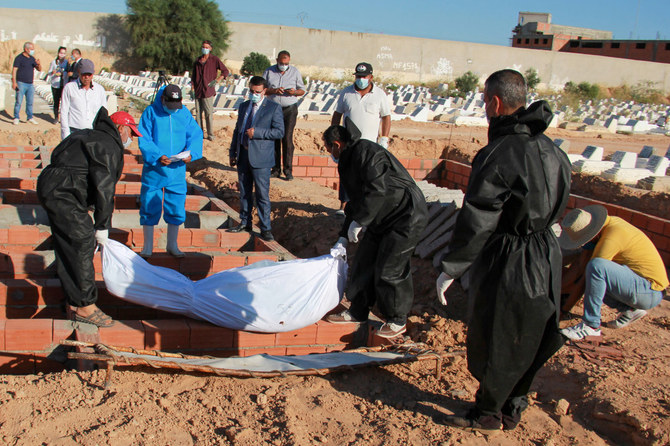

TUNIS: Sixteen migrants have died in shipwrecks off the coasts of Tunisia and Western Sahara, officials said Monday, as North Africa faces a spike in Europe-bound sea crossings.
Much of the North African coast has become a major gateway for irregular migrants and asylum seekers primarily from other parts of the continent, attempting perilous voyages in often rickety boats in the hopes of a better life.
At least 11 migrants died in a shipwreck off the coast of Tunisia’s second city of Sfax, said local court spokesman Faouzi Masmoudi, revising an earlier toll of four fatalities.
Another 44 are missing while two others were rescued from the boat that had 57 people on board, all of them from sub-Saharan African countries, Masmoudi added.
Survivors of the sinking, near Tunisia’s Kerkennah Islands in the Mediterranean Sea, said the makeshift boat had departed over the weekend from a beach north of the coastal city of Sfax.
Masmoudi told AFP coast guard units were searching for more survivors.
The distance between Sfax and Italy’s Lampedusa island is only about 130 kilometers (80 miles).
Authorities in Morocco meanwhile said the bodies of five migrants, all from Senegal, had been recovered while 189 had been rescued after their boat capsized off Western Sahara.
The five bodies as well as 11 migrants in “critical condition” were transferred to a hospital in Dakhla, the disputed Western Sahara’s second city on the Atlantic coast, a military source told Rabat’s state-owned MAP news agency.
According to the source, the boat had embarked from “a country located south of the kingdom” and was headed toward Spain’s Canary Islands before being discovered off the coast of Guerguart, just north of Mauritania.
It was in a “difficult situation,” the source added.
The migrants who were rescued, including at least one woman, were taken to Dakhla on Sunday and handed over to Moroccan authorities, according to the source.
Migrant deaths have surged in recent years as thousands flee war or crushing poverty, seeking to cross the Mediterranean in the hopes of finding better lives in Europe.
The central Mediterranean migrant crossing from North Africa to Europe is the world’s deadliest with more than 20,000 fatalities since 2014, according to the International Organization for Migration.
According to survivor testimony, at least 30 migrants are missing after two unrelated sinkings near Lampedusa of boats that departed last week from Sfax.
Authorities in Tunisia found the bodies of 12 migrants that washed ashore north of Sfax between Friday and Sunday, but it wasn’t immediately clear whether they were related to the shipwreck near the Kerkennah Islands, located just across from Sfax.
Masmoudi said authorities were investigating “whether there have been other shipwrecks in this area.”
According to Tunisia’s interior ministry, 901 bodies had been recovered this year by July 20 following maritime accidents in the Mediterranean, while 34,290 migrants had been rescued or intercepted.
Most of them came from sub-Saharan African countries, it said.
Nearly 90,000 migrants have arrived in Italy this year, according to UN refugee agency, with most of them having embarked from Tunisia or neighboring Libya.
Crossing attempts multiplied in March and April following a incendiary speech by President Kais Saied who had alleged that “hordes” of sub-Saharan migrants were causing crime and posing a demographic threat to the mainly Arab country.
Xenophobic attacks targeting black African migrants and students have increased across the country since Saied’s February remarks, and many migrants have lost jobs and housing.
Since early July, hundreds of migrants have been driven out of Sfax after a Tunisian man’s death in an altercation with migrants.
In the following days, Tunisian police took migrants to the desert and other unhospitable areas near the Libyan and Algerian borders, rights groups and international organizations said.
Humanitarian sources have put their number at over 2,000, with at least 25 reported deaths of migrants abandoned in the Tunisian-Libyan border area since last month.


