


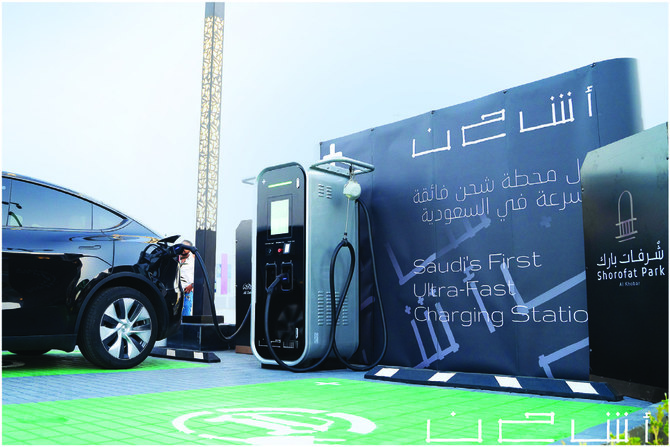

ALKHOBAR: Saudi Arabia is entering a new era in the electric cars market — and at the helm is Alhareth Al-Hisan, the lively 22-year-old who just inaugurated the Kingdom’s first ever ultra-fast charging station, which handles 200 kilowatts.
Arab News spoke to Al-Hisan during the event to collect his thoughts on the launch of his startup, Ishan, which is the Arabic word for “charge.”
During the last two years, he worked tirelessly to secure the necessary permits to help cars juice up.
At Shorofat Park in Alkhobar this week, vehicles lined up to get a taste of what is to come.
Having lived the majority of his life in the UK, Saudi national Al-Hisan is offering the country a European sensibility to elevate the lives of drivers in his home country. Choosing Alkhobar as the launch of the charging station was deliberate — it’s the cradle of oil and gas, and liquid gold has been pumped into the economy and the car-dependent country since the start.

The major players in the area have local car charging stations — but they often do not work since they have not been able to secure the permits to operate and thus, cars will arrive but the charger will not charge. (Supplied)
As an architecture student, he was always adamant at utilizing urban spaces efficiently and admits that cars have never been a passion of his but he saw a need in the market and decided to step in.“I decided to go on an entrepreneurial path. My project is basically three things; first of
all, I get experience so that I can build a bigger project … (second) to gain money — because I will not be able to do my project without having money. The third one is to have a good impact. And this will enable me to check all three,” he told Arab News.
He believes that the environment, people’s quality of life and their safety will all benefit — and their wallets will also thank them.
“If I were to help in the spread of electric vehicles in Saudi Arabia, people would be more safe, we’ll have better cars, people will have a better environment, people will have more money in their pockets,” he told us.
The biggest hurdle is securing permits. The Kingdom does have a system for it currently, but it is rigorous and cumbersome with a stack of seemingly never-ending regulations. Normally, Al-Hisan would say that the paperwork was “too much” but he felt like in this instance, it was wise of the country to be so strict so that they do not repeat the mistakes the US made.
“It is positive to have these strict guidelines because they are mindful that they want to have an almost universal charging station,” he said.
The major reason why electric cars have not become dominant in the Kingdom is because the country does not have adequate working charging stations yet.

Diversifying beyond petrol is not only practical but is the only way to secure a sustainable economy and environment, says yoing Saudi entrepreneur Alhareth Al-Hisan. (Supplied)
The major players in the area have local car charging stations — but they often do not work since they have not been able to secure the permits to operate and thus, cars will arrive but the charger will not charge.
Defying all odds, Al-Hisan has a working station and hopes people will come to try it.
While it is easier to create the roadmap since nothing is set in stone yet, it is always a hard road to enter an emerging market.
“We have to do the same as what has happened in the Netherlands because we don’t want to get into the same issue that the US because the US now, they are in a whole mess with the infrastructure for electric vehicles,” he said.
“They have given the support to buy electric vehicles in the US, they get a discount and tax breaks, but the main issue they face is the distribution, so they had to deal with Tesla because they have the most spread and diverse network of electric vehicles. If we follow the US example it will be a mess. We have to do it the European way,” added Al-Hisan.
Something that also sets him apart from his giant competitors is that he is focused solely on the charging of electric vehicles.
“We are immersed and we know exactly what to do because we own electric vehicles. (Others) do several other things. They do petrol construction, they do importing of devices. We are specialized in electric vehicle chargers. This is the only thing we do. This is why I can say that we are very good at it. Why?Because we don’t know how to do anything else,” he said.
Changing car-dependent user habits is not on his mind as he trusts that Saudi residents are intelligent enough to recognize that this is the future, and diversifying beyond petrol is not only practical but is the only way to secure a sustainable economy and environment.
“You have to add a positive impact – that is the purpose of us as human beings. Because if my ancestors didn’t attempt improving their minds and our lives, we wouldn’t be in what we are in today. So I only have to try,” he said.


