



NIAMEY: Niger’s coup leaders on Thursday evening announced they were ending the mandates of ambassadors to four countries, as they face international pressure to restore the democratically elected leader they ousted last week.
“The functions of the extraordinary and plenipotentiary ambassadors of the Republic of Niger” to France, Nigeria, Togo and the United States “are terminated,” one of the putschists said in a statement read on national television.
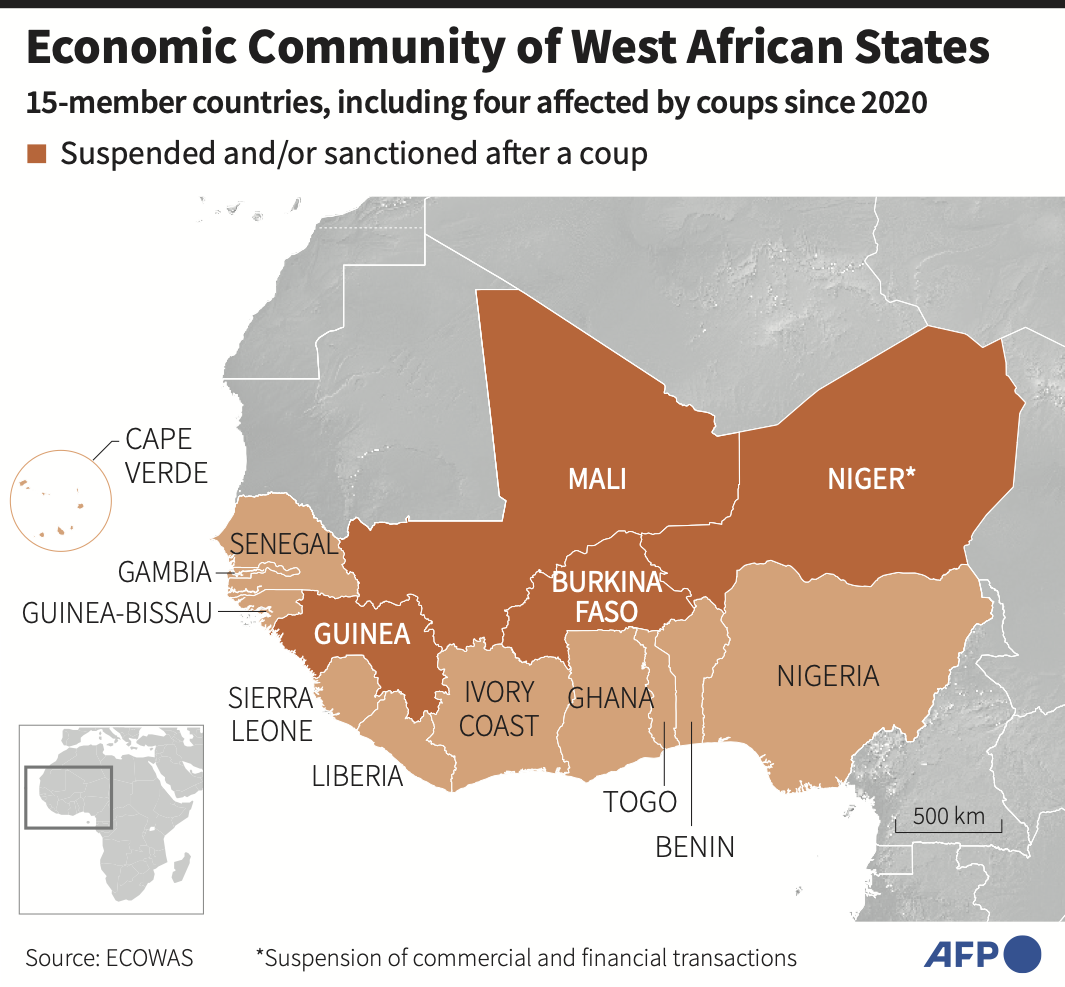
The junta faces international pressure to restore ousted President Mohamed Bazoum, with threats of force by regional bloc the Economic Community of West African States, currently chaired by Nigerian President Bola Tinubu.
The junta also threatened an immediate response to any “aggression or attempted aggression.”
Any aggression or attempted aggression against the State of Niger will see an immediate and unannounced response from the Niger Defense and Security Forces on one of (the bloc’s) members,” read the statement.
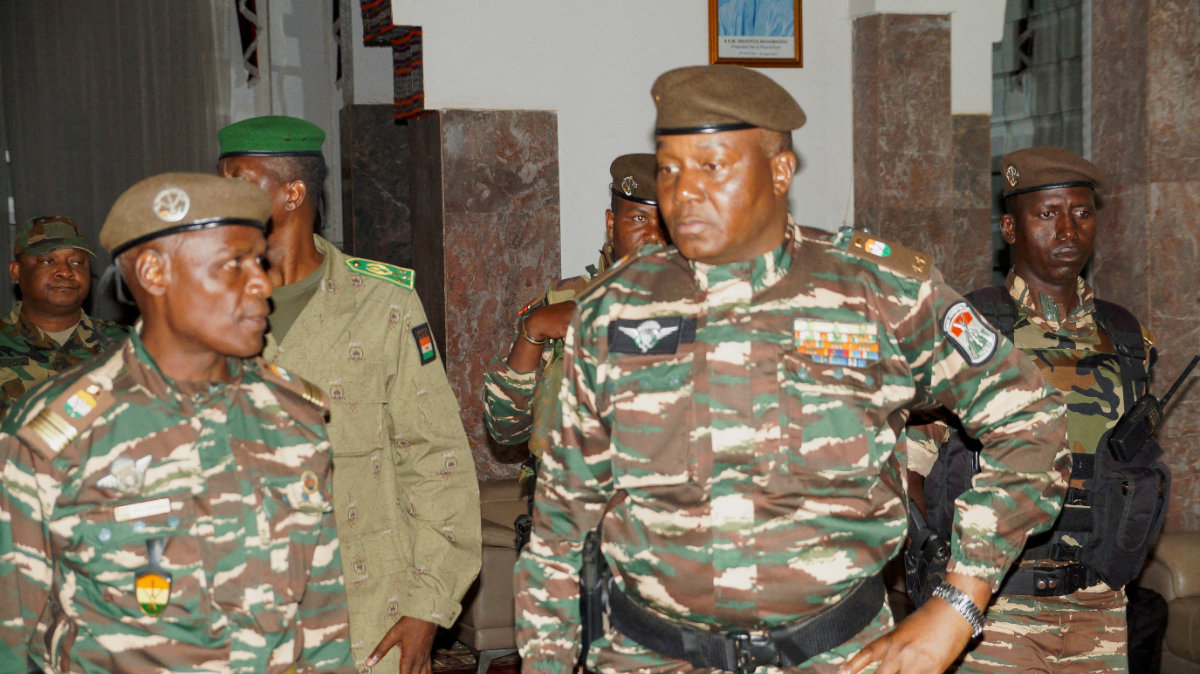
General Abdourahmane Tiani, who was declared as the new head of state of Niger by leaders of a coup, arrives to meet with ministers in Niamey on July 28, 2023. (REUTERS)
This came with “the exception of suspended friendly countries,” an allusion to Burkina Faso and Mali, neighboring countries that have also fallen to military coups in recent years.
Those countries’ juntas have warned any military intervention in Niger would be tantamount to a “declaration of war” against them.
Nigeria, West Africa’s pre-eminent military and economic power, is the current ECOWAS chair and has vowed a firm line against coups.
Military chiefs of the bloc’s member countries met in Nigeria on Wednesday for three days of consultations.
Outside the continent, global condemnation has been led by the United States and former colonial power France, which have about 1,000 and 1,500 troops in the country, respectively.
US Secretary of State Antony Blinken said the United States “stands very much” in support of West African leaders who have threatened to use force to restore the nation’s democracy, and Senegal offered troops to help.
As hundreds of anti-French protesters rallied in the Nigerien capital in support of the ruling junta, Blinken offered general support for the regional bloc known as ECOWAS, though he did not specifically refer to its threat of military action. Blinken told reporters in New York that the US believes the bloc’s efforts to reinstate toppled President Mohamed Bazoum are “important, strong and have our support.”
Senegal’s foreign affairs minister said her country would participate in a military intervention if ECOWAS decides to take action. “Senegalese soldiers have to go … these coups d’état must be stopped,” Aissata Tall Sall said.
Meanwhile, Niger’s military leaders sought to exploit anti-Western sentiment to shore up their takeover. The junta suspended broadcaster RFI and France 24 television from broadcasting in the country, according to the French foreign affairs ministry. The suspensions were part of the junta’s “authoritarian repression,” the ministry wrote on X, the social media platform formerly known as Twitter.
Last week’s coup toppled Bazoum, whose ascendency marked Niger’s first peaceful, democratic transfer of power since independence from France in 1960. The coup stirred strident anti-French sentiment and raised questions about the future of the fight against extremism in Africa’s Sahel region, where Russia and Western countries have vied for influence.
The coup has been condemned by Western countries and the ECOWAS bloc, which has threatened to forcibly remove the junta if it does not hand back power to Bazoum. As tensions have grown in the capital of Niamey and the region, many European countries have moved to evacuate their citizens.
At Thursday’s protest organized by the junta and civil society groups on Niger’s independence day, protesters pumped their fists in the air and chanted support for neighboring countries that have also seen military takeovers in recent years. Some waved Russian flags, and one man brandished a Russian and Nigerien flag sewn together.
“For more than 13 years, the Nigerien people have suffered injustices,” protester Moctar Abdou Issa said. The junta “will get us out of this, God willing … they will free the Nigerien people.”
“We’re sick of the French,” he added.
It remains unclear whether a majority of the population supports the coup, and in many parts of the capital, people went about their lives on Thursday as normal.
US President Joe Biden used the occasion of Niger’s independence day to call for Bazoum to be released and democracy restored.
“The Nigerien people have the right to choose their leaders. They have expressed their will through free and fair elections — and that must be respected,” he said in a statement.
White House National Security Council spokesman John Kirby said the administration was still focused on diplomacy.
“We still believe there’s time and space for that. The window is not going to be open forever,” Kirby said.
In an address to the nation on Wednesday, the new military ruler, Gen. Abdourahmane Tchiani, lashed out at those who have condemned the coup and called on the population to be ready to defend the nation. He said harsh sanctions imposed last week by ECOWAS were illegal, unfair and inhuman.
There were fears the junta could limit the export of uranium from Niger, which contributes 5 percent of the global share, according to the Paris-based Organization for Economic Cooperation and Development.
The ECOWAS bloc has set a deadline of Sunday for the junta to reinstate Bazoum, who remains under house arrest.
At the expiration of the deadline, the bloc is expected to decide by consensus on the next step as recommended by its defense chiefs.
At a bloc meeting in Abuja, Nigeria’s capital, Brig. Gen. Tukur Ismaila Gusau, a Nigeria defense spokesman, said the defense chiefs have been asked to come up with a military solution, which they hope will be “the last option.”
The bloc’s sanctions include halting energy transactions with Niger, which gets up to 90 percent of its power from neighboring Nigeria, according to the International Renewable Energy Agency.
France has 1,500 soldiers in Niger who conduct joint operations with its military against jihadis linked to Al-Qaeda and the Daesh group. The United States and other European countries have helped train Niger’s troops.
Niger was seen as the West’s last reliable partner in the region, but some in the country see Russia and its Wagner mercenary group, which operates in a handful of African countries, as a powerful alternative.
The new junta has not said whether it intends to ally with Moscow or stick with Niger’s Western partners, but that question has become central to the unfolding political crisis. Neighboring Mali and Burkina Faso — both ruled by juntas — have turned toward Moscow.
Even if Niger’s military rulers demand the withdrawal of French troops — as happened in neighboring Mali and Burkina Faso — it wouldn’t make a difference, said Anne-Claire Legendre, a spokesperson for the French foreign minister.
“We don’t answer to the putschists. We recognize one constitutional order and one legitimacy only, that of President Bazoum,” she said Wednesday during a press briefing.
Ahead of Thursday’s demonstration, the French Embassy in Niamey asked Niger’s government to ensure the security of its premises after it was attacked by protesters and a door was set on fire.
The president of Nigeria, Bola Tinubu, dispatched two delegations Thursday to deal with Niger’s crisis.
A group from ECOWAS headed by former Nigerian head of state Gen. Abdulsalami Abubakar was on its way to Niger. A second group led by Ambassador Babagana Kingibe went to engage with the leaders of Libya and Algeria, said Ajuri Ngelale, special adviser to the president.


