

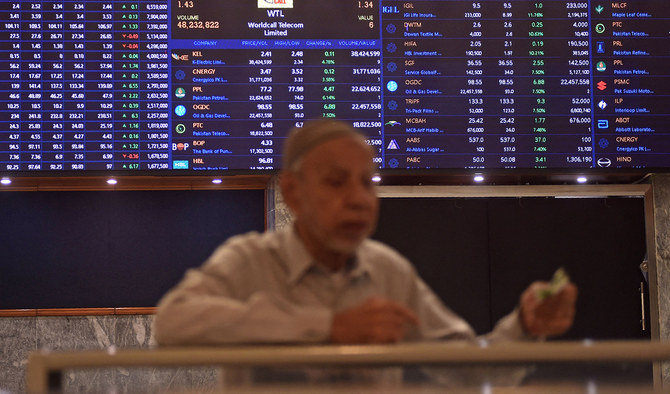

KARACHI: Pakistan's benchmark KSE-100 index on Thursday crossed the psychological barrier of 49,000 points for the first time in six years, as a last-gasp funding deal from the International Monetary Fund (IMF) signed in June continues to fuel investor confidence at the bourse, equity analysts said.
The country on June 30 secured a $3 billion short-term financial package from the IMF, giving its economy some much-awaited respite as it teetered on the brink of default.
Following the approval of the deal by the IMF board, $1.2 billion was disbursed by the multilateral lender, boosting Pakistan’s foreign exchange reserves to $8.1 billion by July 21, 2023, according to the central bank of Pakistan.
On the Monday after the Friday on which the IMF deal was announced, Pakistan's benchmark share index scored its biggest single-day jump in 15 years, gaining 5.9% on the first trading session.
On Thursday, the key stock index gained more than 500 points during mid-day trade and went to the 49,404 level for the first time in six years. The stock index previously hit 49,527 in June 2017.
However, the spurt proved short-lived as the index closed down at 48,611 after shedding 153 points due to inevitable market correction.
Pakistani analysts said the bullish sentiments at the Pakistan bourse are being fueled by the IMF deal.
“The rally at PSX is one of the indicators showing that investors’ confidence is gradually improving, especially after a better-than-expected IMF deal and government steps to comply with IMF conditions,” Muhammad Sohail, the CEO of Topline Securities, told Arab News.
“Another milestone achieved is that the index gained around 20% in just five weeks, from 41,000 to 49,000 level.”
Strong corporate earnings and energy sector reforms are also fueling stock growth, experts said.
“Equity market bullish trend is due to economic stability as a result of the IMF program, strong corporate earnings and announcements and expectations of energy sector reforms as guided by the IMF program,” Ali Nawaz, CEO of Chase Securities, told Arab News.
Nawaz said recent developments to attract foreign investment, including the setting up of a new special investment facilitation council, and strong support for Pakistan from Gulf countries had played a key role in the bullish sentiment.
Soon after the IMF deal, Pakistan received $2 billion from Saudi Arabia and the UAE deposited $1 billion in Pakistan's central bank.
“Saudi and UAE deposits and their interest to set up a refinery and interest in the mining sector and state-owned entities have resulted in bullish sentiments in the market,” Nawaz added.
During trading on Thursday, major auto, banks, power and cement sector players gained further momentum and added 214 points to the index surge.
Market volumes stood at around 523 million shares, down 5.3% on a daily basis, while the value of traded shares declined by 4.5% to Rs19 billion.
In the currency market, the Pakistani rupee appeared stronger after 3 consecutive devaluation sessions, appreciating Rs2.18 to close at Rs287.20 against the United State dollar due to easing of dollar demand in the interbank market during trading.


