

Military trials for civilians: Pakistan court says won’t allow army to take ‘illegal steps’

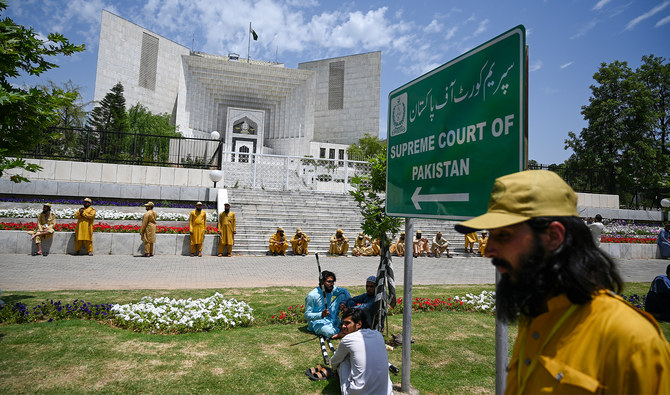
People are gathered outside the building of Supreme Court in Islamabad, Pakistan, on May 15, 2023. (AFP/File)
Short Url
Updated 03 August 2023
Follow

Military trials for civilians: Pakistan court says won’t allow army to take ‘illegal steps’

  • Supreme Court hearing petitions filed by ex-PM Khan, others against civilians being tried under army laws
  • Justice Munib Akhtar says holding civilian trials in military courts will amount to running parallel judicial system

ISLAMABAD: Hearing a landmark case on the constitutionality of civilians being tried in military courts, Pakistan’s top court said on Thursday it would not let the country’s armed forces take “illegal steps.”

Former Prime Minister Imran Khan’s arrest in a land fraud case last month sparked widespread protests by his supporters who ransacked, among other properties, military facilities and installations. While Khan has since been released on bail, the military and government have said those who attacked army installations, including a top commander’s house, an air base, and the military’s headquarters in Rawalpindi, would be tried in military courts.

The military has since said 102 people were being tried by its courts in connection with the May 9 riots while 17 such courts were already functional. Khan’s party and others have filed petitions challenging the legality of civilian trials under army laws.

At the start of Thursday’s hearing, Chief Justice Umer Ata Bandial praised the military for practicing restraint during the May 9 protests while its properties were being damaged.

“However, the military will not be allowed to take any illegal steps,” he was quoted as saying by Dawn newspaper and other local media outlets. 

Justice Bandial said the court needed to hear Attorney General (AGP) Mansoor Usman Awan’s arguments but the court would not be able to do so for at least two weeks due to the unavailability of judges on summer holidays. In the meantime, he instructed the AGP: “No military trials of civilians will be conducted.”

The CJP then adjourned the hearing indefinitely.

Justice Munib Akhtar, another justice on the six-member bench, said, “the concept of fundamental human rights is such that the state cannot take them back even if it wants to.”

He said civilian trials in military courts would amount to running a parallel judicial system.

Local and international human rights bodies have also raised alarm about the use of military courts for civilian cases, saying they infringe on due legal process. 


Pakistan to send over 10,000 workers to Italy over three years after securing employment quota

Updated 27 December 2025
Follow

Pakistan to send over 10,000 workers to Italy over three years after securing employment quota

  • Government says Italy will admit 3,500 workers annually under seasonal and non-seasonal labor schemes
  • It calls the deal a 'milestone' as Italy becomes the first European country to allocate job quota for Pakistan

ISLAMABAD: Pakistan has secured a quota of 10,500 jobs from Italy over the next three years, an official statement said on Saturday, opening legal employment pathways for Pakistani workers in Europe under Italy’s seasonal and non-seasonal labor programs.

Under the arrangement, 3,500 Pakistani workers will be employed in Italy each year, including 1,500 seasonal workers hired for time-bound roles, and 2,000 non-seasonal workers for longer-term employment across sectors.

The Ministry of Overseas Pakistanis and Human Resource Development said Italy is the first European country to allocate a dedicated labor quota to Pakistan, describing the move as a milestone in Pakistan’s efforts to expand overseas employment opportunities beyond traditional labor markets in the Middle East.

“After prolonged efforts, doors to employment for the Pakistani workforce in Italy are about to open,” Federal Minister for Overseas Pakistanis Chaudhry Salik Hussain said, calling the quota allocation a “historic milestone.”

The jobs will be available across multiple sectors, including shipbreaking, hospitality, healthcare and agriculture, with opportunities for skilled and semi-skilled workers in professions such as welding, technical trades, food services, housekeeping, nursing, medical technology and farming.

The agreement comes as Pakistan seeks to diversify overseas employment destinations for its workforce and increase remittance inflows, which remain a key source of foreign exchange for the country’s economy.

The ministry said a second meeting of the Pakistan-Italy Joint Working Group on labor cooperation is scheduled to be held in Islamabad in February 2026, where implementation and future cooperation are expected to be discussed.