

Curse and blessing: Traditional water bearers thrive in Pakistani megacity amid piped supply crisis

A man fills with drinking water a 'mashkeza', a traditional water bag made from goat or sheep skin, in Karachi on March 22, 2022. (AFP/File)
Short Url
Updated 03 August 2023
Follow

Curse and blessing: Traditional water bearers thrive in Pakistani megacity amid piped supply crisis

  • Roughly half of Karachi’s population lacks access to piped water, forcing them to seek alternative sources
  • As a result, water tankers and neighborhood filtration plants are thriving and so too are traditional water bearers

KARACHI: As the sun rose over the Pakistani port city of Karachi earlier this week, Muhammad Dildar pumped water into a large goatskin bag before carrying it through narrow streets to deliver to a family in the Bohrapir neighborhood.

Mashqis, or water bearers, like Dildar have existed in South Asia for centuries, providing water to travelers and warriors during battles in ancient times.

But the age-old profession is today both under threat — as water companies and tankers increasingly serve Karachi residents — but also thriving in a city with fragile infrastructure, struggling with piped supply.

Karachi needs about 1,200 million gallons per day of water to meet the demand of its estimated population of 20 million people. But officials say its two main water sources only provide the city with about 580 million gallons per day. Some of the water is lost due to dilapidated infrastructure and water theft, while experts say climate change and dams built upstream by India also reduce water supplies.

According to urban management expert Dr. Noman Ahmed, roughly half of Karachi’s population lacks access to piped water supplied by the Karachi Water and Sewerage Corporation, forcing them to seek alternative sources. As a result, water tankers and neighborhood filtration plants are thriving. So too are water bearers.

“The water problem in Karachi is enormous, and once [piped] water reaches households, our livelihoods may cease to exist,” Dildar, in his forties, told Arab News.
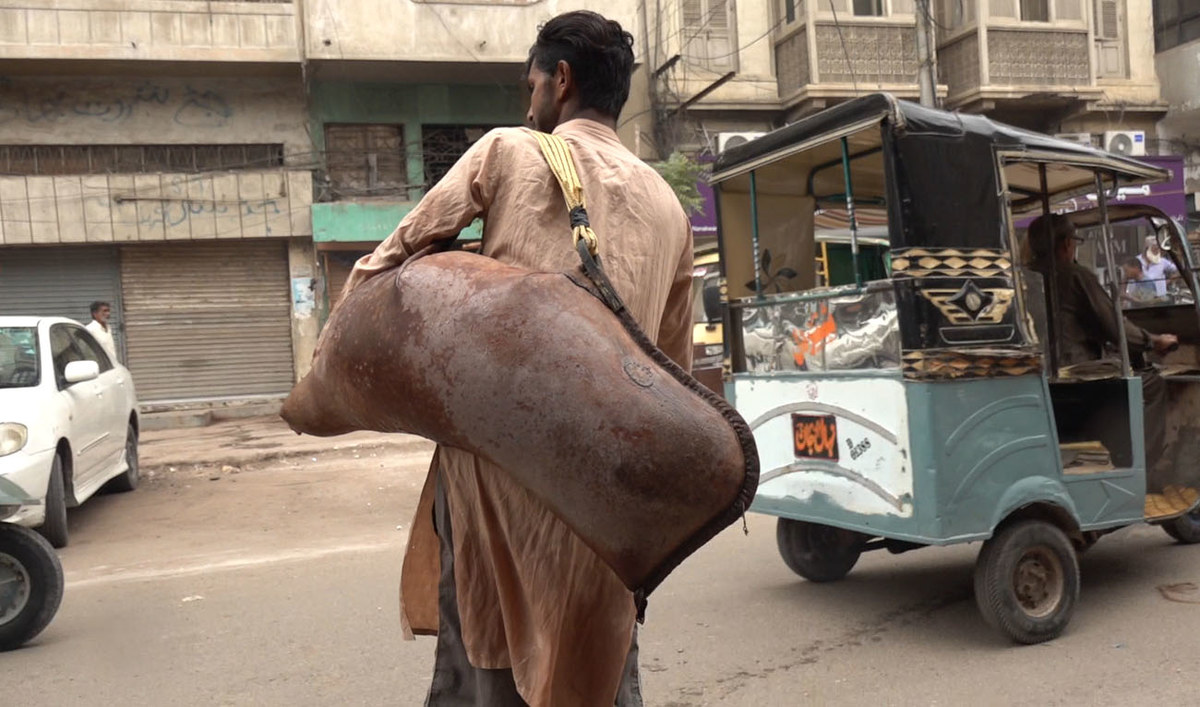


The still image taken from a video recorded on July 31, 2023, shows a traditional water bearer carrying a water filled goatskin bag in Karachi, Pakistan. (AN Photo)

“Right now, usually [piped] water doesn’t reach homes, so people hire one or two mashqis to bring water early in the morning.”

The tradition of water bearing runs deep in the veins of Karachi. Though there are no official figures for the number of mashqis in the city, those associated with the trade put the figure in the hundreds. There were at least 50 mashqis at each of the three locations Arab News visited to conduct interviews.

Ghulam Musfata, one of the few mashq manufacturers in the city, also reported a rising demand for the goatskin bags.

“Sales are higher than they were previously as the demand for water [from mashqis] has increased due to the current [water] situation in Karachi,” he said.

And so, water bearers like Dildar carry on with a profession inherited from their parents.

“My great grandfather used to do it, my grandfather did it, my father did it, and then I joined,” Dildar, who started carrying water as a 12-year-old boy to assist his aging father, said.

“This marks our fifth generation continuing this tradition. My son has already become involved in this work.”
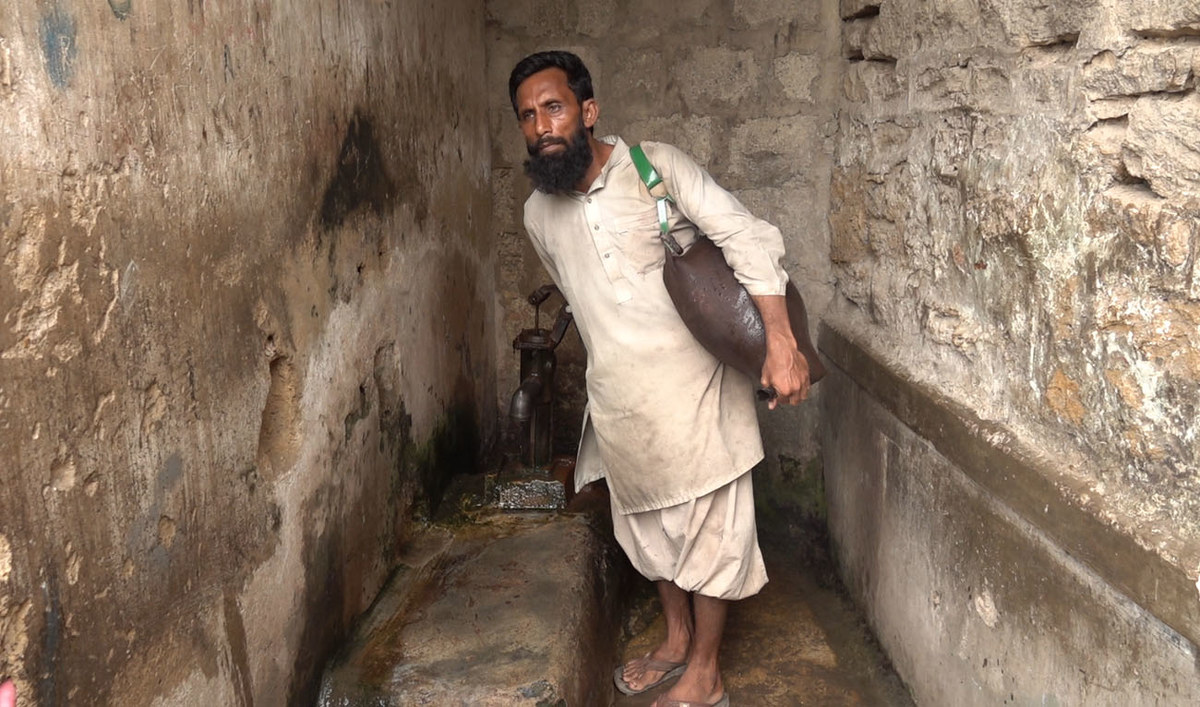


The still image taken from a video recorded on July 31, 2023, shows Muhammad Dildar, a traditional water bearer carrying a water filled goatskin bag in Karachi, Pakistan. (AN Photo)

Mashqis earn around 1,000 rupees ($3.48) in daily wages, carrying up to 50kg of water per mashq, which requires both strength and skill.

“To lift it, a little training is required, it cannot be lifted randomly. Carrying this 50kg weight on [just] one shoulder weakens it,” Dildar said.

But even as the job’s physical demands can significantly shorten a worker’s lifespan, the returns are low.

“Walking back and forth all day, carrying this heavy load, demands a lot of hard work, yet the income we receive for it is very meager,” he said.

Due to the arduous nature of the job and the low wages, Shaukat Ali, a water bearer at the Ranchore Line area, had hoped his children would pursue new career paths.

“But due to compulsion and poverty, we are forced to make them join this work. Our elders used to do it, and so we had no choice but to join as well,” said Ali, who like most mashqis works from sunrise to sunset or until his body can no longer physically bear the strain of carrying so much water.

“It leaves one exhausted and disrupts sleep,” he said.

Though Ali is just in his forties, he looked much older than his years, due to which many people in the neighborhood called him chacha, or uncle, he said with a chuckle. 

“I am 43 years old,” he added, as he adjusted his mashq on one shoulder and prepared to carry it up a six-story building. 

“But you can see how quickly a person involved in this job ages.”


Pakistan clears global crypto exchanges Binance, HTX under new regulatory framework

Updated 8 min 7 sec ago
Follow

Pakistan clears global crypto exchanges Binance, HTX under new regulatory framework

  • NOCs allow Binance, HTX to conduct engagement activities within Pakistan, says regulator PVARA
  • Says move allows entities to open subsidiaries in Pakistan but doesn’t constitute as operating license

ISLAMABAD: The Pakistan Virtual Assets Regulatory Authority (PVARA) announced on Friday that it has granted no objection certificates (NOCs) to global crypto exchanges Binance and HTX, the latest in a series of moves by Islamabad to regulate its fast-growing virtual assets market. 

PVARA said the NOCs were granted following a review process it conducted with public sector stakeholders which focused on governance structures, compliance frameworks, risk management controls and alignment with Pakistan’s emerging regulatory requirements for virtual asset activities.

Pakistan has been moving to regulate its fast-growing crypto and digital assets market by bringing virtual asset service providers (VASPs) under a formal licensing regime. Officials say the push is aimed at curbing illicit transactions, improving oversight and encouraging innovation in blockchain-based financial services.

“The introduction of this structured NOC framework demonstrates Pakistan’s commitment to responsible innovation and financial discipline,” Finance Minister Muhammad Aurangzeb was quoted as saying in a press release issued by PVARA. 

The regulatory authority said the NOCs allow Binance and HTX to conduct preparatory and engagement activities within Pakistan under “defined regulatory oversight,” clarifying that it does not constitute a “full operating license.”

The NOCs allow Binance and HTX to begin registration on the FMU goAML, Pakistan’s anti–money laundering reporting platform, as reporting entries. It also allows them to engage with the Securities and Exchange Commission of Pakistan (SECP) regulator to incorporate their subsidiaries in the country. 

HTX and Binance can also prepare and submit their full VASP license applications once licensing regulations are promulgated and provide anti-money laundering (AML) registered services after the completion of their goAML registration.

“PVARA will continue to engage with domestic and international stakeholders as it advances subsequent phases of its regulatory framework,” the authority said. 

“Additional guidance regarding licensing standards, compliance obligations and supervisory expectations for virtual asset service providers will be issued in due course.”

Chairman PVARA Bilal Bin Saqib said issuing the NOCs marks the first step toward a fully licensed and regulated environment for digital assets in Pakistan. 

“By adopting a phased and internationally aligned approach, Pakistan is ensuring that only well-governed, fully compliant global platforms progress toward full licensing,” Saqib was quoted as saying by PVARA.

According to PVARA, Pakistan already ranks at number three in crypto adoption and is home to an estimated 30 to 40 million users.

It said industry-wide assessments estimate that annual digital asset trading activity linked to Pakistan exceeds $300 billion. 

PAKISTAN, BINANCE SIGN MoU FOR BLOCKCHAIN-BASED INNOVATION

Separately, Pakistan’s finance ministry and Binance signed a memorandum of understanding (MoU) establishing a framework to explore potential collaboration on the tokenization and blockchain-based distribution of Pakistan’s real-world and sovereign assets, the Finance Division said. 

The Finance Division said the step was a significant one to leverage emerging financial technologies to strengthen Pakistan’s capital markets and enhance global investor access. 

These assets include government bonds, treasury bills, commodity reserves and other federally owned assets, the Finance Division said. 

“Subject to applicable laws, policies and regulatory approvals, the initiative may involve assets of up to $2 billion, with the objective of enhancing liquidity, transparency and international market accessibility,” it added. 

Under the proposed arrangement, Binance and/or its affiliates may provide technical expertise, advisory support, training and capacity building to enable Pakistan to assess modern, compliant blockchain infrastructure. 

The Finance Division said the collaboration aims to explore secure and transparent digital platforms that could facilitate broader participation by international investors, while fully respecting Pakistan’s regulatory framework and sovereign control.
