

Ukraine says Russians fail to advance but are well dug in

1 / 3
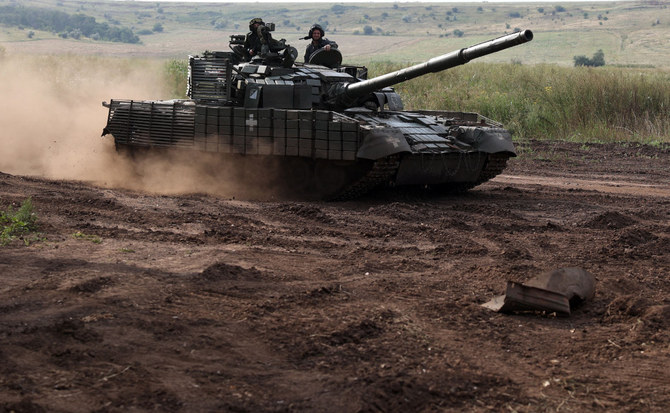
Tankmen of the 93rd Mechanized Brigade "Kholodnyi Yar" rest during a military training near the frontline in Donetsk region, on August 1, 2023. (AFP)
2 / 3
Tankmen of the 93rd Mechanized Brigade "Kholodnyi Yar" rest during a military training near the frontline in Donetsk region, on August 1, 2023. (AFP)
3 / 3
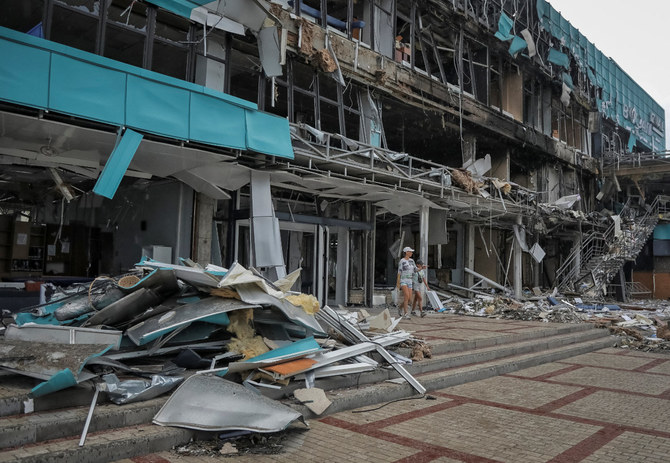
A view shows a marine station building destroyed during a Russian drone strike in Izmail, Odesa region, Ukraine, on August 2, 2023. (REUTERS)
Short Url
Updated 03 August 2023
Follow

Ukraine says Russians fail to advance but are well dug in

  • Russian accounts of the fighting on the frontline said 12 Ukrainian attacks had been repelled in Donetsk region
  • Russian forces had ample time in months of occupation to prepare defenses and lay extensive minefields

KYIV: Russian forces have made no headway along the front lines, but are entrenched in heavily mined areas they control, making it difficult for Ukrainian troops to move east and south, Ukrainian officials said on Wednesday.

Russian accounts of the fighting on the frontline said 12 Ukrainian attacks had been repelled in Donetsk region — a focal point of Russian advances for months.

Much of Russian military activity focused on air attacks that damaged grain infrastructure in Ukraine’s Danube port of Izmail. Russia’s Defense Ministry also said its forces had destroyed a Ukrainian naval drone that tried to attack a Russian warship escorting a civilian vessel in the Black Sea.
Ukrainian forces launched a drive in June to retake occupied areas and have been pressing southward toward the Sea of Azov to sever a land bridge between occupied eastern Ukraine and the Russian-annexed Crimean peninsula.
Kyiv also says it has retaken areas near Bakhmut, an eastern city seized by Russian forces in May after months of battles.
Deputy Ukrainian Defense Minister Hanna Maliar said Russian forces had “tried quite persistently to halt our advance in the Bakhmut sector. Without success.”
Russian forces, she wrote on the Telegram messaging app, were beefing up reserves and equipment in three areas further north, where heavy fighting has also been reported in recent weeks.
Oleksiy Danilov, the Secretary of Ukraine’s Security Council, said Russian forces had ample time in months of occupation to prepare defenses and lay extensive minefields.
“The enemy has prepared very thoroughly for these events,” he told national television. “The number of mines on the territory that our troops have retaken is utterly mad. On average, there are three, four, five mines per square meter.”
Danilov restated assertions by President Volodymyr Zeleskiy that the advances, while slower than hoped, could not be rushed as human lives were at stake.
“No one can set deadlines for us, except ourselves... there is no fixed schedule,” he said. “I have never used the term counter-offensive. There are military operations and they are complex difficult and depend on many factors.”
Russia’s Defense Minister, in its account of the fighting, said Ukrainian forces had made unsuccessful attempts to advance in several sectors in both southern and northern parts of Donetsk region.
It also said Russian forces had launched strikes on towns around Bakhmut, including Kurdyumovka on the city’s southern fringes and Chasiv Yar, the first major town to the west.


’Made in Europe’ or ‘Made with Europe’? Buy European push splits bloc

Updated 3 sec ago
Follow

’Made in Europe’ or ‘Made with Europe’? Buy European push splits bloc

  • Everyone in Europe agrees the EU needs to rescue its industry but the bloc is split over how far it should push a ‘Buy European’ approach in order to do so
BRUSSELS: Everyone in Europe agrees the EU needs to rescue its industry but the bloc is split over how far it should push a ‘Buy European’ approach in order to do so.
The European Commission, the EU’s executive arm, will next week propose new rules that are expected to include a requirement for companies in strategic sectors to produce in Europe if they want to receive public money.
But the definition of “European preference” has triggered debate, with calls especially from France for more “Made in Europe,” while other EU states such as Germany call for “Made with Europe.”
- Protecting Europe or European protectionism? -
French President Emmanuel Macron insisted the new rules would be about “protecting our industry” without “being protectionist,” by defending “certain strategic sectors, such as cleantech, chemicals, steel, cars or defense.”
Otherwise, he warned, “Europeans will be swept aside.”
But other EU countries, which are proponents of free trade, oppose the plans.
Swedish Prime Minister Ulf Kristersson said Europe should compete based on quality and innovation, not because it wanted to protect European markets.
“We do not want to protect European businesses that are basically not competitive,” Kristersson told the Financial Times newspaper last week.
But EU leaders during talks Thursday appeared to reach a consensus on the issue, pushing for the measure in certain specific sectors since they say Europe faces unfair competition from China and other countries.
“We are in favor of open markets,” German Finance Minister Lars Klingbeil said Monday. “But I also want to be very clear: if China changes the rules of the game, if we are confronted with overcapacity, subsidies, and the fact that markets in Europe are flooded, then Europe must defend itself.”
- In Europe or with Europe? -
Supporters want “Made in Europe” to be strictly defined, and only for industrial goods made from components manufactured in the European Economic Area, made of the EU’s 27 states as well as Iceland, Liechtenstein and Norway.
Critics say this definition would be too restrictive and instead call for a more flexible measure, like Germany’s Merz, who calls for “Made with Europe” not “Made in Europe.”
They also argue it would be difficult to apply in practice and risks destabilising European supply chains.
“Typically, even a vehicle assembled in Europe incorporates hundreds of specialized components sourced from all over the world. Many critical inputs cannot be competitively produced at scale in Europe,” Japanese carmaker Honda said.
Britain and Turkiye, for whom the EU is an important trading partner, have also privately expressed concern to Brussels about keeping their countries out.
Some EU capitals are worried about potential retaliatory measures from supplier countries, which would drag Europe into showdowns at a moment when it needs to strengthen its exports.
- What will the rules look like? -
The EU executive insists it has balanced the need to be open and protect firms.
The measure will be “targeted in three ways,” said the office of EU industry chief Stephane Sejourne — who is spearheading the push.
It will affect:
-- a limited number of critical components
-- a limited number of strategic sectors
-- only when public funding is involved.
The final proposal, which will be announced on February 25, could end up only touching a handful of sectors: the auto industry and those playing an essential role in the green transition and confronted by what the EU says unfair Chinese competition, such as solar panels, wind turbines and batteries.
Sejourne’s office insisted companies producing in the EU would be considered European and there will be “reciprocal commitments” with trusted partners.
A draft document seen by AFP says products made in countries outside the EU with rules similar to the bloc will be treated like those made in Europe.
Non-EU countries however remain watchful until the real proposal lands.
For example, there are still many unknowns including what the percentages of European or equivalent components will be required from manufacturers if they wish to continue accessing public money.
