

Amid rise in attacks, Pakistan says can act in 'self-defence' against militants in Afghanistan

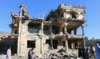
Security personnel stand guard at the site of a bomb blast in Bajaur district of Pakistan's Khyber Pakhtunkhwa province on July 31, 2023. (AFP)
Short Url
Updated 01 August 2023
Follow

Amid rise in attacks, Pakistan says can act in 'self-defence' against militants in Afghanistan

  • Pakistani leaders have said this month they are seriously concerned militants had found safe havens in Afghanistan
  • Kabul has denied past accusations that it allows militant groups to launch attacks on Pakistan from its territory

ISLAMABAD: Foreign minister Bilawal Bhutto-Zardari said on Tuesday Pakistan could act in “self-defence” against militants hiding in Afghanistan if Afghan authorities failed to take action amid growing attacks in the neighboring country. 

Pakistani leaders, including the chief of its army, have said this month they are seriously concerned that militants had found safe havens in neighboring Afghanistan as Pakistan has seen a rise in terror attacks, including last Sunday’s suicide bombing on a political rally in the country's northwest in which over 50 people were killed. The attack was claimed by Daesh.

Kabul has denied past accusations that it allows militant groups to launch attacks on Pakistan from its territory. As per the Doha peace agreement signed between Afghanistan's Taliban authorities and the US in 2020 when its forces were withdrawing from the country, Kabul has made a commitment not to cooperate with or permit international terror groups or individuals "to recruit, train, raise funds (including through the production or distribution of narcotics), transit Afghanistan or misuse its internationally recognized travel documents, or conduct other support activities in Afghanistan, and will not host them."

“Regarding Pakistan going there [Afghanistan] and taking action against these terrorists, we do not want to be forced to do this, but according to international law, we have the right to self-defence,” Bhutto-Zardari told reporters.

“If we are repeatedly attacked like this, and there is not the appropriate response, we will be forced to do this. But I don't think it should be amongst the first options for us.”

The FM said Kabul’s Taliban government needed to act against Pakistani Taliban (TTP) and other militant groups that were targeting Pakistan.

“Our preference will be that we want the officials there [in Kabul], the interim government, to act against them,” he said.

The FM reminded the Afghan Taliban that they had “promised the world” that they would not allow anyone to use their soil for terrorism under the Doha agreement.

“If they need any help, then I think Pakistan should be prepared to help them,” Bhutto-Zardari added. “

The FM said after the takeover of Kabul by the Afghan Taliban, there had been a “quantitative increase” in terror attacks in Pakistan.

“Statistics show that if you look at our data 500 days before the fall of Kabul, and then compare it with our data 500 days later, you can see that there has been a clear increase,” he said, adding that weapons left in Afghanistan by US and NATO forces had fallen into the hands of militants.

World Bank president in Pakistan to discuss development projects, policy issues

Updated 01 February 2026
Follow

World Bank president in Pakistan to discuss development projects, policy issues

  • Pakistan, World Bank are currently gearing up to implement a 10-year partnership framework to grant $20 billion loans to the cash-strapped nation
  • World Bank President Ajay Banga will hold meetings with Pakistan Prime Minister Shehbaz Sharif and other senior officials during the high-level visit

ISLAMABAD: World Bank President Ajay Banga has arrived in Pakistan to hold talks with senior government officials on development projects and key policy issues, Pakistani state media reported on Sunday, as Islamabad seeks multilateral support to stabilize economy and accelerate growth.

The visit comes at a time when Pakistan and the World Bank are gearing up to implement a 10-year Country Partnership Framework (CPF) to grant $20 billion in loans to the cash-strapped nation.

The World Bank’s lending for Pakistan, due to start this year, will focus on education quality, child stunting, climate resilience, energy efficiency, inclusive development and private investment.

"World Bank President Ajay Banga arrives in Pakistan for a high-level visit," the state-run Pakistan TV Digital reported on Sunday. "During his stay, he will meet Prime Minister Shehbaz Sharif and other senior officials to discuss economic reforms, development projects, and key policy issues."

Pakistan, which nearly defaulted on its foreign debt obligations in 2023, is currently making efforts to stabilize its economy under a $7 billion International Monetary Fund (IMF) program.

Besides efforts to boost trade and foreign investment, Islamabad has been seeking support from multilateral financial institutions to ensure economic recovery.

“This partnership fosters a unified and focused vision for your county around six outcomes with clear, tangible and ambitious 10-year targets,” Martin Raiser, the World Bank vice president for South Asia, had said at the launch of the CPF in Jan. last year.

“We hope that the CPF will serve as an anchor for this engagement to keep us on the right track. Partnerships will equally be critical. More resources will be needed to have the impact at the scale that we wish to achieve and this will require close collaboration with all the development partners.”

In Dec., the World Bank said it had approved $700 million in ​financing for Pakistan under a multi-year initiative aimed at supporting the country's macroeconomic stability and service delivery.

It ‍followed a $47.9 ‍million World Bank grant ‍in August last year to improve primary education in Pakistan's most populous Punjab province.