

Pakistan hosts first minerals summit as leaders call for emulating Middle Eastern example

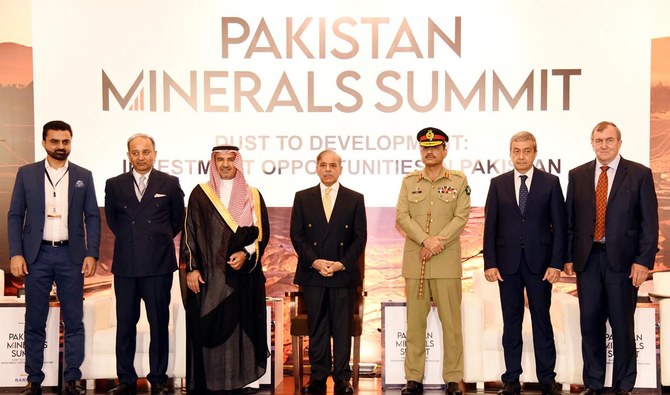
Pakistan's prime minister Shehbaz Sharif, center, along with army chief General Syed Asim Munir, third right, and foreign dignitaries attend Pakistan Mineral Summit in Islamabad on August 1, 2023. (PID)
Short Url
Updated 01 August 2023
Follow

Pakistan hosts first minerals summit as leaders call for emulating Middle Eastern example

  • Foreign investors, dignitaries attend summit aimed at tapping Pakistan's $6 trillion worth of natural deposits
  • Army chief says government and military on the “same page” to provide security to foreign investments

ISLAMABAD: Army chief General Syed Asim Munir said on Tuesday foreign investors would be an "integral part" of realizing the potential of Pakistan’s estimated $6 trillion worth of natural deposits, while Prime Minister Shehbaz Sharif called for following the example of Middle Eastern states in tapping and developing mineral wealth.

Both leaders were addressing Pakistan's first dedicated summit on minerals, which was widely attended in Islamabad by foreign investors, diplomats, and international dignitaries.

The summit was organized under the umbrella of the Special Investment Facilitation Council (SIFC) that Pakistan set up in June to attract foreign investment. The army has been given a key role in the body and will be involved in all projects under the new framework.

“Our vision for the mining industry goes beyond financial gains,” Munir said, assuring foreign investors that the federal and provincial governments and Pakistan's security forces were on the “same page” to provide secure investment opportunities.

“Foreign investors will be an integral part of the mines and mineral projects and their investment will be secure under the Special Investment Facilitation Council … We will establish an investor-friendly system that avoids unnecessary complications and provides favorable conditions.”

“There are vast opportunities for exploration in our country, and we will make sure that these opportunities are realized through joint efforts,” Munir added.

In the past, a joint venture was blocked by Pakistan’s Supreme Court from developing Reko Diq - one of the world’s biggest untapped deposits of copper and gold - following a court case over how the contract had been awarded. Pakistan’s government was later ordered by a global arbitration body to pay $5.8 billion in damages after Tethyan Copper took it to court. The dispute was only resolved after Barrick Gold ended the conflict last year and said it would start to develop the gold and copper mining projects under a new agreement.

Pakistan's mineral-rich province of Balochistan and the country's northwestern regions are also home to both militants and separatist insurgents, who have engaged in insurgency against the government for decades and made exploration difficult for the government and undesirable for foreign investors. 
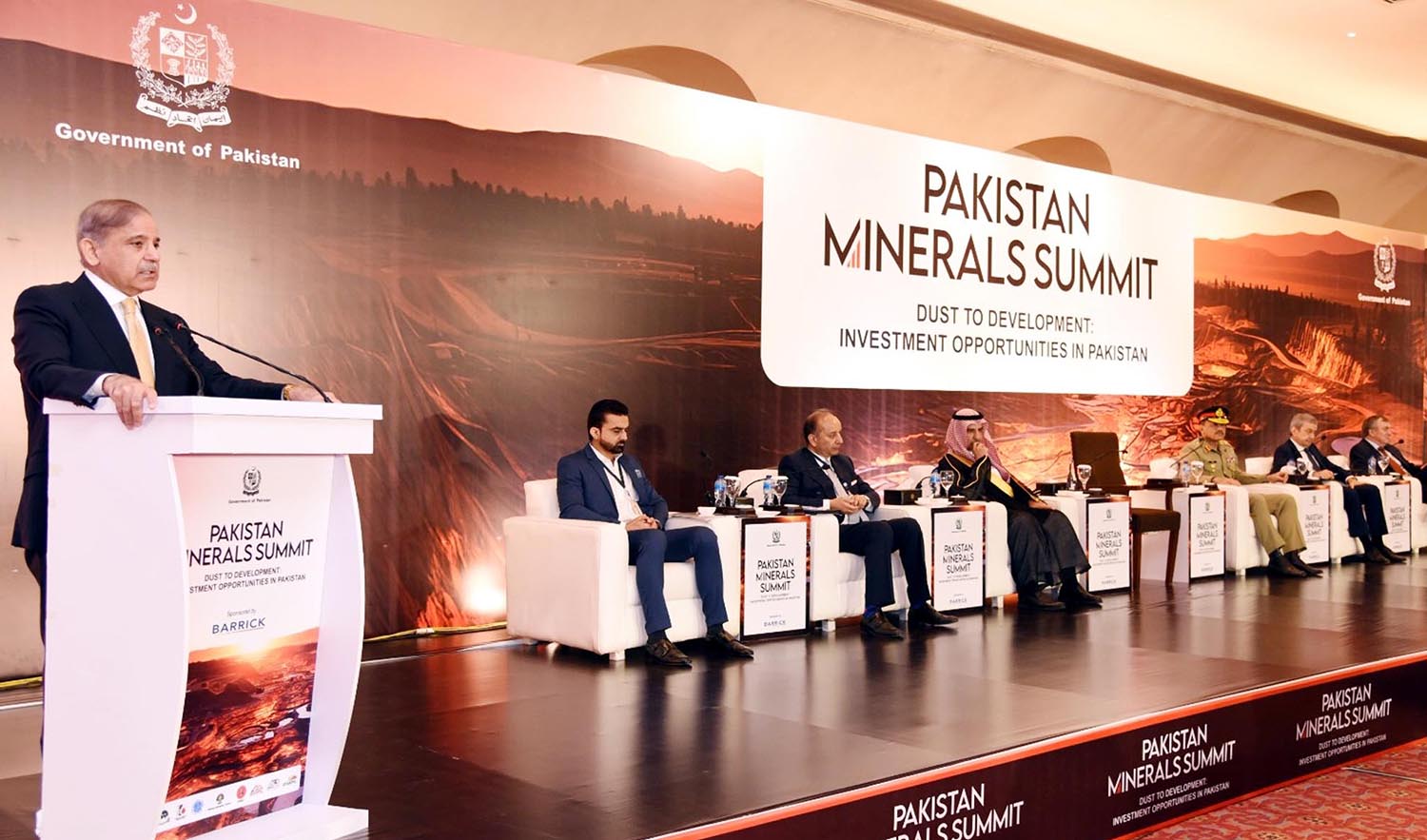


Pakistan Prime Minister Shehbaz Sharif addressing Pakistan Mineral Summit in Islamabad on August 1, 2023. (PID)

Addressing Tuesday’s ceremony, Prime Minister Shehbaz Sharif said Pakistan should learn from its "bitter experiences" of the past and follow the example of Middle Eastern states who had built and strengthened their economies by tapping mineral wealth.

States like Saudi Arabia and the United Arab Emirates had set an example for other countries, including Pakistan, by building on oil and gas resources, Sharif said.

“If sand dunes could be converted into great models of progress and prosperity by our brothers, why can’t we convert our dust into gold,” he asked.

Saudi vice minister for mining affairs, Engineer Khalid Bin Saleh Al-Mudafiq, who was also present at the summit, said the Kingdom wanted to enable the development of a responsible mineral value chain in Pakistan.

“Let us unite our efforts to harness the full potential of Pakistan’s, Saudi Arabia’s, and the region’s mineral sector,” the minister said. 

“Together, we can pave the way from dust to development, transforming our nations into thriving hubs of mineral resources, economic prosperity, and sustainable growth …I look forward to celebrating soon the eminent success of the Pakistan mining sector.”


At least one killed, nine injured in IED blast in northwestern Pakistan

Updated 05 January 2026
Follow

At least one killed, nine injured in IED blast in northwestern Pakistan

  • Blast takes place near vehicle carrying employees of Lucky Cement factory in Lakki Marwat district, say police
  • No group has claimed responsibility for IED blast as Khyber Pakhtunkhwa police launch probe into the incident

PESHAWAR: At least one person was killed and nine others were injured in Pakistan’s northwestern Lakki Marwat district on Monday after an improvised explosive device (IED) blast occurred near a vehicle transporting employees of a cement factory, a police official said.

Lakki Marwat police official Shahid Marwat told Arab News the blast took place on the district’s Begu Khel Road at around 6:30 a.m. The explosion occurred near a vehicle carrying employees of the Lucky Cement factory located in the district, he said.

“Initial investigations suggest the device had been planted by militants,” Marwat said. “A rapid police response force was immediately deployed to the scene to evacuate the dead and wounded, secure the area and collect evidence.”

The police officer said several victims were in critical condition and were referred for treatment to the nearby Bannu district, adding that all those affected by the blast were residents of Begu Khel village.

He said police had launched an investigation into the incident.

No group has so far claimed responsibility for the attack. However, the Pakistani Taliban, or the Tehreek-e-Taliban Pakistan (TTP), have claimed responsibility for similar attacks in the past against Pakistani law enforcers and civilians in the province.

The TTP has carried out some of the deadliest attacks against Pakistani law enforcers since 2008 in its bid to impose its own brand of strict Islamic law across the country.

The attack comes as Pakistan struggles to contain a sharp surge in militant violence in recent months. According to statistics released last month by the Pakistan Institute for Conflict and Security Studies (PICSS), combat-related deaths in 2025 rose by 73 percent to 3,387, compared with 1,950 deaths in 2024.

These deaths included 2,115 militants, 664 security forces personnel, 580 civilians, and 28 members of pro-government peace committees, the think tank said. Most of the attacks took place in Khyber Pakhtunkhwa’s Pashtun-majority districts and southwestern Balochistan province, the PICSS noted.

On Sunday, three traffic police officials were shot dead by unidentified gunmen in Lakki Marwat district. No group claimed responsibility for the incident.

Islamabad accuses the Afghan government of harboring militants who launch attacks against Pakistan, a charge Kabul repeatedly denies. The surge in militant attacks in Pakistan has strained ties between the two neighbors, with Islamabad urging Kabul to take steps to dismantle militant outfits allegedly operating from its soil.