

Pakistan party targeted by deadly Daesh bombing questions state security services

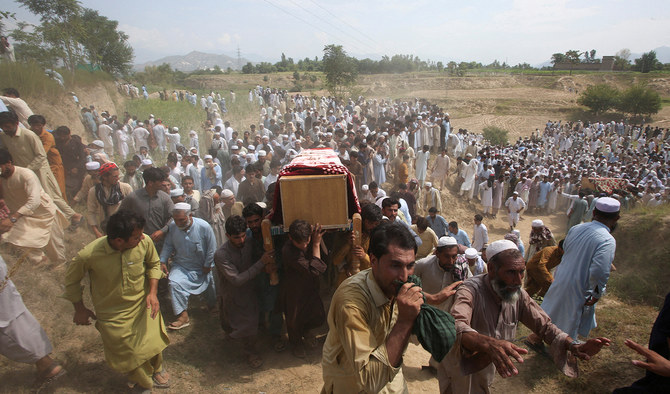
People carry the coffins of victims, who were killed in a blast, during funeral in Bajaur district of Khyber Pakhtunkhwa province, Pakistan on July 31, 2023. (REUTERS)
Short Url
Updated 01 August 2023
Follow

Pakistan party targeted by deadly Daesh bombing questions state security services

  • Maulana Fazlur Rehman says his party is peaceful but ‘even patience and endurance have their limits’
  • The suicide blast has raised concerns about a bloody election period following months of political chaos

PESHAWAR: The leader of an influential Pakistan political party called Tuesday for better state-provided security after a Daesh suicide bomber killed 54 people — almost half of them children — at an election gathering.

Around 400 members of the Jamiat Ulema-e-Islam-F (JUI-F) party — a key government coalition partner — were meeting Sunday when a bomber detonated a vest packed with explosives and ball bearings.

JUI-F’s leader, firebrand cleric Fazlur Rehman, questioned how such a “significant intelligence failure” could have occurred.

“The entire nation is turning to the state institutions responsible for its security,” he said in a statement posted to Twitter.

“Where are they? When will they listen to us? When will they heal our wounds? When will they establish a system that safeguards our future generations?”

Rehman said Jamiat Ulama-e-Islam was a peaceful party, “but even patience and endurance have their limits.”

“Nonetheless, I urge my supporters not to abandon patience and endurance,” he said.

Rehman started political life as a firebrand Islamist hard-liner, and while his party continues to advocate for socially conservative policies, he has more recently forged alliances with secular rivals.

In the past, he has also helped facilitate talks between the government and Tehreek-e-Taliban Pakistan (TTP), a Daesh rival that has since 2007 waged a bloody campaign of bombings and other attacks across the country.

Sunday’s attack occurred in the town of Khar, 45 kilometers (28 miles) from the Afghan border, in an area where militancy has been rising since the Afghan Taliban — who are allied with but distinct from the TTP — took control of Kabul in 2021.

The blast has raised fears Pakistan could be in for a bloody election period following months of political chaos prompted by the ousting of Imran Khan as prime minister in April last year.

Parliament is likely to be dissolved after it completes its term in the next two weeks, with national elections to be held by mid-November.

Last year, Daesh said it was behind attacks against religious scholars affiliated with JUI-F, which has a huge network of mosques and schools in the north and west of Pakistan.

Daesh accuses the JUI-F of hypocrisy for being a religious party while supporting secular governments and the military.

While Rehman’s party never musters more than a dozen or so seats in parliament, it can be crucial in any coalition and his ability to mobilize tens of thousands of religious school students grants him additional clout.

Violence has been rising across Pakistan in recent months.

In January, a suicide bomber linked to Pakistan’s Taliban blew himself up in a mosque inside a police compound in the northwestern city of Peshawar, killing more than 80 officers.

Militant assaults have focused on regions abutting Afghanistan, and Islamabad alleges some are being planned on Afghan soil — a charge Kabul denies.


Tens of thousands flee northwest Pakistan over fears of military operation

Updated 28 January 2026
Follow

Tens of thousands flee northwest Pakistan over fears of military operation

  • More than 70,000 people, mostly women and children, have fled remote Tirah region bordering Afghanistan 
  • Government says no military operation underway or planned in Tirah, a town in Khyber Pakhtunkhwa province

BARA, Pakistan: More than 70,000 people, mostly women and children, have fled a remote region in northwestern Pakistan bordering Afghanistan over uncertainty of a military operation against the Pakistani Taliban, residents and officials said Tuesday.

Pakistan’s Defense Minister Khawaja Mohammad Asif has denied the claim by residents and provincial authorities. He said no military operation was underway or planned in Tirah, a town in Khyber Pakhtunkhwa province.

Speaking at a news conference in Islamabad, he said harsh weather, rather than military action, was driving the migration. His comments came weeks after residents started fleeing Tirah over fears of a possible army operation.

The exodus began a month after mosque loudspeakers urged residents to leave Tirah by Jan. 23 to avoid potential fighting. Last August, Pakistan launched a military operation against Pakistani Taliban in the Bajau r district in the northwest, displacing hundreds of thousands of people.

Shafi Jan, a spokesman for the provincial government in Khyber Pakhtunkhwa, posted on X that he held the federal government responsible for the ordeal of the displaced people, saying authorities in Islamabad were retracting their earlier position about the military operation.

Khyber Pakhtunkhwa Chief Minister Suhail Afridi, whose party is led by imprisoned former Prime Minister Imran Khan, has criticized the military and said his government will not allow troops to launch a full-scale operation in Tirah.

The military says it will continue intelligence-based operations against Pakistani Taliban, who are known as Tehrik-e-Taliban Pakistan, or TTP. Though a separate group, it has been emboldened since the Afghan

Taliban returned to power in 2021. Authorities say many TTP leaders and fighters have found sanctuary in Afghanistan and that hundreds of them have crossed into Tirah, often using residents as human shields when militant hideouts are raided.

Caught in the middle are the residents of Tirah, who continued arriving in Bara.

So far, local authorities have registered roughly 10,000 families — about 70,000 people — from Tirah, which has a population of around 150,000, said Talha Rafiq Alam, a local government administrator overseeing the relief effort. He said the registration deadline, originally set for Jan. 23, has been extended to Feb. 5.

He said the displaced would be able to return once the law-and-order situation improves.

Among those arriving in Bara and nearby towns was 35-year-old Zar Badshah, who said he left with his wife and four children after the authorities ordered an evacuation. He said mortar shells had exploded in villages in recent weeks, killing a woman and wounding four children in his village. “Community elders told us to leave. They instructed us to evacuate to safer places,” he said.

At a government school in Bara, hundreds of displaced lined up outside registration centers, waiting to be enrolled to receive government assistance. Many complained the process was slow.

Narendra Singh, 27, said members of the minority Sikh community also fled Tirah after food shortages worsened, exacerbated by heavy snowfall and uncertain security.

“There was a severe shortage of food items in Tirah, and that forced us to leave,” he said.

Tirah gained national attention in September, after an explosion at a compound allegedly used to store bomb-making materials killed at least 24 people. Authorities said most of the dead were militants linked to the TTP, though local leaders disputed that account, saying civilians, including women and children, were among the dead.