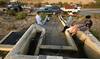
KHAR, Pakistan: The Daesh group claimed responsibility Monday for a suicide bomb blast in Pakistan that killed at least 54 people, including 23 children, at a political party gathering ahead of elections due later this year.
The blast has raised fears Pakistan could be in for a bloody election period following months of political chaos prompted by the ousting of Imran Khan as prime minister in April last year.
Around 400 members of the Jamiat Ulema-e-Islam-F (JUI-F) party — a key government coalition partner led by a firebrand cleric — were waiting Sunday for speeches to begin when a bomber detonated a vest packed with explosives and ball bearings near the front stage.
“I was confronted with a devastating sight — lifeless bodies scattered on the ground while people cried out for help,” Fazal Aman, who was near the tent when the bomb went off, told AFP.
Shaukat Abbas, a senior official with the counter-terrorism department (CTD) told AFP that 54 people had been killed, including 23 under the age of 18.
On Monday the Daesh group claimed responsibility.
“A suicide attacker from the Islamic State... detonated his explosive jacket in the middle of a crowd” in Khar, the group’s news arm Amaq said in a statement Monday.
The attack occurred in the town of Khar in the northwestern Bajaur district, just 45 kilometers from the Afghan border, in an area where militancy has been rising since the Taliban took control of Kabul in 2021.
Parliament is likely to be dissolved after it completes its term in the next two weeks, with national elections to be held by mid-November or earlier.
The local chapter of the Daesh group has in the past targeted JUI-F rallies and leaders.
On Monday, blood-stained shoes and prayer caps littered the site, along with ball bearings and steel bolts from the suicide vest.
Pieces of human flesh could still be seen, blasted 30 meters (100 feet) from the stage where the bomber detonated his device.
Thousands of mourners attended the first funeral ceremonies, including for two young cousins aged 16 and 17.
“It was not easy for us to lift two coffins. This tragedy has shattered our family,” said Najib Ullah, the brother of one of the boys.
“Our women are profoundly shocked and devastated. When I see the mothers of the victims, I find myself losing my own courage.”
JUI-F’s leader, cleric Fazl-ur-Rehman, started political life as a firebrand Islamist hard-liner, and while his party continues to advocate for socially conservative policies, he has more recently forged alliances with secular rivals.
He has operated in the past as a facilitator for talks between the government and Tehreek-e-Taliban Pakistan (TTP), a rival of the Daesh group.
Last year, Daesh said it was behind attacks against religious scholars affiliated with JUI-F, which has a huge network of mosques and schools in the north and west of the country.
Daesh accuses the JUI-F of hypocrisy for being a religious party while supporting secular governments and the military.
JUI-F officials hit out at the government for failing to provide security in areas where militants operate.
“The state has not fulfilled its responsibilities. I think the state has failed regardless of who is in power,” said Shams uz Zaman, deputy general secretary of its Bajaur branch.
“For God’s sake take notice of the situation.”
While Rehman’s party never musters more than a dozen or so seats in parliament, they can be crucial in any coalition and his ability to mobilize tens of thousands of religious school students allows him to punch above his weight.
“It is important to consider why workers of a religious inclined political party could have been subjected to such bestial violence,” Dawn newspaper said in an editorial Monday.
“However ultra-conservative the JUI-F’s worldview, the party has chosen to contest power and operate within the parameters set by the Constitution of Pakistan.”
A spokeswoman for EU foreign policy chief Joseph Borrell said the blast was “an attempt to weaken democracy.”
Pakistan has seen a sharp rise in militant attacks since the Afghan Taliban surged back to power in neighboring Afghanistan in 2021.
In January, a suicide bomber linked to Pakistan’s Taliban blew himself up in a mosque inside a police compound in the northwestern city of Peshawar, killing more than 80 officers.
The militant assaults have been focused in regions abutting Afghanistan, and Islamabad alleges some are being planned on Afghan soil — a charge Kabul denies.
Analysts say militants in the former tribal areas have become emboldened since the return of the Afghan Taliban.
The blast coincides with a visit to the country by a senior delegation of Chinese officials, including Vice Premier He Lifeng, who arrived in the capital Sunday evening.