

Lebanon central bank’s first vice governor to take over as acting head, urges reform

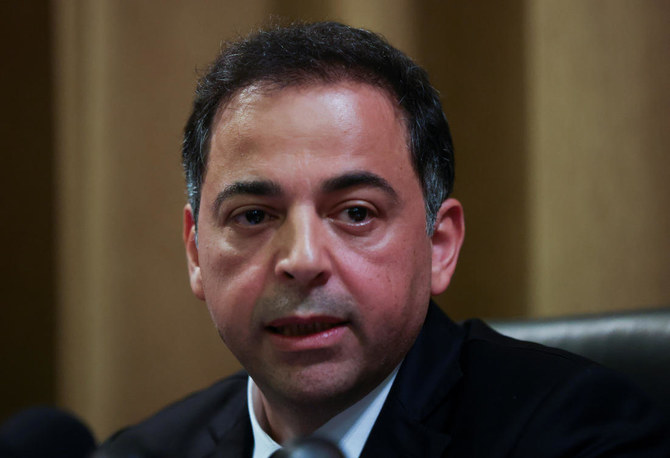
Wassim Mansouri, first vice governor of Lebanon's central bank, attends a press conference at Lebanon's Central Bank building in Beirut. (REUTERS)
Short Url
Updated 31 July 2023
Follow

Lebanon central bank’s first vice governor to take over as acting head, urges reform

  • Ruling politicians failed to appoint successor to Salameh
  • First Vice Governor Mansouri takes role in interim capacity

BEIRUT: Lebanon’s incoming interim central bank governor Wassim Mansouri on Monday urged the government to undertake long-delayed reforms to address a deep financial crisis and said he would seek to restrict central bank lending to the heavily indebted state.
First Vice Governor Mansouri is due to take over as interim chief after ruling factions failed to appoint a successor to Riad Salameh despite the meltdown that has fueled poverty and frozen depositors out of their savings.
Salameh, 73, leaves office after a 30-year tenure, tarnished by the meltdown that has paralyzed a once sprawling banking system, as well as corruption charges against him at home and abroad — which he denies.
The failure to appoint a new governor reflects wider dysfunction that has left Lebanon with neither a fully empowered government nor a president, further hollowing out a state paralyzed by the four-year-old financial collapse.
While Salameh’s departure marks the end of an era, analysts questioned how much Mansouri could change course with the same factions in power.
Mansouri was nominated a vice governor in 2020 by Parliament Speaker Nabih Berri, a pillar of the sectarian system.
Criticizing previous policies as unsustainable, Mansouri told a news conference future lending to the government should be restricted to specific uses and conditioned on the state demonstrating it could pay the bank back. He vowed to reject any government financing requests he was not convinced by and which were “outside the legal framework.”
“We are looking at a short transition period that allows the state to be financed through a law from parliament,” he added.
The crisis has given rise to an array of exchange rates for the Lebanese pound, which has sunk by some 98 percent since 2019. Mansouri said exchange rate unification would “happen without central bank intervention and without spending more money.”
He also said the authorities should phase out a controversial exchange platform known as Sayrafa and lift the peg on the local currency.

‘LAST CHANCE’
The International Monetary Fund said in June the crisis had been aggravated by vested interests resisting reforms.
Mansouri, 51, called on the government to implement a capital control law, a financial restructuring law and a 2023 state budget within six months, saying this was Lebanon’s “last chance” to enact the changes.
The only way to halt the state’s reliance on central bank financing was to improve public finances, he said.
Financial analyst Mike Azar cast doubt on whether Mansouri could follow through with correcting the course of monetary policy in the absence of reforms by government and parliament.
“Will the vice governors do the right thing, even in the face of what will surely be fierce political pressure, or will they fall back on Salameh’s policies of enabling the political parties to avoid any reforms at the cost of the long-term welfare of Lebanon’s economy and society?” he said.
The central bank leadership is selected via the same sectarian power-sharing system that governs Lebanon’s other top posts, leaving its policies subject to political pressure.
Mansouri, a Shiite Muslim, is a distant cousin of Berri, who heads the Shiite Amal Movement. He is the first Shiite to exercise the powers of governor, a post reserved for a Maronite Catholic.


US military launches strikes in Syria against Daesh fighters after American deaths

Updated 20 December 2025
Follow

US military launches strikes in Syria against Daesh fighters after American deaths

  • “This is not the beginning of a war — it is a declaration of vengeance,” Defense Secretary Pete Hegseth says
  • President Trump earlier pledged “very serious retaliation” but stressed that Syria was fighting alongside US troops

WASHINGTON: The Trump administration launched military strikes Friday in Syria to “eliminate” Daesh group fighters and weapons sites in retaliation for an ambush attack that killed two US troops and an American interpreter almost a week ago.
A US official described it as “a large-scale” strike that hit 70 targets in areas across central Syria that had Daesh (also known as Islamic State or IS) infrastructure and weapons. Another US official, who also spoke on condition of anonymity to discuss sensitive operations, said more strikes should be expected.
The attack was conducted using F-15 Eagle jets, A-10 Thunderbolt ground attack aircraft and AH-64 Apache helicopters, the officials said. F-16 fighter jets from Jordan and HIMARS rocket artillery also were used, one official said.
“This is not the beginning of a war — it is a declaration of vengeance. The United States of America, under President Trump’s leadership, will never hesitate and never relent to defend our people,” Defense Secretary Pete Hegseth said on social media.


President Donald Trump had pledged “very serious retaliation” after the shooting in the Syrian desert, for which he blamed Daesh. The troops were among hundreds of US troops deployed in eastern Syria as part of a coalition fighting the terrorist group.
Trump in a social media post said the strikes were targeting Daesh “strongholds.” He reiterated his support for Syrian President Ahmad Al-Sharaa, who he said was “fully in support” of the US effort to target the militant group.
Trump also offered an all-caps threat, warning the group against attacking US personnel again.
“All terrorists who are evil enough to attack Americans are hereby warned — YOU WILL BE HIT HARDER THAN YOU HAVE EVER BEEN HIT BEFORE IF YOU, IN ANY WAY, ATTACK OR THREATEN THE USA.,” the president added.
The attack was a major test for the warming ties between the United States and Syria since the ouster of autocratic leader Bashar Assad a year ago. Trump has stressed that Syria was fighting alongside US troops and said Al-Sharaa was “extremely angry and disturbed by this attack,” which came as the US military is expanding its cooperation with Syrian security forces.
Syria’s foreign ministry in a statement on X following the launch of US strikes said that last week’s attack “underscores the urgent necessity of strengthening international cooperation to combat terrorism in all its forms” and that Syria is committed “to fighting Daesh and ensuring that it has no safe havens on Syrian territory and will continue to intensify military operations against it wherever it poses a threat.”


Daesh has not claimed responsibility for the attack on the US service members, but the group has claimed responsibility for two attacks on Syrian security forces since, one of which killed four Syrian soldiers in Idlib province. The group in its statements described Al-Sharaa’s government and army as “apostates.” While Al-Sharaa once led a group affiliated with Al-Qaeda, he has had a long-running enmity with Daesh.
Syrian state television reported that the US strikes hit targets in rural areas of Deir ez-Zor and Raqqa provinces and in the Jabal Al-Amour area near Palmyra. It said they targeted “weapons storage sites and headquarters used by Daesh as launching points for its operations in the region.”

Trump this week met privately with the families of the slain Americans at Dover Air Force Base in Delaware before he joined top military officials and other dignitaries on the tarmac for the dignified transfer, a solemn and largely silent ritual honoring US service members killed in action.

President Donald Trump, from left, Defense Secretary Pete Hegseth and Chairman of the Joint Chiefs Air Force Gen. Dan Caine attend a casualty return ceremony at Dover Air Force Base, Delaware, on Dec. 17, 2025,of soldiers who were killed in an attack in Syria last week. (AP)

The guardsmen killed in Syria last Saturday were Sgt. Edgar Brian Torres-Tovar, 25, of Des Moines, and Sgt. William Nathaniel Howard, 29, of Marshalltown, according to the US Army. Ayad Mansoor Sakat, of Macomb, Michigan, a US civilian working as an interpreter, was also killed.
The shooting nearly a week ago near the historic city of Palmyra also wounded three other US troops as well as members of Syria’s security forces, and the gunman was killed. The assailant had joined Syria’s internal security forces as a base security guard two months ago and recently was reassigned because of suspicions that he might be affiliated with Daesh, Interior Ministry spokesperson Nour Al-Din Al-Baba has said.
The man stormed a meeting between US and Syrian security officials who were having lunch together and opened fire after clashing with Syrian guards.
When asked for further information, the Pentagon referred AP to Hegseth’s social media post.