

China, Pakistan to mark mega infrastructure anniversary

A policeman stands guard under the national flags of China and Pakistan along a road ahead of the visit of Chinese Vice Premier He Lifeng, in Islamabad, Pakistan, on July 30, 2023. (AFP)
Short Url
Updated 31 July 2023
Follow

China, Pakistan to mark mega infrastructure anniversary

  • Since 2013, the China-Pakistan Economic Corridor has seen tens of billions of dollars funnelled into massive projects
  • But the undertaking has also been hit by Pakistan struggling to keep up its financial obligations as well as militant attacks

ISLAMABAD: Chinese Vice Premier He Lifeng arrived in the Pakistan capital Sunday to mark the 10th anniversary of an enormous economic plan that is the cornerstone of Beijing’s Belt and Road Initiative. 

Since its initiation in 2013, the China-Pakistan Economic Corridor (CPEC) has seen tens of billions of dollars funnelled into massive transport, energy and infrastructure projects. 

But the undertaking has also been hit by Pakistan struggling to keep up its financial obligations, as well as attacks on Chinese targets by militants. 

“After a decade since its inception, CPEC has shown mixed results,” said Azeem Khalid, assistant professor of international relations at COMSATS University Islamabad. 

“The primary goal of connecting China with the Arabian Sea is still relatively low in achievement for China. On the other hand, Pakistan has made notable progress in achieving short-term objectives.” 
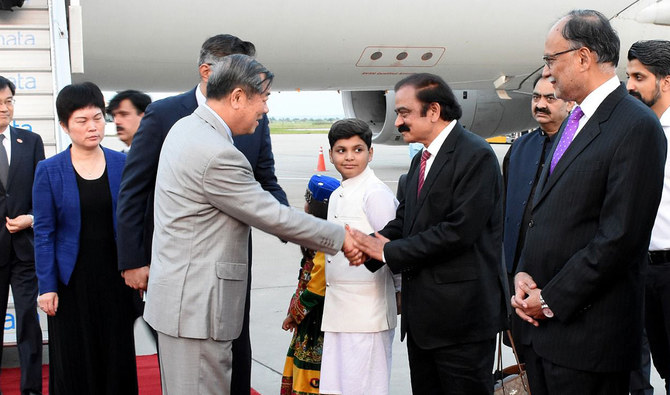


In this handout photo taken and released by the Ministry of Interior, Pakistan, Chinese Vice Premier He Lifeng (left) shakes hands with Pakistan Interior Minister Rana Sanaullah as he arrived in Islamabad on July to mark the 10th anniversary of the China-PakistanEconomic Corridor project. (Photo courtesy: Ministry of Interior)

In recent years Beijing has been one of Islamabad’s most reliable foreign partners, readily providing financial assistance to bail out its often struggling neighbor. 

Earlier this week, Beijing granted Pakistan a two-year rollover on a $2.4 billion loan, giving the debt-saddled nation much-needed breathing space as it tackles a balance-of-payments crisis. 

An IMF report last year said China and its commercial banks held about 30 percent of Pakistan’s total external debt. 

The two countries share a 596-kilometer (370-mile) frontier near the Siachen Glacier in the Karakoram Mountains, one of the world’s tallest ranges. 

Pakistan politicians frequently trot out the phrase “stronger than the Himalayas, deeper than the ocean, and sweeter than honey” to portray the depth and closeness of the relationship with China. 

But ties have been strained by numerous hurdles in recent years, including stalled or scaled-back CPEC projects. 

The economic corridor presents an attractive gateway for China to access the Indian Ocean, but the safety and security of its workers has been a longstanding concern. 

On Sunday at least 44 people were killed and dozens more wounded by a suicide bombing at a political gathering of a leading Islamic party in northwest Pakistan. 

The CPEC corridor linking China’s far-western Xinjiang region with Pakistan’s strategic port of Gwadar in Balochistan has sparked claims that the vast influx of investment does not benefit locals. 

Baloch separatists have claimed several attacks on CPEC projects, and thousands of Pakistani security personnel are deployed to counter threats against Chinese interests. 

In April 2021, five people were killed in an attack claimed by Pakistan’s Taliban at a luxury hotel hosting the Chinese ambassador in Quetta. 

Months later, 12 people — including nine Chinese workers — were killed by a blast aboard a bus carrying staff to the Dasu dam site. 

Islamabad blamed the explosion on a “gas leak” but Beijing insisted it was a bomb attack. 

“Security stands out as the core problem that hinders the realization of Chinese goals,” Khalid told AFP. 

“This factor is the primary reason why CPEC has not reached its full functional potential yet.” 

Ahead of the visit, banners celebrating the anniversary and flags of both countries have been put on display across Pakistan’s capital. 

Security is on high alert, and a two-day public holiday has been ordered for Islamabad to keep people off the streets. 

Pakistan deftly manages relations with China and the United States, seeking a balance between its strategic interests and regional dynamics. 

Arch-rival India has more fractious relations with China, with the two sides coming to blows along their frontier on occasion. 


Tens of thousands flee northwest Pakistan over fears of military operation

Updated 28 January 2026
Follow

Tens of thousands flee northwest Pakistan over fears of military operation

  • More than 70,000 people, mostly women and children, have fled remote Tirah region bordering Afghanistan 
  • Government says no military operation underway or planned in Tirah, a town in Khyber Pakhtunkhwa province

BARA, Pakistan: More than 70,000 people, mostly women and children, have fled a remote region in northwestern Pakistan bordering Afghanistan over uncertainty of a military operation against the Pakistani Taliban, residents and officials said Tuesday.

Pakistan’s Defense Minister Khawaja Mohammad Asif has denied the claim by residents and provincial authorities. He said no military operation was underway or planned in Tirah, a town in Khyber Pakhtunkhwa province.

Speaking at a news conference in Islamabad, he said harsh weather, rather than military action, was driving the migration. His comments came weeks after residents started fleeing Tirah over fears of a possible army operation.

The exodus began a month after mosque loudspeakers urged residents to leave Tirah by Jan. 23 to avoid potential fighting. Last August, Pakistan launched a military operation against Pakistani Taliban in the Bajau r district in the northwest, displacing hundreds of thousands of people.

Shafi Jan, a spokesman for the provincial government in Khyber Pakhtunkhwa, posted on X that he held the federal government responsible for the ordeal of the displaced people, saying authorities in Islamabad were retracting their earlier position about the military operation.

Khyber Pakhtunkhwa Chief Minister Suhail Afridi, whose party is led by imprisoned former Prime Minister Imran Khan, has criticized the military and said his government will not allow troops to launch a full-scale operation in Tirah.

The military says it will continue intelligence-based operations against Pakistani Taliban, who are known as Tehrik-e-Taliban Pakistan, or TTP. Though a separate group, it has been emboldened since the Afghan

Taliban returned to power in 2021. Authorities say many TTP leaders and fighters have found sanctuary in Afghanistan and that hundreds of them have crossed into Tirah, often using residents as human shields when militant hideouts are raided.

Caught in the middle are the residents of Tirah, who continued arriving in Bara.

So far, local authorities have registered roughly 10,000 families — about 70,000 people — from Tirah, which has a population of around 150,000, said Talha Rafiq Alam, a local government administrator overseeing the relief effort. He said the registration deadline, originally set for Jan. 23, has been extended to Feb. 5.

He said the displaced would be able to return once the law-and-order situation improves.

Among those arriving in Bara and nearby towns was 35-year-old Zar Badshah, who said he left with his wife and four children after the authorities ordered an evacuation. He said mortar shells had exploded in villages in recent weeks, killing a woman and wounding four children in his village. “Community elders told us to leave. They instructed us to evacuate to safer places,” he said.

At a government school in Bara, hundreds of displaced lined up outside registration centers, waiting to be enrolled to receive government assistance. Many complained the process was slow.

Narendra Singh, 27, said members of the minority Sikh community also fled Tirah after food shortages worsened, exacerbated by heavy snowfall and uncertain security.

“There was a severe shortage of food items in Tirah, and that forced us to leave,” he said.

Tirah gained national attention in September, after an explosion at a compound allegedly used to store bomb-making materials killed at least 24 people. Authorities said most of the dead were militants linked to the TTP, though local leaders disputed that account, saying civilians, including women and children, were among the dead.