

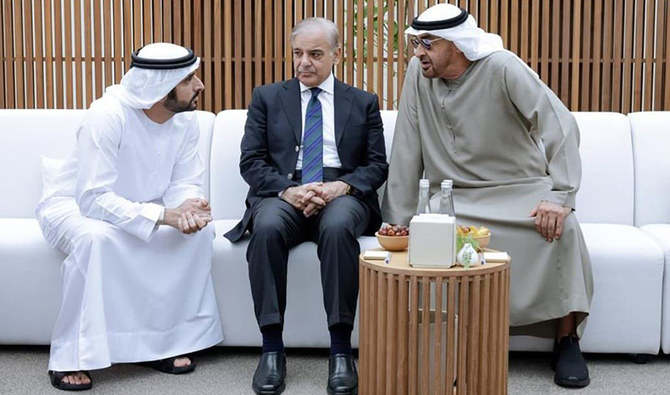
Pakistan PM meets UAE president, offers condolences over death of his brother

Pakistan Prime Minister Shehbaz Sharif, center, meets UAE President Sheikh Mohammed bin Zayed Al Nahyan, right, and Crown Prince of Dubai Hamdan bin Mohammed Al Maktoum in Abu Dhabi on July 28, 2023. (PID)
Short Url
Updated 28 July 2023
Follow

Pakistan PM meets UAE president, offers condolences over death of his brother

  • Sheikh Saeed bin Zayed Al Nahyan recently passed away after suffering from a health problem
  • Pakistan and UAE are close allies, UAE this month deposited $1 billion in Pakistan’s central bank

ISLAMABAD: Prime Minister Shehbaz Sharif arrived on a one-day visit to the United Arab Emirates on Friday where he met the country’s president, Sheikh Mohammed bin Zayed Al Nahyan, and offered condolences over the passing of his brother.

Sheikh Saeed bin Zayed Al Nahyan, a representative of the ruler of Abu Dhabi, passed away after suffering from a health problem, the UAE announced on Thursday.

The prime minister informed in a Twitter post that he offered his “heartfelt condolences” to the UAE president during the meeting.

“The deceased was a great friend of Pakistan,” he said on the social media website. “His demise is certainly a big loss for the Al Nahyan family. We, in Pakistan, share the grief & sorrow of our Emirati brothers & sisters and pray for peace of the departed soul.”


Pakistan and the UAE are long-time close allies.

UAE this month deposited $1 billion in Pakistan’s central bank, ahead of Islamabad getting a formal nod from the International Monetary Fund (IMF) for a $3 billion bailout package.

Sharif is also accompanied by Federal Finance Minister Ishaq Dar and Special Assistant Tariq Fatemi during his visit to the Gulf country.

President Dr. Arif Alvi also expressed grief over the death of the UAE president’s brother.

“In this hour of sorrow, my sympathies and those of the Pakistani nation are with the people and the royal family of the UAE,” he said.


Pakistan highlights economic reforms at Davos, eyes cooperation in AI, IT and minerals

Updated 21 January 2026
Follow

Pakistan highlights economic reforms at Davos, eyes cooperation in AI, IT and minerals

  • Prime Minister Shehbaz Sharif speaks at breakfast event in Davos at sidelines of World Economic Forum summit
  • Pakistan, rich in gold, copper reserves, has sought cooperation with China, US, Gulf countries in its mineral sector

ISLAMABAD: Prime Minister Shehbaz Sharif highlighted Pakistan’s recent economic reforms during the sidelines of the ongoing World Economic Forum (WEF) summit in Davos on Wednesday, saying that his country was eyeing greater cooperation in mines and minerals, information technology, cryptocurrency and artificial intelligence with other states. 

The Pakistani prime minister was speaking at the Pakistan Pavilion in Davos on the sidelines of the WEF summit at a breakfast event. Sharif arrived in Switzerland on Tuesday to attend the 56th annual meeting of the WEF, which brings together global business leaders, policymakers and politicians to speak on social, economic and political challenges. 

Pakistan has recently undertaken several economic reforms, which include removing subsidies on energy and food, privatization of loss-making state-owned enterprises and expanding its tax base. Islamabad took the measures as part of reforms it agreed with the International Monetary Fund (IMF) in exchange for a financial bailout package. 

“We are now into mines and minerals business in a big way,” Sharif said at the event. “We have signed agreements with American companies and Chinese companies.”

Islamabad has sought to attract foreign investment in its critical minerals sector in recent months. In April 2025, Pakistan hosted an international minerals summit where top companies and government officials from the US, Saudi Arabia, China, Türkiye, the UK, Azerbaijan, and other nations attended.

Pakistan is rich in gold, copper and lithium reserves as well as other minerals, yet its mineral sector contributes only 3.2 percent to the countrys GDP and 0.1 percent to global exports, according to official figures.

Sharif said Pakistan has been blessed with infinite natural resources which are buried in its mountains in the northern Gilgit-Baltistan, Khyber Pakhtunkhwa, Azad Kashmir and southwestern Balochistan regions. 

“But we have now decided to go forward at lightning speed,” he said. “And we are also moving speedily in the field of crypto, AI, IT.”

He said the government’s fiscal and economic measures have reduced inflation from nearly 30 percent a few years ago to single-digit figures, adding that its tax-to-GDP ratio had also increased from 9 to 10.5 percent. 

The prime minister admitted Pakistan’s exports face different kinds of challenges collectively, saying the country’s social indicators needed to improve. 

“But the way forward is very clear: that Pakistan has to have an export-led growth,” he said. 

SHARIF MEETS IMF MANAGING DIRECTOR

Separately, Sharif met IMF Managing Director Kristalina Georgieva on improvements in Pakistan’s macroeconomic indicators, efforts toward stability and progress on institutional reforms, a statement from Sharif’s office said.

He emphasized Pakistan’s commitment to fiscal discipline, revenue mobilization and sustainable development, it added. 

The IMF managing director acknowledged and appreciated Pakistan’s reform efforts, the Prime Minister’s Office (PMO) said.

“Both sides exchanged views on the global economic outlook, challenges facing emerging economies, and the importance of multilateral cooperation in safeguarding economic stability,” the PMO said.