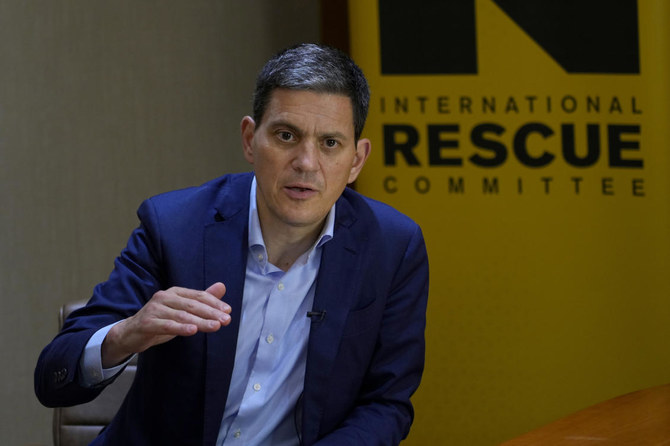
BEIRUT: An impasse at the United Nations over a border crossing with Syria’s last rebel-held enclave is putting 4.1 million Syrian there in danger, the president of the International Rescue Committee warned this week.
David Miliband’s comments came more than two weeks after the UN Security Council failed to renew the mandate for the Bab Al-Hawa border crossing between Syria and Turkiye, which secures aid for Syrians in the enclave.
The vast majority of people in northwestern Syria live in poverty and rely on aid to survive — a crisis that was further worsened by a devastating magnitude 7.8 earthquake that hit southern Turkiye and northern Syria in February. The earthquake killed more than 50,000 people, including over 6,000 in Syria, according to the United Nations. The quake also displaced hundreds of thousands of others.
“The people of northwest Syria can ill afford a new wave of suffering, having lived through the trauma of the earthquake,” Miliband told The Associated Press in an interview on Tuesday.
He urged the Security Council to “do its job” and resume the humanitarian border crossing.
The council earlier in July failed to adopt one of two rival resolutions on the crossing. Russia, a top ally of the Syrian government in Damascus, vetoed a Swiss-Brazilian compromise resolution backed by Western countries that renewed authorization for the crossing of aid through Bab Al-Hawa for six months. Moscow’s draft resolution with additional requirements — including increasing aid delivery to the opposition enclave through Damascus — only received China’s backing.
The paralysis also comes as donor fatigue has led to aid cuts in aid to both northwestern Syria and neighboring countries hosting millions of Syrian refugees who fled the ongoing conflict, now in its 13th year.
Syrian President Bashar Assad opened two additional crossing points from Turkiye at Bab Al-Salameh and Al-Rai to increase the aid flow to the quake victims. The UN says that some 85 percent of its aid to northwestern Syria goes through Bab Al-Hawa, a more efficient route.
For the moment, Miliband said the International Rescue Committee is trying to cope by using other crossings and finding other ways of getting aid into the enclave.
“Our point of view is that interference with the humanitarian crossing point poses severe danger to the efficiency and the effectiveness of humanitarian aid,” he explained.
Additionally, the United States said Monday that it has joined major donors in demanding the UN be able to deliver aid through Bab Al-Hawa independently and to everyone in need — a rejection of conditions set by Syria and backed by its ally Russia that Damascus control all aid and banning UN communications with rebels in the region.
The Security Council initially authorized aid deliveries in 2014 from Turkiye, Iraq and Jordan through four border crossing points into rebel-held areas in Syria.
However, Russia, backed by China, over the years successfully applied pressure to reduce the authorized crossings to just Bab Al-Hawa, and the mandates from a year to six months.
Moscow alleges that militant groups in the northwestern province of Idlib are taking the aid and preventing it from reaching families in need. Russia and China have been calling for all aid to be routed through Damascus instead.
But Syrians in the northwestern enclave, as well as Western countries critical of Assad, say they are skeptical of the push.
“There’s a lot of danger for people in need in northwest Syria,” Miliband said. “And it’s very important that they’re not forgotten.”

Aid group official warns that impasse at the UN on border crossing puts 4.1 million Syrians at risk
Short Url
https://arab.news/njd93
Aid group official warns that impasse at the UN on border crossing puts 4.1 million Syrians at risk
- The vast majority of people in northwestern Syria live in poverty and rely on aid to survive
- The Security Council initially authorized aid deliveries in 2014 from Turkiye, Iraq and Jordan through four border crossing points
Syria moves military reinforcements east of Aleppo after telling Kurds to withdraw
ALEPPO: Syria’s army was moving reinforcements east of Aleppo city on Wednesday, a day after it told Kurdish forces to withdraw from the area following deadly clashes last week.
The deployment comes as Syria’s Islamist-led government seeks to extend its authority across the country, but progress has stalled on integrating the Kurds’ de facto autonomous administration and forces into the central government under a deal reached in March.
The United States, which for years has supported Kurdish fighters but also backs Syria’s new authorities, urged all parties to “avoid actions that could further escalate tensions” in a statement by the US military’s Central Command chief Admiral Brad Cooper.
On Tuesday, Syrian state television published an army statement with a map declaring a large area east of Aleppo city a “closed military zone” and said “all armed groups in this area must withdraw to east of the Euphrates” River.
The area, controlled by Kurdish forces, extends from near Deir Hafer, around 50 kilometers (30 miles) from Aleppo, to the Euphrates about 30 kilometers further east, as well as toward the south.
State news agency SANA published images on Wednesday showing military reinforcements en route from the coastal province of Latakia, while a military source on the ground, requesting anonymity, said reinforcements were arriving from both Latakia and the Damascus region.
Both sides reported limited skirmishes overnight.
An AFP correspondent on the outskirts of Deir Hafer reported hearing intermittent artillery shelling on Wednesday, which the military source said was due to government targeting of positions belonging to the US-backed, Kurdish-led Syrian Democratic Forces.
’Declaration of war’
The SDF controls swathes of the country’s oil-rich north and northeast, much of which it captured during Syria’s civil war and the fight against the Daesh group.
On Monday, Syria accused the SDF of sending reinforcements to Deir Hafer and said it would send its own personnel there in response.
Kurdish forces on Tuesday denied any build-up of their personnel and accused the government of attacking the town, while state television said SDF sniper fire there killed one person.
Cooper urged “a durable diplomatic resolution through dialogue.”
Elham Ahmad, a senior official in the Kurdish administration, said that government forces were “preparing themselves for another attack.”
“The real intention is a full-scale attack” against Kurdish-held areas, she told an online press conference, accusing the government of having made a “declaration of war” and breaking the March agreement on integrating Kurdish forces.
Syria’s government took full control of Aleppo city over the weekend after capturing its Kurdish-majority Sheikh Maqsud and Ashrafiyeh neighborhoods and evacuating fighters there to Kurdish-controlled areas in the northeast.
Both sides traded blame over who started the violence last week that killed dozens of people and displaced tens of thousands.
PKK, Turkiye
On Tuesday in Qamishli, the main Kurdish city in the country’s northeast, thousands of people demonstrated against the Aleppo violence, with some burning pictures of Syrian President Ahmed Al-Sharaa, an AFP correspondent said, while shops were shut in a general strike.
Some protesters carried Kurdish flags and banners in support of the SDF.
“Leave, Jolani!” they shouted, referring to President Sharaa by his former nom de guerre, Abu Mohammed Al-Jolani.
“This government has not honored its commitments toward any Syrians,” said cafe owner Joudi Ali.
Other protesters burned portraits of Turkish Foreign Minister Hakan Fidan, whose country has lauded the Syrian government’s Aleppo operation “against terrorist organizations.”
Turkiye has long been hostile to the SDF, seeing it as an extension of the Kurdistan Workers’ Party (PKK) and a major threat along its southern border.
Last year, the PKK announced an end to its long-running armed struggle against the Turkish state and began destroying its weapons, but Ankara has insisted that the move include armed Kurdish groups in Syria.
On Tuesday, the PKK called the “attack on the Kurdish neighborhoods in Aleppo” an attempt to sabotage peace efforts between it and Ankara.
A day earlier, Ankara’s ruling party levelled the same accusation against Kurdish fighters.
The Britain-based Syrian Observatory for Human Rights reported 45 civilians and 60 soldiers and fighters from both sides killed in the Aleppo violence.
Aleppo civil defense official Faysal Mohammad said Tuesday that 50 bodies had been recovered from the Kurdish-majority neighborhoods after the fighting.
The deployment comes as Syria’s Islamist-led government seeks to extend its authority across the country, but progress has stalled on integrating the Kurds’ de facto autonomous administration and forces into the central government under a deal reached in March.
The United States, which for years has supported Kurdish fighters but also backs Syria’s new authorities, urged all parties to “avoid actions that could further escalate tensions” in a statement by the US military’s Central Command chief Admiral Brad Cooper.
On Tuesday, Syrian state television published an army statement with a map declaring a large area east of Aleppo city a “closed military zone” and said “all armed groups in this area must withdraw to east of the Euphrates” River.
The area, controlled by Kurdish forces, extends from near Deir Hafer, around 50 kilometers (30 miles) from Aleppo, to the Euphrates about 30 kilometers further east, as well as toward the south.
State news agency SANA published images on Wednesday showing military reinforcements en route from the coastal province of Latakia, while a military source on the ground, requesting anonymity, said reinforcements were arriving from both Latakia and the Damascus region.
Both sides reported limited skirmishes overnight.
An AFP correspondent on the outskirts of Deir Hafer reported hearing intermittent artillery shelling on Wednesday, which the military source said was due to government targeting of positions belonging to the US-backed, Kurdish-led Syrian Democratic Forces.
’Declaration of war’
The SDF controls swathes of the country’s oil-rich north and northeast, much of which it captured during Syria’s civil war and the fight against the Daesh group.
On Monday, Syria accused the SDF of sending reinforcements to Deir Hafer and said it would send its own personnel there in response.
Kurdish forces on Tuesday denied any build-up of their personnel and accused the government of attacking the town, while state television said SDF sniper fire there killed one person.
Cooper urged “a durable diplomatic resolution through dialogue.”
Elham Ahmad, a senior official in the Kurdish administration, said that government forces were “preparing themselves for another attack.”
“The real intention is a full-scale attack” against Kurdish-held areas, she told an online press conference, accusing the government of having made a “declaration of war” and breaking the March agreement on integrating Kurdish forces.
Syria’s government took full control of Aleppo city over the weekend after capturing its Kurdish-majority Sheikh Maqsud and Ashrafiyeh neighborhoods and evacuating fighters there to Kurdish-controlled areas in the northeast.
Both sides traded blame over who started the violence last week that killed dozens of people and displaced tens of thousands.
PKK, Turkiye
On Tuesday in Qamishli, the main Kurdish city in the country’s northeast, thousands of people demonstrated against the Aleppo violence, with some burning pictures of Syrian President Ahmed Al-Sharaa, an AFP correspondent said, while shops were shut in a general strike.
Some protesters carried Kurdish flags and banners in support of the SDF.
“Leave, Jolani!” they shouted, referring to President Sharaa by his former nom de guerre, Abu Mohammed Al-Jolani.
“This government has not honored its commitments toward any Syrians,” said cafe owner Joudi Ali.
Other protesters burned portraits of Turkish Foreign Minister Hakan Fidan, whose country has lauded the Syrian government’s Aleppo operation “against terrorist organizations.”
Turkiye has long been hostile to the SDF, seeing it as an extension of the Kurdistan Workers’ Party (PKK) and a major threat along its southern border.
Last year, the PKK announced an end to its long-running armed struggle against the Turkish state and began destroying its weapons, but Ankara has insisted that the move include armed Kurdish groups in Syria.
On Tuesday, the PKK called the “attack on the Kurdish neighborhoods in Aleppo” an attempt to sabotage peace efforts between it and Ankara.
A day earlier, Ankara’s ruling party levelled the same accusation against Kurdish fighters.
The Britain-based Syrian Observatory for Human Rights reported 45 civilians and 60 soldiers and fighters from both sides killed in the Aleppo violence.
Aleppo civil defense official Faysal Mohammad said Tuesday that 50 bodies had been recovered from the Kurdish-majority neighborhoods after the fighting.
© 2026 SAUDI RESEARCH & PUBLISHING COMPANY, All Rights Reserved And subject to Terms of Use Agreement.


