

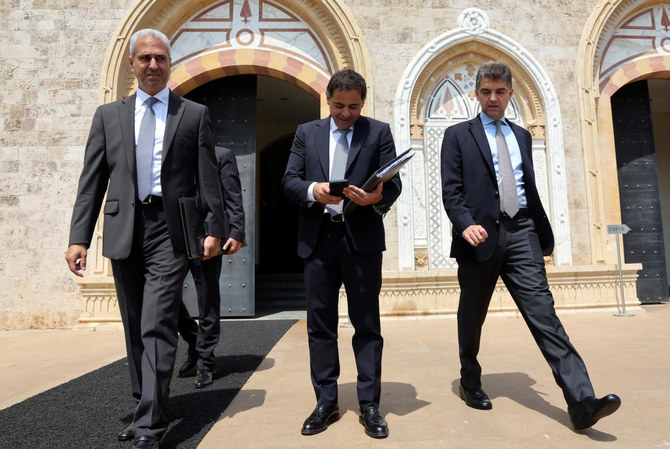

BEIRUT: Lebanese Caretaker Prime Minister Najib Mikati said on Thursday that he was “not afraid of significant jumps in the exchange rate and that the money supply could be absorbed quickly.”
His remarks came after the Cabinet on Thursday failed to meet to choose a successor to long-time central bank Gov. Riad Salameh.
The Cabinet session was canceled minutes after it was set to start because there were not enough ministers to meet the quorum.
The session lost quorum as ministers from the armed party Hezbollah and its Christian ally the Free Patriotic Movement did not attend.
Mikati had called for the Cabinet session to discuss financial issues and to look into ways to avoid a leadership vacuum at the bank.
The bank could be leaderless from Monday as the country heads into a fifth year of financial turmoil.
Mikati and Parliament Speaker Nabih Berri have led efforts to name a new governor.
Hezbollah and the FPM have, however, rejected the moves, saying a caretaker Cabinet had no right to take such decisions.
Ministers affiliated with the Progressive Socialist Party and the Amal Movement, in addition to independent ministers, attended the session.
Mikati replaced the session with a “consultative meeting” — as he described it — with the attending ministers.
In a statement published by his media office, Mikati affirmed that “today, we had the chance to temporarily address a file related to the financial and monetary situation.
“However, the political calculations of the concerned parties within the government have priority over others.”
Mikati called on “every party to bear the responsibility of its decision.”
Mikati urged MPs to “assume their responsibility and elect a new president for the country as soon as possible, so the work of constitutional institutions can be regulated again.”
He said that the current Cabinet was not responsible for the presidential vacuum and was trying during its caretaker period to manage public affairs.
Salameh — the 72-year-old Maronite Christian — is set to leave office next Monday, after serving as governor for 30 years with Lebanon’s economy in tatters and facing charges of embezzling public funds, which he denies.
The looming prospect of a leadership vacuum at the bank raises fears of further state fragmentation and reflects wider divisions that have also left the presidency vacant and the country without a fully empowered Cabinet for over a year.
Salameh’s term was renewed several times by successive cabinets.
First Vice Gov. Wassim Mansouri, of Shiite background, is expected to succeed Salameh as of Tuesday amid the presidential vacuum that has been ongoing since last October in Lebanon.
The four vice governors, who represent other sects, have threatened to resign if no new successor to Salameh is appointed.
Mikati said: “In case of vacuum, the first vice governor takes over. If he fails to do so, the second vice governor must assume the position.”
Mikati said that he relies “on everyone’s awareness to help the four vice governors and explore ways of securing temporary funding or a temporary loan until the situation is stabilized.”
Lebanon has witnessed no longer than one or two weeks of leadership vacuum at the central bank in its recent history.
Economic expert Louis Hobeika told Arab News: “Today, we fear that this vacancy might last for a long time until the election of a new president and the formation of a new Cabinet.”
The current legal status requires the first vice governor to take over, Hobeika added.
“The decisions will be taken during the meeting of the central council and implemented by the vice governor.”
Hobeika said: “Some people argue that the vice governor will act in caretaker capacity. But I say that this is an institution and not a Cabinet, and therefore, he will not act as a caretaker governor but will manage the work as usual.”
He added that the bank’s central council includes the four vice governors, the director-general of the Ministry of Finance, the director-general of the Ministry of Economy and the government commissioner to the central bank.
The vice governors fear the large responsibility that they will have to assume amid the atmosphere of political intimidation and the pressure put on them.
Hobeika believes that their resignation, however, will not be accepted.
The vice governor might appoint Salameh as his adviser in the next phase, he added.
On whether the financial market might witness a setback after Salameh’s departure, Hobeika said: “The dollar exchange rate is not linked to Salameh’s presence or absence but to actors with interests. If those actors wanted to mess up the current situation, they could.”


