

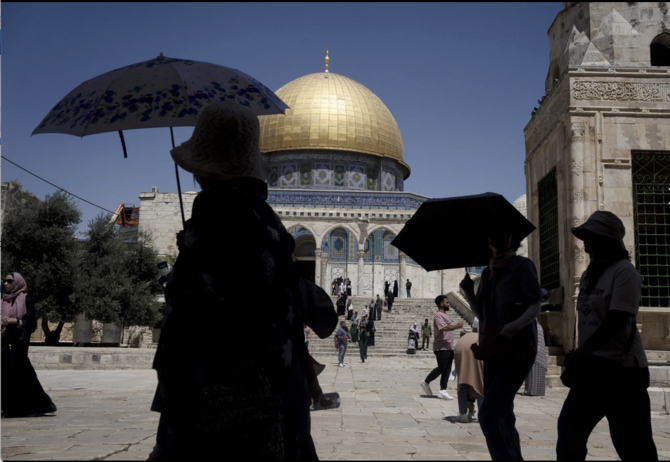

JERUSALEM: Israeli military fire killed a 14-year-old Palestinian in the occupied West Bank, Palestinian health officials said Thursday, as an extremist Israeli Cabinet minister visited a sensitive Jerusalem holy site that has been a frequent flashpoint for violence between Israel and the Palestinians.
Itamar Ben-Gvir’s visit to the disputed hilltop compound comes as Israel and the Palestinians are locked in a year-and-a-half long bout of fighting and could enflame already surging tensions. It was also likely to draw condemnation from Palestinians who view such visits as provocative. The site is revered by Jews and Muslims, and the competing claims lie at the heart of the Israeli-Palestinian conflict.
Early Thursday, the Palestinian Health Ministry said 14-year-old Fares Sharhabil Abu Samra was killed by Israeli fire in the West Bank town of Qalqilya. The Israeli military said Palestinians threw rocks and firebombs at troops, who responded by firing into the air. It said the incident was being reviewed.
Ben-Gvir was joining what will likely to be hundreds of Jews visiting the Al-Aqsa Mosque compound to mark the Jewish holiday of Tisha B'Av, a day of mourning and repentance when Jews reflect on the destruction of the First and Second Temples, key events in Jewish history.
“This is the most important place for the people of Israel which we must return to and show our rule,” Ben-Gvir said in a video released by his office, with the golden Dome of the Rock in the background.
Ben-Gvir, a former West Bank settler leader and far-right activist who years ago was convicted of incitement and supporting a Jewish terror group, now serves as Israel’s national security minister, overseeing the country’s police force.
Thursday was Ben-Gvir’s third known visit to the contested site since becoming a minister in Prime Minister Benjamin Netanyahu’s far-right government. The site, known to Jews as the Temple Mount, is the holiest site in Judaism, where the biblical Temples once stood. Today, it is home to the Al-Aqsa Mosque, the third-holiest site in Islam.
His visit could enflame already surging tensions between Israel and the Palestinians, who have been engaged in months of fighting that have sparked the worst violence in nearly two decades in the West Bank.
Israel-Palestine fighting escalates
Since early last year, Israel has been staging near-nightly raids into Palestinian areas which it says are meant to stamp out militancy and thwart future attacks. More than 160 Palestinians have been killed in the fighting this year, according to a tally by The Associated Press.
The military says most of those killed have been militants. But stone-throwing youths protesting the incursions and others not involved in the confrontations have also been killed. At least 26 people have been killed in Palestinian attacks against Israelis since the start of 2023.
Under longstanding arrangements, Jews are permitted to visit the site, but not to pray there. But in recent years, a growing number of Jewish visitors have begun to quietly pray, raising fears among Palestinians that Israel is plotting to divide or take over the site. Ben-Gvir has long called for increased Jewish access.
Israel captured east Jerusalem, where the compound lies, along with the West Bank and the Gaza Strip in the 1967 Mideast war. The Palestinians seek those territories for a future independent state, with east Jerusalem as its capital. Israel annexed east Jerusalem in a move unrecognized by most of the international community and considers the city its undivided, permanent capital.
Netanyahu’s government, consisting of ultranationalists and West Bank settlement supporters like Ben-Gvir, has intensified steps to solidify Israel’s hold on territories that Palestinians seek for a future state, angering Israel’s top ally, the United States, and dimming hopes for Palestinian statehood.


