

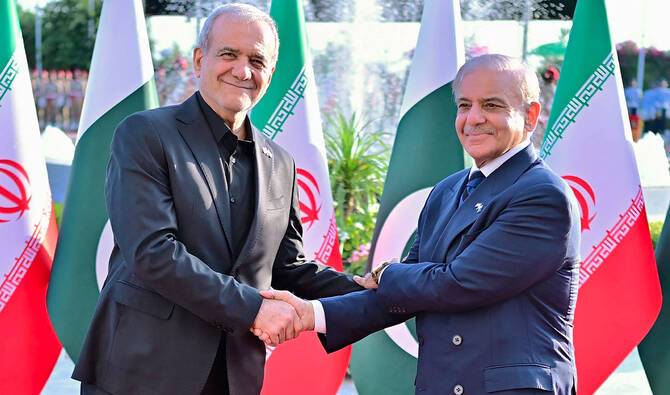

ISLAMABAD: Pakistan’s foreign office spokesperson said on Wednesday that progress on Islamabad’s economic projects with Iran will hinge on the pace at which sanctions against Tehran are lifted, a day after President Masoud Pezeshkian visited Pakistan.
Iran’s president arrived in Islamabad on Tuesday for a day-long visit to discuss the next phase of US-Iran peace talks with Pakistan’s civilian and military leadership. Pakistan has actively sought to expand its bilateral trade with Iran to $10 billion as it eyes sustainable economic growth.
Economic projects between the two countries have been hit by international sanctions targeting Iran. One of these projects is a 1,900-kilometer pipeline that was meant to supply 750 million to one billion cubic feet per day of natural gas for 25 years from Iran to Pakistan. Fears of US sanctions against Iran have delayed construction work on Pakistan’s side.
“The progress on economic projects and opening up of Iran for economic and trade relations across the world will take place simultaneously with the relief of sanctions,” Foreign Office Spokesperson Tahir Andrabi told reporters during a weekly press briefing.
“Till such time that the sanctions are relieved, the progress on these projects will hinge on the pace of the relief of sanctions,” he added. “It is important to match the two.”
When asked about the absence of any trade agreements or signing of new memoranda of understanding (MoU) between the two sides, Andrabi described Pezeshkian’s visit as a “historic” one.
He said leaders of both countries focused on a “broad-brush” review of trade and implementation of MoUs signed previously.
He said the “major outcome” of the visit was that the two sides resolved to make progress on peace and stability in the region.
“The Iranian side reaffirmed their trust in us, for which we are grateful,” Andrabi said. “In that sense, the visit carried significant outcomes both in terms of its historic importance as well as its substance for the future of our relations.”
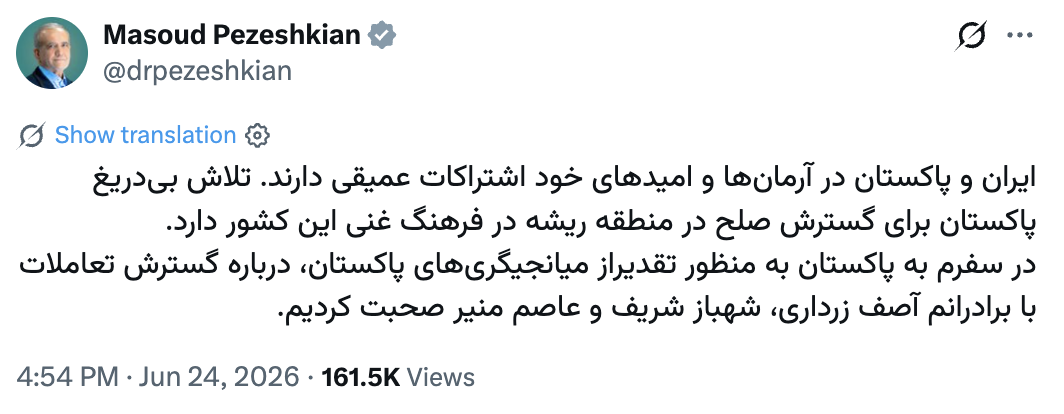
Pezeshkian spoke about his meetings with the Pakistani leadership in a post on X on Wednesday.
“Pakistan’s tireless efforts to promote peace in the region are rooted in the rich culture of this country,” he wrote.
’OPTICS, WARM ATMOSPHERE’
Foreign policy experts said Pezeshkian’s visit was a significant one for Pakistan. Maleeha Lodhi, Pakistan’s former ambassador to the United States, said the Iranian president’s visit had both “symbolic and substantive aspects.”
“Symbolic because it was aimed at conveying Iran’s gratitude to Pakistan for its role as a mediator that helped lead to a peace deal between the US and Iran,” she explained.
She said the visit was also important because under the Islamabad Memorandum of Understanding framework, Pakistan is a member of several task forces and committees charged with implementing the agreement.
“This involves close coordination between Iran and Pakistan, and the visit enabled the two to discuss these mechanisms,” Lodhi said.
Imran Ali, another former Pakistani ambassador, described Pezeshkian’s visit as significant “but not highly so” as they were reciprocal in nature.
He noted that relations between Pakistan and Iran were already cordial, adding that Pakistan’s civil and military leaders had recently visited Tehran to broker regional peace.
“The optics, the warmth— that is very important,” he said. “I think the talks took place in a very warm atmosphere.”
Ali said the gas pipeline project, energy agreements and bilateral tie between Pakistan and Iran would see progress in the long-term.
“Yes, small and short-term sanctions are going to be lifted through an executive order at least for 60 days,” he said.
“But I think Pakistan and Iran are discussing beyond that, and it will take some more meetings at the lower level.”


