How will ongoing judicial overhaul affect Arab citizens of Israel?

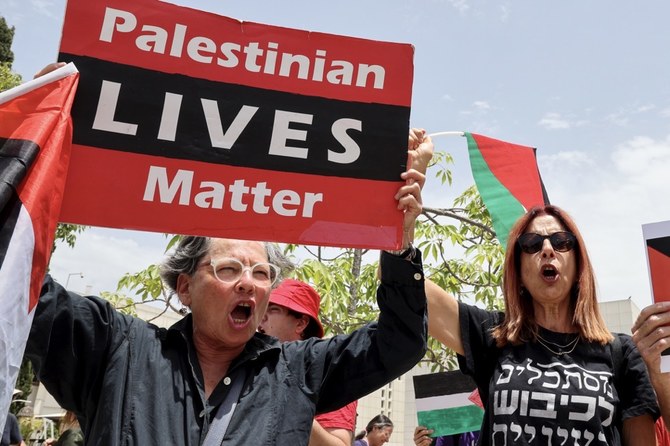
Protests against proposed legislation banning the Palestinian flag. (AFP)
Short Url
Updated 27 July 2023
Follow

How will ongoing judicial overhaul affect Arab citizens of Israel?

  • Israel’s Knesset passed on Monday one of a series of controversial laws aimed at limiting the Supreme Court’s power
  • Introduction of the changes in January had drawn a backlash, with hundreds of thousands taking to the streets in protest

DUBAI: On Monday, despite months of massive pro-democracy protests across the country, Israeli lawmakers voted to implement a key element of what proponents have long called “judicial overhaul.”

While the decision met with immediate backlash from various segments of Israeli society, political analysts say that these new limitations on judicial power may serve to eliminate the very few, and often painfully insufficient, means by which Arab citizens of Israel can pursue justice in the country.

Prominent opposition politicians have also warned Palestinian Arab citizens of Israel about the ramifications of what they view as the decay of democracy in the country. During a march commemorating Land Day in March this year, Knesset member Aida Touma-Suleiman, from the Democratic Front for Peace and Equality Party, said Arabs “are going to be hurt the most from these reforms.”

While any country’s Supreme Court is supposed to act as the blind enforcer of justice and strike down laws that are discriminatory or violate human rights, “this does not mean the Israeli courts have been fair to the Arabs,” Palestinian author and commentator Ramzy Baroud told Arab News.



Land Day protests commemorate the events of March 30, 1976. (AFP)

“To the contrary, most of the discriminatory laws, passed by the Israeli Knesset for decades, have been challenged by Arab and pro-Arab civil society and legal organizations and litigated. Yet, every one of these laws (has) been validated by Israeli courts, including the Supreme Court itself.”

Baroud pointed out that the Supreme Court upheld Israel’s Nation-State Law of 2018 declaring Israel a Jewish nation by law, “degrading the rights of Arab and other minorities, including their culture, historical claims, and language.”

The latest changes, introduced in January by Israeli Justice Minister Yariv Levin, are wide-reaching: The government will gain full control of the appointment of Supreme Court justice; courts will not be allowed to hear arguments against the country’s Basic Laws, which serve as Israel’s constitution; and Supreme Court decisions that nullify laws can be overridden by the Knesset, Israel’s parliament, after a reintroduction and majority vote for approval.

Though the reform process was paused in late March to allow for dialogue, the government and various opposition parties were unable to reach a compromise. On July 24, the section of the reform package that canceled the “reasonableness clause,” a mechanism which allowed the country’s Supreme Court to nullify government decisions that it felt were not reasonable or went against public interest, was passed.

In a country such as Israel, where the legislative and executive branches are ruled by the same governing coalition, the judiciary is one of the only powers able to stand against complete subjugation of the government by the former two branches.

“If you have three branches and two are close together, you’re left with the judicial to ensure that the government is not taking complete control and taking liberties. This is why Israelis understand, many Israelis understand, that what the government is trying to do is ensure that most of the power is in the hands of the government,” Yossi Mekelberg, professor of international relations and an associate fellow of the MENA Program at Chatham House, told Arab News.


Benjamin Netanyahu at the Knesset. (AFP)

“It’s moving toward a very authoritarian type of government … if you look at the character, it’s Orthodox, it’s religious Zionism, you can envisage the direction that this will take.”

The reason for the massive outcry against the so-called judicial overhaul, according to Baroud, is that it has the potential to affect more than just minority groups in Israel.

“The current ‘crisis’ in Israel was instigated by the fact that the Israeli government is now manipulating Israeli laws to ensure its superiority over other Israeli Jewish groups — not just the country’s minorities. When this practice was used against Arabs for generations, it didn’t seem to bother most Israelis,” he said.

“When most Israelis become the victims of the misuse of political majority (in) the parliament, they are now protesting en masse.”

INNUMBERS

• After the 1947-1949 war, around 150,000 Palestinians remained inside of what became Israel’s borders.

• Today, there are approximately 1.6 million Palestinian citizens of Israel.

• Total Israeli population, including Jews and Arabs, stands at 9.18 million.

Baroud said that while Israel’s Supreme Court often upheld discriminatory laws, it did occasionally “strike down proposed Knesset laws as illegal, especially when they seemed outlandishly racist, for example.”

In 2006, the Supreme Court ruled Amendment No. 7, which granted the state immunity from compensation claims from Palestinians injured by Israel’s security forces, null and void.

Three years ago, it struck down the Judea and Samaria Settlement Regulation Law, which would essentially legitimize illegal settlements on Palestinian-owned land in the West Bank, and a year later, it froze an amendment which would see parents of Palestinian minors convicted of security-related offenses denied social benefits from the state.

While the future of Arabs in Israel was already far from bright, the extreme limitations on the Israeli judiciary may remove the final legal avenue Arabs have to fight for their rights.

“This will not be possible in the future, now that it is the Knesset itself that plays the role of the monitor of the courts, as opposed to the other way around. Palestinian rights advocates inside Israel are already warning against the worsening of an already bad situation in terms of Arab civil, legal and political rights in Israel as a result of the changes underway,” Baroud said.



A protest at the Tel Aviv University campus. (AFP)

“This does not mean that Palestinians have any illusions about the devastating role played by Israeli courts to validate Israel’s selective democracy. But they are aware that things can, and will, become even worse.”

Baroud’s concerns are shared by Osama Al-Sharif, an Amman-based journalist and political commentator, who believes “the outlook is pretty bleak for Israeli Arabs as the state becomes more ultra-nationalist and ultra religious.”

He mentioned that just a day after the cancellation of the reasonableness clause, the Knesset approved an expansion of the Admissions Committees Law, allowing small communities within Israel to practice discrimination when providing housing.

The law, passed in 2010 as a loophole to a Supreme Court ruling banning discrimination on the basis of race, religion, or nationality when selling land, allowed communities to reject applicants they found “unsuitable to the social and cultural makeup” of the community.

Initially only applied to communities of up to 400 families in certain regions, the expansion approved on Tuesday will henceforth empower admissions committees in many more regions, for communities of up to 700 families, and will allow the law’s application to even larger communities after five years.


Israeli security forces break up a sit-in outside the Knesset in Jerusalem, below, on the eve of the judicial overhaul. (AFP)

“This is a discriminatory law and is aimed at keeping Arab citizens of Israel in ghettos that lack basic services and now suffer from lawlessness,” Al-Sharif told Arab News.

While there has been Arab participation in the Israeli protest movement, with 200 politicians, professionals, intellectuals, and artists signing a petition against the reforms in February, overall Arab participation had been low, according to an April report by the BBC.

Though many Arab citizens of Israel may see the government’s democratic backsliding as a solely Jewish issue, others warn that it will have severe consequences for minorities.

“If this trend continues, it will just make it worse,” Chatham House’s Mekelberg said. “The government will do whatever it likes. If in certain cases they back Palestinians, this will disappear. In the government we experience now, elements of that would like to annex the entire West Bank, or at least parts of the West Bank.”


Epstein tried to build web of powerful ties across Middle East, documents show

Updated 8 sec ago
Follow

Epstein tried to build web of powerful ties across Middle East, documents show

DUBAI: The departure of the chief executive of Dubai port giant DP World is the biggest fallout in the Middle East from US Department of Justice documents which show that disgraced financier Jeffrey Epstein tried to build a powerful network of political figures and business leaders across the region.
DP World announced on Friday that Sultan Ahmed Bin Sulayem had resigned as chief executive and chair.
The decision to act was taken after Bin ​Sulayem’s name appeared in the Epstein files, two sources with direct knowledge of the matter told Reuters, and as his relationship with the late convicted sex offender faced increasing scrutiny.
In their correspondence, Bin Sulayem discussed sexual relationships with women with whom Epstein helped him connect.
In an email dated November 9, 2007, Bin Sulayem told Epstein he had met one such woman in New York, whom he does not name and with whom he said he did not have sex.
“Yes after several attempts for several months we managed to meet in NY,” he wrote, adding that there was a misunderstanding because “she wanted some BUSINESS! while i only wanted some PUSSYNESS!“
Dubai’s ruler on Friday also issued a decree appointing a new chairman for Dubai’s Ports, Customs and Free Zone Corporation, one of several roles Bin Sulayem held.
Reuters was able to independently review only some of the Epstein files relating to Bin Sulayem and was unable to ascertain what specifically led to his departure from DP World although the sources said, without providing further details, that it was related to the files.
Bin Sulayem did not respond to Reuters requests for comment on his departure. DP World declined to comment.
COOKING TOGETHER
In one email exchange, Epstein described Bin Sulayem as funny, trustworthy and a foodie. Epstein went on to ‌say that Bin Sulayem, a ‌Muslim, does not drink and prays five times a day.
An undated photograph that appears in an email and is publicly available shows ​Epstein ‌cooking with ⁠Bin Sulayem ​and the ⁠two of them looking relaxed together.
The full name of the person it was sent to by Epstein is not provided.
Bin Sulayem has not publicly commented on Epstein’s description or the emails about his relationship with him.
Being named in the file is not evidence of criminal activity. But after members of the US Congress said Bin Sulayem’s name appeared in files released by the US Department of Justice (DOJ), he faced renewed questions from some of DP World’s financial backers over his past interactions.
Bin Sulayem did not respond publicly to those concerns. The UK development finance agency, British International Investment, and Canada’s second-largest pension fund said last week they would suspend all new investment with DP World over Bin Sulayem’s alleged ties to Epstein.
“We are shocked by the allegations emerging in the Epstein
Files regarding Sultan Ahmed Bin Sulayem,” said a spokesperson for BII, without saying which allegations he was referring to. “In light of the allegations, we will not be making any new investments with DP World until the required actions have been taken by the company.”
Canadian pension fund La Caisse said it was “pausing additional capital deployment alongside the company” until DP World ⁠clarified the situation and took “the necessary actions.”
In a statement after Friday’s leadership changes at DP World, BII welcomed DP World’s decision and said it ‌looked forward to continuing “our partnership to advance the development of key African trading ports.” La Caisse said “the company took the appropriate measures” and that ‌it would “move quickly to work with DP World’s new leadership to continue our partnership on port projects around the world.”
Bin Sulayem ​did not immediately respond when asked by Reuters to comment on the actions taken by BII and ‌La Caisse. DP World declined comment.
NETWORK OF CONTACTS
The large cache of documents released by the DOJ, including text messages and emails, also shows the Middle East was no exception to Epstein’s efforts to use ‌his wealth to build relationships with prominent people in politics, finance, academia and business around the world.
Reuters was unable to ascertain how successful Epstein was in seeking to influence his contacts in the Middle East, and whether his advice was heeded. The DOJ documents reviewed by Reuters show Epstein tried to advise Qatari business leaders and political figures during the 2017-21 blockade of Qatar by Saudi Arabia, the United Arab Emirates, Bahrain and Egypt over accusations that Doha failed to curb ties with Iran and supported terrorism, which Qatar denied.
In exchanges with a Qatari businessman and ruling family member Sheikh Jabor Yousuf Jassim Al Thani, Epstein urged Qatar to “stop kicking and arguing...let the heat come down a bit.” He said “the current ‌Qatar team is very weak” and “FM is not experienced and it shows.”
Qatar’s foreign minister at the time was Sheikh Mohammed bin Abdulrahman Al Thani, who now serves as both foreign minister and prime minister. Sheikh Mohammed has not commented publicly on Epstein’s portrayal of him. Asked about the ⁠exchange, Qatar’s International Media Office, which handles media requests for ⁠the prime minister, declined to comment.
There was no response to a Reuters request for comment emailed to three companies in Qatar that Sheikh Jabor is listed as chairman of, or to a text message sent to an individual who, according to the files released by the DOJ, works in Sheikh Jabor’s office. Epstein urged Doha to forge links with Israel to stay in the good graces of Donald Trump, who was then in his first term as US president. He suggested the Gulf state either move toward recognizing Israel or pledge $1 billion to a fund for terrorism victims. Ultimately, Qatar stuck to its independent course. In 2021, the blockading countries restored ties with Doha, and ties between the Trump administration and Qatar are now strong.
DISCUSSION OF SAUDI ARAMCO IPO
Epstein discussed Saudi Aramco’s initial public offering in dozens of email exchanges. In one exchange dated September 10, 2016, with a person named as Aziza Alahmadi, and with former Norwegian diplomat Terje Roed-Larson copied in, Epstein warned that Aramco going public could expose Saudi Arabia to lawsuits and asset seizures. Saudi Aramco declined to comment on these emails.
Alahmadi could not be reached for comment and Reuters was unable to establish her role, if any, in Epstein’s activities.
In an email dated October 16, 2017, and also sent to Alahmadi, Epstein suggested selling China an option to buy a $100-billion stake in Aramco rather than pursuing a traditional IPO, saying it would provide liquidity while limiting exposure to public markets.
Saudi Aramco declined to comment to Reuters on the emails. Roed-Larsen did not immediately respond to a request for comment sent by email via his lawyer.
Epstein’s reach also extended to Egypt, the documents released by the DOJ show. Some emails show a request from ​a family member of Hosni Mubarak — the wife of his son Gamal Mubarak — that was passed on ​to Epstein asking for help in 2011, following the former president’s ouster and subsequent legal troubles. They did not say what kind of assistance was sought and Reuters was unable to establish whether Epstein had tried to intercede on the family’s behalf. Reuters emailed a request for comment to one lawyer and sent a text message to another, both of whom represented Gamal Mubarak. There was no immediate response.