

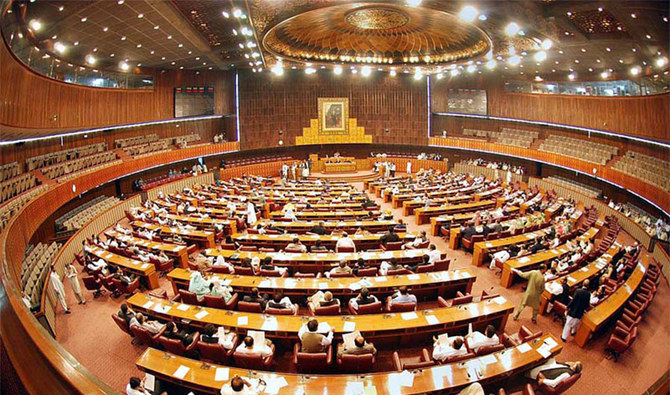

ISLAMABAD: Pakistan’s parliament on Wednesday approved legislation that grants additional powers to any caretaker government, empowering it to take important decisions and engage with international institutions ahead of the upcoming general elections.
The development takes place a day after Prime Minister Shehbaz Sharif's government introduced multiple amendments to the Election Act, 2017, days before the five-year constitutional tenure of the present National Assembly is due to expire. Section 230 of the Elections Act empowers caretaker setups to make important decisions like elected administrations of the country.
A leading coalition partner of the government, the Pakistan Peoples Party (PPP) objected to the proposed amendments on Tuesday, stating that they put caretaker governments "on the same pedestal" as elected ones.
However, during Wednesday's parliamentary session, the government managed to allay its allies' concerns and managed to get the legislation passed by a majority vote. Former Prime Minister Imran Khan's Pakistan Tehreek-e-Insaf (PTI) and the opposition Jamaat-e-Islami (JI) rejected the move.
“The caretaker government can look into urgent matters only, we have tried our best to empower the caretaker government while remaining within the framework of the constitution,” Federal Law Minister Azam Nazir Tarar briefed the joint sitting of the parliament.
Article 230 of the legislation empowers the caretaker government to take important decisions about “existing bilateral, multilateral and ongoing projects” already signed with international institutions like the World Bank and the International Monetary Fund (IMF).
“The kind of economic crisis we have been passing through, it is important to empower the caretaker government to sign bilateral and multilateral agreements,” the minister explained.
He said while Pakistan was receiving some investments, other agreements worth hundreds of millions of dollars, such as the one with the World Bank, are expected to be signed in September. These agreements, the minister said, should be handled by the interim government.
“No new authority is being awarded [to the caretaker government] …. They will take care of only day-to-day affairs,” Tarar assured the house, adding that the caretaker government would intervene only where the federal cabinet has already approved some deals which require consequential work.
Senator Mushtaq Ahmad of the JI said empowering the caretaker setup through legislation is a “soft coup” that would make the upcoming general elections controversial.
“I cannot support it,” he said, emphasizing that caretaker governments in Punjab and Khyber Pakhtunkhwa provinces were already working on an agenda instead of performing their duties in a neutral and unbiased manner as mandated by Pakistan's constitution.
Ahmad said the government's move was against the “spirit of the constitution” that could be used as a pretext to extend the tenure of the interim setup.
PTI's Senator Ali Zafar opposed the empowering the caretaker setup, describing it as a “murder of the constitution” and saying that the powers of an elected government were granted to a caretaker setup.
“The only job of the caretaker government is to hold free and fair elections,” he said, warning that the Supreme Court would strike the amendments down for being in violation of the constitution.
The ruling Pakistan Muslim League-Nawaz's (PML-N) head of the parliamentary committee on electoral reforms, Ayaz Sadiq, clarified that the proposed legislation would not be used to delay general elections.
“It is categorically written in the bill that they would take decisions only regarding bilateral, multilateral, and ongoing projects," he said.
The proposed legislation would become law after President Dr Arif Alvi grants his assent to it.


