

Pakistanis abandon hopes of reaching Europe after boat tragedies

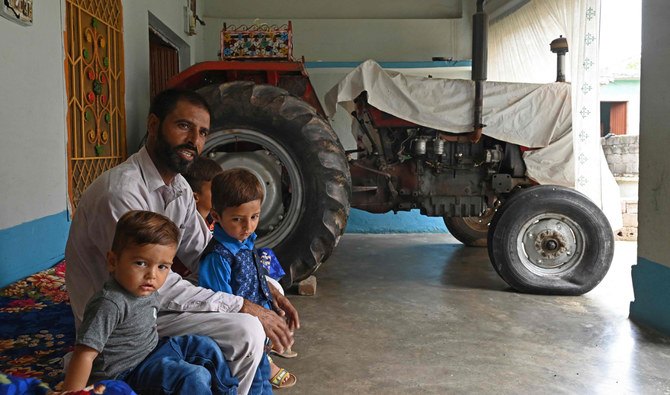
In this picture taken on July 18, 2023, Pakistani worker Muhammad Naeem Butt sits with his children at his home in Khuiratta. (AFP)
Short Url
Updated 25 July 2023
Follow

Pakistanis abandon hopes of reaching Europe after boat tragedies

  • The International Organization for Migration has declared the Mediterranean passage the world’s most perilous migration route
  • Around 1,728 migrants have gone missing there this year alone, surpassing the 1,417 disappearances recorded in 2022

KHUIRATTA: After spending weeks in Libya trying to reach Europe illegally, Mohammed Naeem Butt turned back — abandoning a journey that has already cost hundreds of Pakistani lives this summer.

Shoveling sand onto a truck surrounded by Pakistan’s Kashmir Valley, he says he ended his treacherous bid for a better life when an overloaded fishing trawler sank off the coast of Greece last month.

Up to 350 Pakistanis were believed to be among the 600 who drowned, including 24 from Butt’s hometown of Khuiratta in the lush Kashmir Valley.

“Looking back, I realize that the risk I took was not worth it,” Butt said.

Butt is one of several men from Khuiratta who told AFP the disaster prompted them to give up on the journey after reaching Libya.

“Life is defined by the quality time you spend with your children and spouse, not the amount of money you possess,” he said.

Tens of thousands of young men have handed over family fortunes to agents who smuggle them to Europe, from where remittances — even more valuable since Pakistan’s economy slumped into crisis last year — can be wired home.

Butt sought help from friends and family, and his wife sold her precious wedding jewelery to scrape up the 2.2 million rupees (around $7,500) he needed to pay the human traffickers organising the trips.

The first legs of his journey were uneventful — commercial flights to Dubai and Egypt, then overland to Libya, where his ordeal really started.

He spent two months in a makeshift shanty camp with 600 other migrants, waiting for the day they would be put on a cargo ship to make the journey across the Mediterranean.

Instead, they were crowded onto a rickety fishing boat and spent eight days floundering in international waters, where they were first fired on, then rammed, by a Libyan naval vessel, Butt said.

They only stayed afloat because the navy ship abandoned them when a storm struck, he added — but it returned days later to tow them back to port, where they were thrown in jail.

“They gave us the minimal amount of food to keep us alive ... a plate of macaroni or boiled rice would be shared among five people,” Butt said.

“They were brutal people.”

While he was in jail, news reached his hometown of the migrant boat sinking off Greece, causing heartbreak and distress.

“I can’t explain the pain and anguish I went through for a week,” Butt’s wife Mehwish Matloob said.

“I felt as though my entire world had crumbled before me,” the 31-year-old said, clutching a shawl.

Butt finally got out of jail and was able to contact his family to tell them he was alive.

The International Organization for Migration has declared the Mediterranean passage the world’s most perilous migration route.

Around 1,728 migrants have gone missing there this year alone —surpassing the 1,417 disappearances recorded in 2022.

Zafar Iqbal Ghazi of Kashmir’s Human Rights Forum group said more than 175 youngsters from Khuiratta alone left illegally for Europe last year, and he believes any recent pause after the boat incident in Greece will only be temporary.

Pakistan’s Federal Investigation Agency said 69 smuggling agents had been arrested since a crackdown was launched last month, but prosecutions will be difficult.

“The challenge lies in the fact that most of these youngsters possess valid visas for Dubai, which they use as a starting point to reach Libya,” one FIA official said, speaking anonymously to AFP.


DR Congo’s amputees bear scars of years of conflict

Updated 2 sec ago
Follow

DR Congo’s amputees bear scars of years of conflict

GOMA: They survived the bombs and bullets, but many lost an arm or a leg when M23 fighters seized the city of Goma in the eastern Democratic Republic of Congo nearly a year ago.
Lying on a rug, David Muhire arduously lifted his thigh as a carer in a white uniform placed weights on it to increase the effort and work the muscles.
The 25-year-old’s leg was amputated at the knee — he’s one of the many whose bodies bear the scars of the Rwanda-backed M23’s violent offensive.
Muhire was grazing his cows in the village of Bwiza in Rutshuru territory, North Kivu province, when an explosive device went off.
He lost his right arm and right leg in the blast, which killed another farmer who was with him.
Fighting had flared at the time in a dramatic escalation of a decade-long conflict in the mineral-rich region that had seen the M23 seize swathes of land.
The anti-government M23 is one of a string of armed groups in the eastern DRC that has been plagued by internal and cross-border violence for three decades, partly traced back to the 1994 Rwanda genocide.
Early this year, clashes between M23 fighters and Congolese armed forces raged after the M23 launched a lightning offensive to capture two key provincial capitals.
The fighting reached outlying areas of Muhire’s village — within a few weeks, both cities of Goma and Bukavu had fallen to the M23 after a campaign which left thousands dead and wounded.
Despite the signing in Washington of a US-brokered peace deal between the leaders of Rwanda and the DRC on December 4, clashes have continued in the region.
Just days after the signing, the M23 group launched a new offensive, targeting the strategic city of Uvira on the border with the DRC’s military ally Burundi.
More than 800 people with wounds from weapons, mines or unexploded ordnance have been treated in centers supported by the International Committee of the Red Cross (ICRC) in the eastern DRC this year.
More than 400 of them were taken to the Shirika la Umoja center in Goma, which specializes in treating amputees, the ICRC said.
“We will be receiving prosthetics and we hope to resume a normal life soon,” Muhire, who is a patient at the center, told AFP.


- ‘Living with the war’ -


In a next-door room, other victims of the conflict, including children, pedalled bikes or passed around a ball.
Some limped on one foot, while others tried to get used to a new plastic leg.
“An amputation is never easy to accept,” ortho-prosthetist Wivine Mukata said.
The center was set up around 60 years ago by a Belgian Catholic association and has a workshop for producing prostheses, splints and braces.
Feet, hands, metal bars and pins — entire limbs are reconstructed.
Plastic sheets are softened in an oven before being shaped and cooled. But too often the center lacks the materials needed, as well as qualified technicians.
Each new flare-up in fighting sees patients pouring into the center, according to Sylvain Syahana, its administrative official.
“We’ve been living with the war for a long time,” he added.
Some 80 percent of the patients at the center now undergo amputation due to bullet wounds, compared to half around 20 years ago, he said.
“This clearly shows that the longer the war goes on, the more victims there are,” Syahana said.