

UK foreign minister kicks off Middle East tour

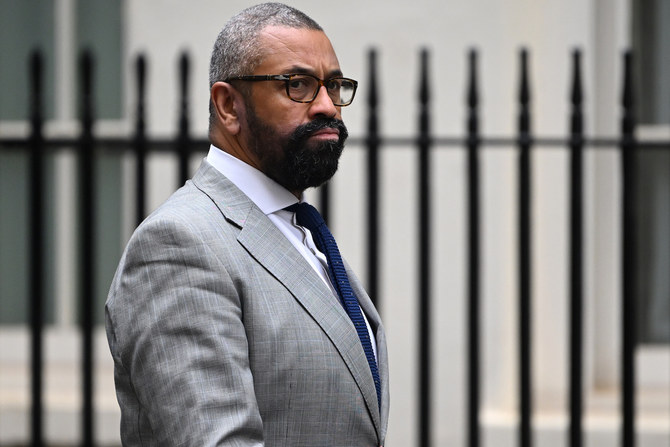
UK Foreign Secretary James Cleverly arrives for a cabinet meeting at 10 Downing Street in central London. (File/AFP)
Short Url
Updated 25 July 2023
Follow

UK foreign minister kicks off Middle East tour

  • Cleverly will begin his trip with Jordan, followed by Qatar, Kuwait

AMMAN: UK Foreign Secretary James Cleverly began a three-day tour to the Middle East on Tuesday to boost ties with the region, Jordan News Agency reported.

The trip — to Qatar, Kuwait and Jordan — comes after the UK government announced that citizens of Gulf countries and Jordan will benefit from a new electronic travel authorization visa scheme.

The scheme will make visiting the UK more affordable and accessible for Gulf and Jordanian travelers.

All three countries are also significant energy, defense, and security partners for the UK, and trade and investment with the Gulf are critical to supporting Prime Minister Rishi Sunak’s ambitions for economic growth, according to a statement from the British Embassy in Amman.

The statement added that UK trade with Qatar and Kuwait was worth £18.1 billion ($23.2 billion) in 2022.

Cleverly will meet his Jordanian counterpart Ayman Safadi in Amman on Tuesday and will announce up to £1.5 million in funding to support Jordan’s projects for women and girls.

Safadi will also meet UNHCR and World Food Programme representatives, where he will announce £30 million in financing over three years to provide cash aid and support to Jordan’s poorest refugees. This would provide basic food and living necessities to an about 70,000 refugees in camps and host communities each year.

“The UK’s mutually beneficial relationships with the Gulf and Jordan continue to thrive,” said Cleverly.

The foreign minister expressed pride in UK-Jordanian collaboration on common goals, such as strengthening commercial ties and security “for the benefit of us all.

“The UK also remains committed to supporting refugees and host communities, collaborating with our partners to help the most vulnerable in the region,” he added.

Cleverly will also meet Qatari Prime Minister Sheikh Mohammed bin Abdulrahman Al-Thani on Tuesday in Doha and later head to Kuwait to meet Crown Prince Sheikh Mishal Al-Ahmed Al-Jaber Al-Sabah.


El Paso flights resume after US anti-drone system prompts sudden shutdown

Updated 3 sec ago
Follow

El Paso flights resume after US anti-drone system prompts sudden shutdown

  • Aviation officials lifts restrictions after sudden overnight halt
  • FAA, US Army in dispute ‌over laser anti-drone system
WASHINGTON: A secret military laser-based anti-drone system prompted the Trump administration to ban air traffic for more than seven hours in and out of the Texas border city of El Paso after US aviation officials raised drastic concerns about the safety of commercial air traffic.
The sudden closure of the nation’s 71st busiest airport by the Federal Aviation Administration stranded air travelers and disrupted medical evacuation flights overnight. The FAA initially said the closure would last 10 days for “special security reasons,” in what would have been an unprecedented action involving a single airport. Government and airline officials, speaking on condition of anonymity, said the FAA closed the airspace due to concerns that an Army laser-based counter-drone system could pose risks to air traffic. The two agencies had planned to discuss the issue at a February 20 meeting but the Army opted to proceed without FAA approval, sources said, which prompted the FAA to halt flights.
The Army’s laser was a direct-energy weapon called LOCUST and is manufactured by AeroVironment, a Virginia-based ‌drone and counter-drone defense ‌firm, two people briefed on the matter said. The company and the Pentagon did not ‌immediately ⁠respond to requests ⁠for comment.
The FAA lifted its restrictions after the Army agreed to more safety tests before using the system, which is housed at Fort Bliss, next to El Paso International Airport.
The White House was surprised by the El Paso airspace closure, according to two sources speaking on condition of anonymity, touching off a scramble among law enforcement agencies to figure out what happened.
The FAA lifted the restrictions shortly after the situation was discussed in the office of White House chief of staff Susie Wiles, the sources said. US Transportation Secretary Sean Duffy, who oversees the FAA, said the closure had been prompted by a drone incursion by a Mexican drug cartel. However, a drone sighting near an airport would typically ⁠lead to a brief pause on traffic, not an extended closure, and the Pentagon says there ‌are more than 1,000 such incidents each month along the US-Mexico border.
FAA Administrator ‌Bryan Bedford met senators on Wednesday and told them there could have been better coordination about the move but did not answer detailed questions about ‌why the agency initially planned a 10-day halt to flights, lawmakers said. Senate Commerce Committee chair Ted Cruz, a Texas Republican, and Senator ‌Ben Ray Lujan, a New Mexico Democrat, both called for a classified briefing to get more answers. “The details of what exactly occurred over El Paso are unclear,” Cruz said.
The move had stranded numerous aircraft from Southwest Airlines, United Airlines and American Airlines at the airport, which handles about 4 million passengers annually.
El Paso Mayor Renard Johnson said the FAA did not reach out to the airport, the police chief or other local officials before ‌shutting down the airspace.
“I want to be very, very clear that this should have never happened,” he said at a news conference.
The US official in charge of airport security, Transportation Security ⁠Administration Acting Administrator Ha Nguyen McNeill, ⁠also told Congress that she had not been notified.
“That’s a problem,” said Republican Representative Tony Gonzales of Texas, who said there are daily drone incursions along the US-Mexico border.
Airlines caught off guard
Airlines were also caught off-guard by the early Wednesday announcement. Southwest Airlines said the effects should be minimal for its 23 daily departures scheduled.
“FAA has not exactly acquitted itself credibly, objectively, or professionally,” said Bob Mann, an airline industry consultant. “The question should be, do we get an explanation?”
Trump has repeatedly threatened to deploy US military force against Mexican drug cartels, which have used drones to carry out surveillance and attacks on civilian and government infrastructure, according to US and Mexican security sources.
Mexican President Claudia Sheinbaum said at her daily news conference that her administration would try to find out what exactly happened but had no information about drone traffic along the border.
Tensions between the US and regional leaders have ramped up since the Trump administration mounted a large-scale military buildup in the southern Caribbean, attacked Venezuela and seized its president, Nicolas Maduro, in a military operation. The FAA curbed flights throughout the Caribbean after the attack, forcing the cancelation of hundreds of flights.