

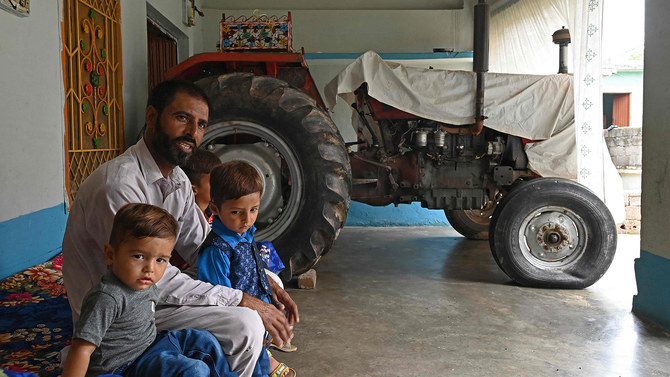

KHUIRATTA: After spending weeks in Libya trying to reach Europe illegally, Muhammad Naeem Butt turned back — abandoning a journey that has already cost hundreds of Pakistani lives this summer.
Shovelling sand onto a truck surrounded by Pakistan’s Kashmir valley, he says he ended his treacherous bid for a better life when an overloaded fishing trawler sank off the coast of Greece last month.
Up to 350 Pakistanis were believed to be among the 600 who drowned, including 24 from Butt’s hometown of Khuiratta in the lush Kashmir valley.
“Looking back, I realize that the risk I took was not worth it,” Butt told AFP.
Butt is one of several men from Khuiratta who told AFP the disaster prompted them to give up on the journey after reaching Libya.
“Life is defined by the quality time you spend with your children and spouse, not the amount of money you possess,” he said.

In this picture taken on July 17, 2023, Pakistani worker Muhammad Naeem Butt shows his photograph, when he was at a camp in Libya, at his home in Khuiratta. (AFP)
Tens of thousands of young men have handed over family fortunes to agents who smuggle them to Europe, from where remittances — even more valuable since Pakistan’s economy slumped into crisis last year — can be wired home.
Butt sought help from friends and family, and his wife sold her precious wedding jewelry to scrape up the 2.2 million rupees (around $7,500) he needed to pay the human traffickers organizing the trips.
The first legs of his journey were uneventful — commercial flights to Dubai and Egypt, then overland to Libya, where his ordeal really started.
He spent two months in a makeshift shanty camp with 600 other migrants, waiting for the day they would be put on a cargo ship to make the journey across the Mediterranean.
Instead, they were crowded onto a rickety fishing boat and spent eight days floundering in international waters, where they were first fired on, then rammed, by a Libyan naval vessel, Butt said.
They only stayed afloat because the navy ship abandoned them when a storm struck, he added — but it returned days later to tow them back to port, where they were thrown in jail.
“They gave us the minimal amount of food to keep us alive... a plate of macaroni or boiled rice would be shared among five people,” Butt said.
“They were brutal people.”
While he was in jail, news reached his hometown of the migrant boat sinking off Greece, causing heartbreak and distress.
“I can’t explain the pain and anguish I went through for a week,” Butt’s wife Mehwish Matloob told AFP.
“I felt as though my entire world had crumbled before me,” the 31-year-old said, clutching a shawl.
Butt finally got out of jail and was able to contact his family to tell them he was alive.
His mother, 76-year-old Razia Latif, says she now regrets the danger he endured.
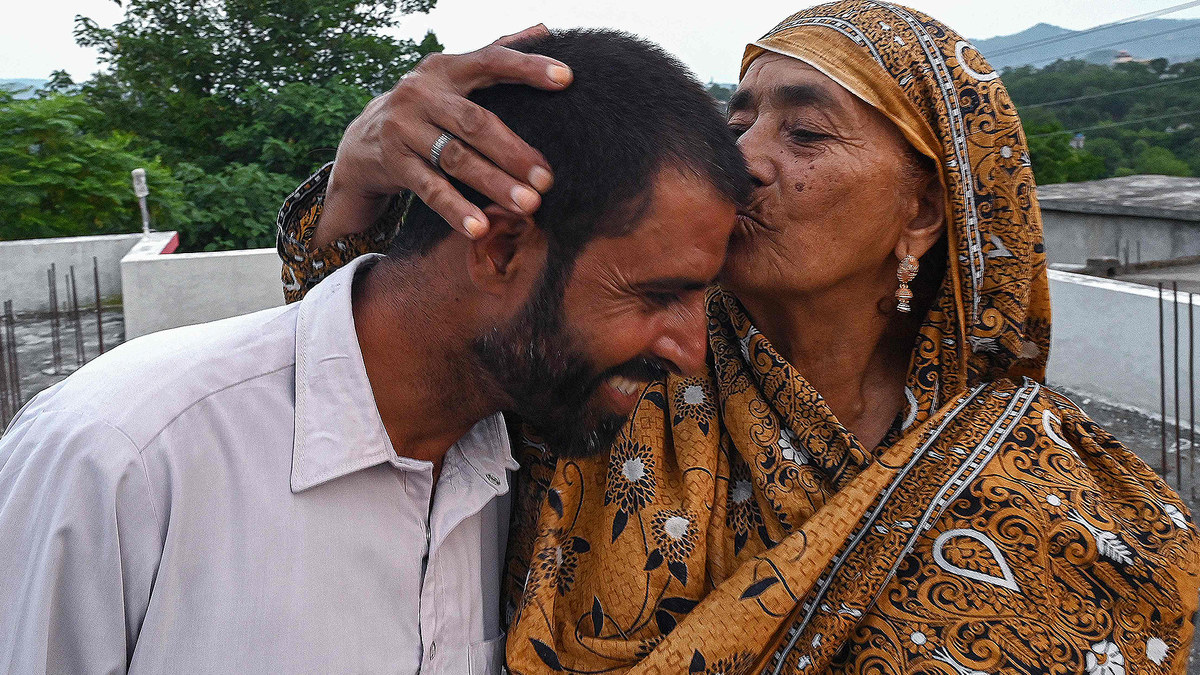
In this picture taken on July 17, 2023, Pakistani worker Muhammad Naeem Butt (L) is kissed by his mother Razia Latif at their home in Khuiratta. (AFP)
“We thought that others were making it to Europe, so why not send him,” she said.
“We would have preferred begging had we known it was that difficult.”
The International Organization for Migration has declared the Mediterranean passage the world’s most perilous migration route.
Around 1,728 migrants have gone missing there this year alone — surpassing the 1,417 disappearances recorded in 2022.
But families that do get one or more of their young men abroad can prosper from the money sent back.
The noticeable disparity between families with relatives in Europe and those without is causing envy, said Zafar Iqbal Ghazi of Kashmir’s Human Rights Forum group.
“If someone has a single-story home, right next to it you will find a three-story home, and bigger mansions, and so on,” he said.
And the promise of untold riches abroad attracts those even well off by local standards.
Hamza Bhatti was earning 200,000 rupees a month (around $700) as a driver in Saudi Arabia — enough to comfortably support his wife and their eight-month-old son — but he still saw greener pastures in Europe.
“I believed that life in Europe would be more vibrant and colorful compared to my experience in Saudi Arabia,” the 29-year-old told AFP.
Bhatti was jailed after his boat was returned to port by Libyan authorities and he found himself alongside Butt as news of the sinking broke.
“It was my greed that took me to the brink of death,” he said.
Ghazi said more than 175 youngsters from Khuiratta alone left illegally for Europe last year, and he believes any recent pause after the boat incident in Greece will only be temporary.
Pakistan’s Federal Investigation Agency (FIA) said 69 smuggling agents had been arrested since a crackdown was launched last month, but prosecutions will be difficult.
“The challenge lies in the fact that most of these youngsters possess valid visas for Dubai, which they use as a starting point to reach Libya,” one FIA official said, speaking anonymously to AFP.
“This is not a new phenomenon, and it will not end after the Greece boat tragedy.”
European Union lawmakers have urged Brussels to provide support to member states to strengthen their capacity to carry out sea rescues, but attitudes toward migrants are hardening across Europe, with Greece steadily slashing benefits for asylum seekers.
Mehwish says her husband Butt will never again attempt the journey — even though traffickers refunded part of his payment in the hope they wouldn’t be reported.
“I don’t regret losing the gold, and I am content to live in poverty as long as he is with me,” she said.


