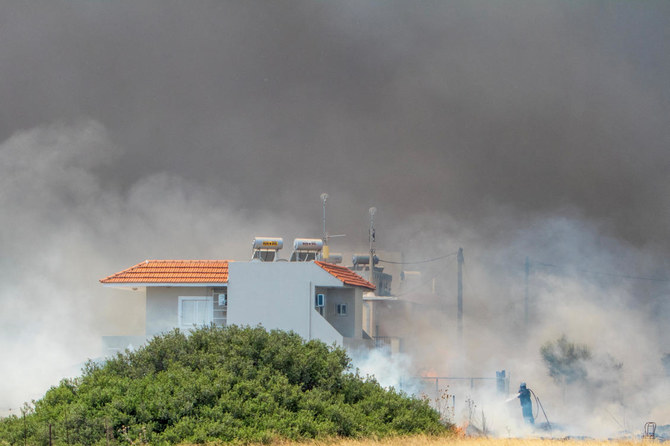
Rhodes: Greece braced for a new wave of soaring temperatures Tuesday, as wildfires raged on several popular tourist islands, forcing mass evacuations.
In the capital city of Athens the mercury is expected to soar to 41 degrees Celsius (106 degrees Fahrenheit), and reach up to 44C in central Greece, according to the national weather forecaster EMY.
Many regions of the country were on “red alert,” meaning there is an extreme risk of dangerous forest fires exacerbated by strong winds.
The very hot weather comes after a weekend of intense heat as thousands of locals and tourists fled forest fires on the Greek islands of Rhodes and Corfu, with the prime minister warning the heat-battered nation is “at war” with the flames.
Authorities evacuated nearly 2,500 people from the Greek island of Corfu on Monday, after tens of thousands of people had already fled blazes on the island of Rhodes, with many frightened tourists scrambling to get home on evacuation flights.
More than 260 firefighters were still battling flames for an eighth consecutive day on Rhodes, supported by two helicopters and two planes.
Fires were also raging on Greece’s second largest island of Evia, where Greek civil protection authorities issued an overnight evacuation order in one northern locality.
The mercury hit 46.4C in Gythio, in the southern Peloponnese peninsula on Sunday, though failed to reach the hottest temperature nationally on record of 48C.
“We are at war and are exclusively geared toward the fire front,” Greek Prime Minister Kyriakos Mitsotakis told parliament on Monday.
He warned that the country faced “another three difficult days ahead” before high temperatures are forecast to ease.
The severe heatwave in Greece has also been reflected across much of southern Europe and Northern Africa.
In Algeria at least 34 people have died as wildfires raged through residential areas, forcing mass evacuations.
In southeastern France officials Monday issued a fire warning at the highest level in the Bouches-du-Rhone region, warning that the weather conditions make the risk of flames “very high compared to normal summers.”
The exceptional temperatures in Greece have forced key tourist sites such as the Acropolis in Athens to close at the hottest times of the day.
Vassilis Kikilias, Greece’s civil protection minister, said crews had battled over 500 fires around the country for 12 straight days.
The fires are particularly devastating on very touristic islands such as Rhodes and Corfu where the season is in full swing and hotels are often full.
Volunteers had come to the aid of foreign tourists in the north of the island where nearly 200 people are still camped out at a school after being evacuated from the fires on Saturday.
School director Kyriakos Kyriakoulis told AFP that dozens of local volunteers and school staff had come forward to help those stranded.
“I can’t believe they are so nice, they gave so much in every way,” said 69-year-old British tourist Christine Moody, who was spending her first vacation in Greece when the fires hit.
“I am very moved,” she said.
In the village of Vati, in the southeast of the island, local mayor Vassilis Kalabodakis said that the impact on the region was “tragic.”
“The village has been ordered to evacuate but we can’t abandon it,” he said. “We are leading the fight to protect our home.”
Scientists from the World Weather Attribution group said Tuesday that the heatwaves that have hit parts of Europe and North America this month would have been almost impossible without human-caused climate change.


![]()

Greece faces new heatwave as wildfires rage
Short Url
https://arab.news/8mb69
Greece faces new heatwave as wildfires rage
- The severe heatwave in Greece has also been reflected across much of southern Europe and Northern Africa
- exceptional temperatures in Greece have forced key tourist sites such as the Acropolis in Athens to close at the hottest times of the day.


Latest updates


© 2026 SAUDI RESEARCH & PUBLISHING COMPANY, All Rights Reserved And subject to Terms of Use Agreement.