MILAN: Palermo’s airport reopened on Tuesday after wildfires in Sicily forced its closure for a few hours as extreme weather continued to batter Italy, with severe storms causing damage and at least two deaths in the north of the country.
The airport operator said in a tweet shortly before 0900 GMT that only a limited number of outbound flights would be allowed “for the moment.” However, it later added that a plane from Turin in northern Italy had been able to land.
The airport was closed earlier as firefighters sought to put out a major blaze in a nearby area that also disrupted local road and rail traffic. Regional authorities said a woman died after an ambulance could not reach her home due to the blaze.
The temporary closure of the airport added to Sicily’s travel misery at the peak of the tourist season. The island’s main airport of Catania, Italy’s fifth-biggest, was closed last week due to a fire in a terminal building and has reopened only for a few flights.
A heat wave has hit southern Europe, with scorching temperatures bringing increased risk of fires and deaths.
In some parts of eastern Sicily, temperatures rose to 47.6 Celsius (117.7 Fahrenheit) on Monday, close to a record European high of 48.8 Celsius recorded on the island two years ago.
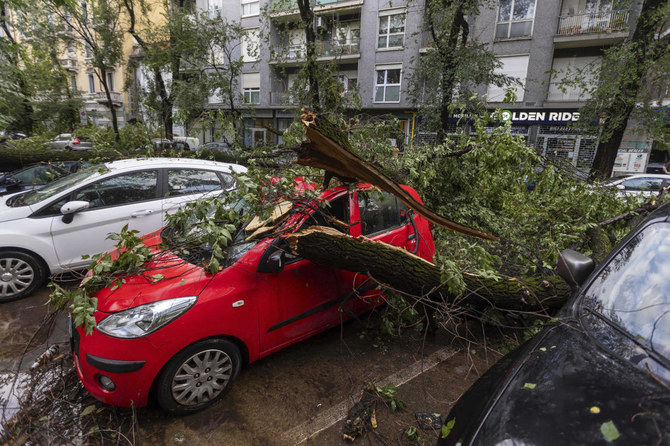
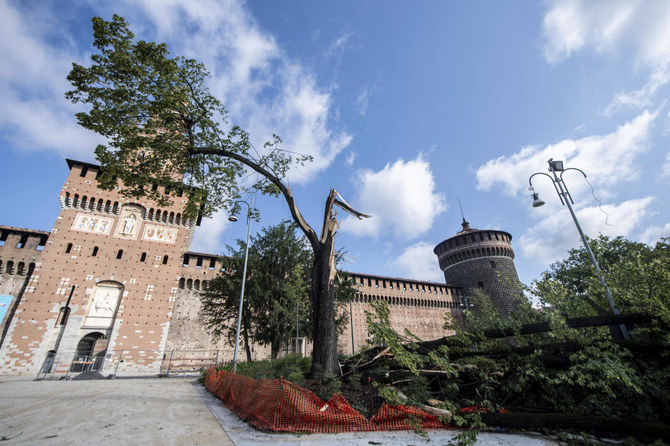
On Tuesday, Italy put 16 cities on red alert because of the high temperatures. These include Palermo and Catania, where power and water supply cuts that local officials blamed in part on the heat have been frequent in recent days. Meanwhile, an overnight storm in Milan tore off roofs and uprooted trees, blocking roads and disrupting overground transportation in Italy’s financial capital.
Two women were killed on Monday and Tuesday in the northern Monza and Brescia provinces after being crushed by falling trees.
“I have been through 65 summers in my lifetime... and what I am seeing now is not normal, we can no longer deny it, climate change is changing our lives,” Milan Mayor Giuseppe Sala said on social media.


Storms kill two in northern Italy, Palermo airport reopens after fire
https://arab.news/nh5at
Storms kill two in northern Italy, Palermo airport reopens after fire

- Airport was closed earlier as firefighters sought to put out major blaze in nearby area
- Italy put 16 cities on red alert because of the high temperatures


Only 4% women on ballot as Bangladesh prepares for post-Hasina vote
- Women PMs have ruled Bangladesh for over half of its independent history
- For 2026 vote, only 20 out of 51 political parties nominated female candidates
DHAKA: As Bangladesh prepares for the first election since the ouster of its long-serving ex-prime minister Sheikh Hasina, only 4 percent of the registered candidates are women, as more than half of the political parties did not field female candidates.
The vote on Feb. 12 will bring in new leadership after an 18-month rule of the caretaker administration that took control following the student-led uprising that ended 15 years in power of Hasina’s Awami League party.
Nearly 128 million Bangladeshis will head to the polls, but while more than 62 million of them are women, the percentage of female candidates in the race is incomparably lower, despite last year’s consensus reached by political parties to have at least 5 percent women on their lists.
According to the Election Commission, among 1,981 candidates only 81 are women, in a country that in its 54 years of independence had for 32 years been led by women prime ministers — Hasina and her late rival Khaleda Zia.
According to Dr. Rasheda Rawnak Khan from the Department of Anthropology at Dhaka University, women’s political participation was neither reflected by the rule of Hasina nor Zia.
“Bangladesh has had women rulers, not women’s rule,” Khan told Arab News. “The structure of party politics in Bangladesh is deeply patriarchal.”
Only 20 out of 51 political parties nominated female candidates for the 2026 vote. Percentage-wise, the Bangladesh Socialist Party was leading with nine women, or 34 percent of its candidates.
The election’s main contender, the Bangladesh Nationalist Party, whose former leader Zia in 1991 became the second woman prime minister of a predominantly Muslim nation — after Pakistan’s Benazir Bhutto — was the party that last year put forward the 5 percent quota for women.
For the upcoming vote, however, it ended up nominating only 10 women, or 3.5 percent of its 288 candidates.
The second-largest party, Jamaat-e-Islami, has not nominated a single woman.
The 4 percent participation is lower than in the previous election in 2024, when it was slightly above 5 percent, but there was no decreasing trend. In 2019, the rate was 5.9 percent, and 4 percent in 2014.
“We have not seen any independent women’s political movement or institutional activities earlier, from where women could now participate in the election independently,” Khan said.
“Real political participation is different and difficult as well in this patriarchal society, where we need to establish internal party democracy, protection from political violence, ensure direct election, and cultural shifts around female leadership.”
While the 2024 student-led uprising featured a prominent presence of women activists, Election Commission data shows that this has not translated into their political participation, with very few women contesting the upcoming polls.
“In the student movement, women were recruited because they were useful, presentable for rallies and protests both on campus and in the field of political legitimacy. Women were kept at the forefront for exhibiting some sort of ‘inclusive’ images to the media and the people,” Khan said.
“To become a candidate in the general election, one needs to have a powerful mentor, money, muscle power, control over party people, activists, and locals. Within the male-dominated networks, it’s very difficult for women to get all these things.”


