

Upheaval in Israel as Knesset approves judicial ‘power grab’

1 / 3
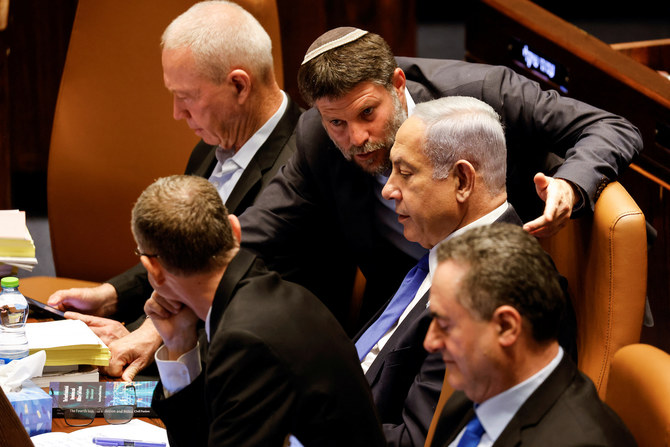
Israeli Defence Minister Yoav Gallant speaks with Prime Minister Benjamin Netanyahu as lawmakers gather at the Knesset plenum to vote on a bill that would limit some Supreme Court power, in Jerusalem July 24, 2023. (REUTERS)
2 / 3
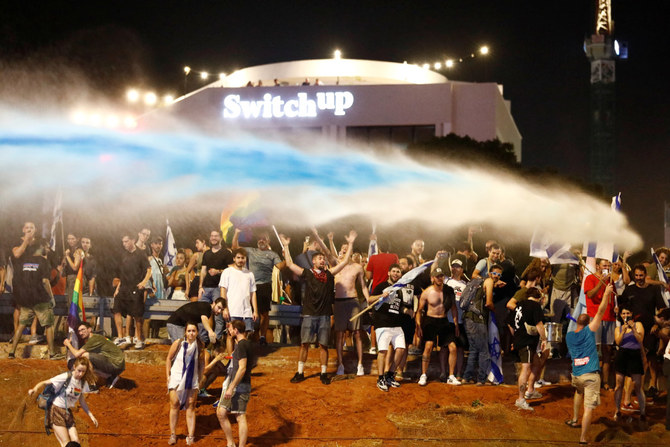
Police use water cannon as protesters block part of Ayalon Highway during a demonstration following a parliament vote on a contested bill that limits Supreme Court powers to void some government decisions, in Tel Aviv, Israel July 24, 2023. (REUTERS)
3 / 3
Israeli Finance Minister Bezalel Smotrich speaks with PM Benjamin Netanyahu as lawmakers gather at the Knesset plenum to vote on a bill in Jerusalem July 24, 2023. (Reuters)
Short Url
Updated 25 July 2023
Follow

Upheaval in Israel as Knesset approves judicial ‘power grab’

  • The judicial overhaul has sparked the biggest protests in Israel’s history
  • Opposition leader Yair Lapid described the vote as a “defeat for Israeli democracy.”

JEDDAH: Israel faced a political crisis unprecedented in its history on Monday after the Knesset voted to approve the first part of a controversial judicial overhaul that critics have described as a power grab.

Trade unions threatened a general strike, police used water cannon to quell angry street protests, activists began an appeal to the Supreme Court, the White House described the vote as “unfortunate,” Israeli financial markets tumbled and the shekel hit a two-week low against the US dollar.

The legislation limiting the Supreme Court’s powers to overturn government decisions it deemed “unreasonable” passed by a 64-0 vote after opposition Knesset members abandoned the session in protest, some shouting: “For shame!”
Within minutes of the vote, a political watchdog group and a centrist opposition leader said they would appeal against the law at the Supreme Court. The appeal itself risks miring Israel in a legal quagmire — asking the court to overturn a law that bars the court from overturning laws.
The Histadrut labor union threatened to declare a general strike if the government pursued what it called “unilateral” measures. A walkout by Histadrut in March prompted Prime Minister Benjamin Netanyahu to halt the legislative process, paving the way for cross-party talks that ultimately collapsed.
The judicial overhaul has sparked the biggest protests in Israel’s history. As the Knesset met, demonstrators outside booed, beat drums, blew horns and chanted “shame.” Police used water cannon to disperse them and officers dragged away protesters who had chained themselves to posts and blocked the road outside parliament.

The crisis has also seeped into the military. Thousands of volunteer reservists have threatened to refuse report for duty if the government continues with the plans, and former senior officers have cautioned that Israel’s war-readiness could be at risk.

Opposition leader Yair Lapid described the vote as a “defeat for Israeli democracy.” He said: “The government can decide a policy but not change the character of the state of Israel, and that’s what happened today. This government can win the battle, but not the war.”

The White House said US President Joe Biden had "expressed his views that major changes in a democracy, to be enduring, must have as broad a consensus as possible. It is unfortunate that the vote today took place with the slimmest possible majority.”


Syrian Democratic ​Forces withdraws from east of Aleppo

Updated 17 January 2026
Follow

Syrian Democratic ​Forces withdraws from east of Aleppo

RIYADH: Syrian Democratic Forces have withdrawn from positions east of Aleppo, according to SDF head Mazloum Abdi.

He announced Friday that SDF will withdraw from east ⁠of ‌Aleppo at ‍7 a.m. ‍local time on Saturday and redeploy them to areas ⁠east of the Euphrates, citing calls from friendly countries and ‌mediators.

Hours earlier, a US military designation had visited Deir Hafer and met with SDF officials in an apparent attempt to tamp down tensions.

The US has good relations with both sides and has urged calm. A spokesperson for the US military did not immediately respond to a request for comment.

Shortly before Abdi’s announcement, interim President Ahmed Al-Sharaa had announced issuance of a decree strengthening Kurdish rights.

A wave of displacement

Earlier in the day, hundreds of people carrying their belongings arrived in government-held areas in northern Syria ahead of the anticipated offensive by Syrian troops on territory held by Kurdish-led fighters.

Many of the civilians who fled were seen using side roads to reach government-held areas because the main highway was blocked at a checkpoint in the town of Deir Hafer controlled by the SDF.

The Syrian army said late Wednesday that civilians would be able to evacuate through the “humanitarian corridor” from 9 a.m. to 5 p.m. Thursday and then extended the evacuation period another day, saying the SDF had stopped civilians from leaving.

There had been limited exchanges of fire between the two sides in the area before that.

Men, women and children arrived on the government side of the line in cars and pickup trucks that were packed with bags of clothes, mattresses and other belongings. They were met by local officials who directed them to shelters.

* with input from Reuters, AP