

9 killed in civilian plane crash in Sudan, as war-hit capital left hungry

1 / 2
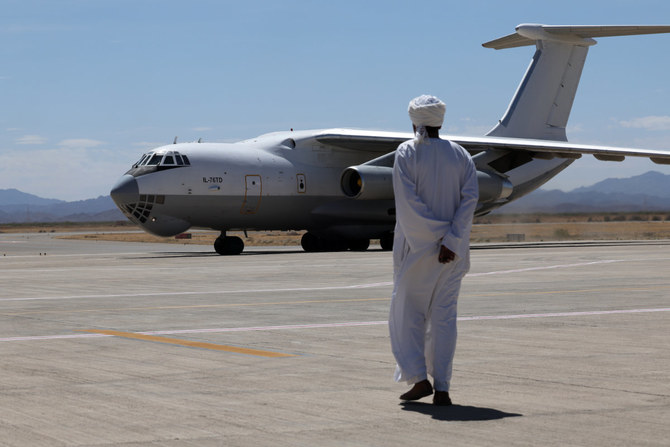
In this photo taken of May 5, 2023, a Russian-made Ilyushin Il-76 aircraft is seen at the airport in Port Sudan, eastern Sudan. A civilian Antonov aircraft crashed at the airport on July 23, 2023, killing at least nine passengers and crew. (AFP file photo)
2 / 2
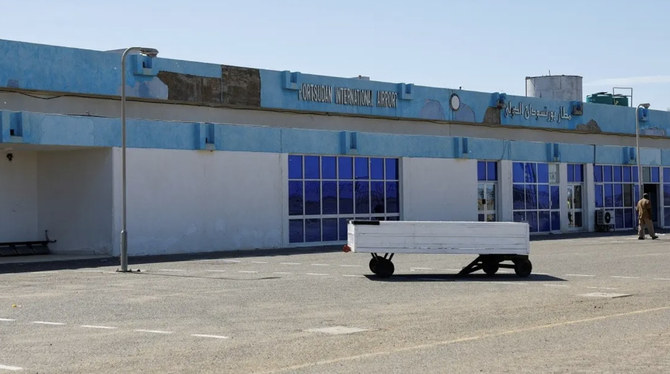
A general view of the Port Sudan International Airport as seen on May 5, 2023. (Reuters)
Short Url
Updated 27 July 2023
Follow

9 killed in civilian plane crash in Sudan, as war-hit capital left hungry

  • Young girl had survived in the crash of an Antonov plane at Port Sudan airport, says army report
  • Port Sudan airport is the only one still working in the country due to the conflict

WAD MADANI, Sudan: Nine people, including four soldiers, were killed Sunday evening when a civilian plane crashed in Sudan due to “technical” reasons, the army said, as the war in the east African country entered its 100th day.

The fighting has left millions trapped in their homes and some without water, particularly in the suburbs of the capital Khartoum where residents were calling for food donations to help them survive.
In a war-devastated district of the city, Abbas Mohammed Babiker says he and his family have only been able to eat once a day. Now even that is in doubt, but on Sunday a citizens’ support group issued an urgent appeal for donations to help people like him.
“We only have enough for two more days,” Babiker said from Khartoum North, where residents said at least one person, a local musician, has already died from hunger.
In Port Sudan, on the east coast largely spared by the war, the army said a child had survived the crash of an Antonov plane which killed nine others. Port Sudan airport is the only one still working in the country due to the conflict.
Since April 15, battles between the army led by Abdel Fattah Al-Burhan and the paramilitary Rapid Support Forces (RSF), headed by Mohamed Hamdan Daglo, have killed more than 3,900 people, according to the latest toll from the Armed Conflict Location & Event Data Project (ACLED).
More than 2.6 million people have been internally displaced, mostly from Khartoum, the International Organization for Migration said.
Thousands who remain in the capital, particularly in Khartoum North, are trapped without water since the local water station was damaged at the start of the war.
Residents say there is only intermittent electricity and food has nearly run out.
Across the country, about one-third of the population already faced hunger even before the war began, said the United Nations’ World Food Programme. Despite the security challenges, the agency says it has reached more than 1.4 million people with emergency food aid as needs intensify.
“With the fighting, there is no market any more and anyway we have no money,” said another resident of Khartoum North, Essam Abbas.
To help them, the local “resistance committee,” a pro-democracy neighborhood group, issued an emergency appeal.
“We have to support each other, give food and money and distribute to those around us,” the committee wrote on Facebook.
In adjacent Omdurman, Khartoum’s other battle-scarred sister city, locally known violinist Khaled Senhouri “died from hunger” last week, his friends wrote on Facebook.
In his own online posts, Senhouri had said he was unable to leave home because of the fighting and had tried to hang on with the supplies that he had. It wasn’t enough.


Lebanon close to completing disarmament of Hezbollah south of Litani River, says PM

Updated 2 sec ago
Follow

Lebanon close to completing disarmament of Hezbollah south of Litani River, says PM

BEIRUT: Lebanon is close to completing the disarmament of Hezbollah south of the Litani River, Prime Minister Nawaf Salam said on Saturday, as the country ​races to fulfil a key demand of its ceasefire with Israel before a year-end deadline.
The US-backed ceasefire, agreed in November 2024, ended more than a year of fighting between Israel and Hezbollah and required the disarmament of the Iran-aligned militant group, starting in areas south of the river adjacent to Israel.
Lebanese authorities, ‌led by President ‌Joseph Aoun and Salam,
tasked
the US-backed Lebanese ‌army ⁠on ​August ‌5 with devising a plan to establish a state monopoly on arms by the end of the year.
“Prime Minister Salam affirmed that the first phase of the weapons consolidation plan related to the area south of the Litani River is only days away from completion,” a statement from his ⁠office said.
“The state is ready to move on to the second ‌phase — namely (confiscating weapons) north of the ‍Litani River — based on the ‍plan prepared by the Lebanese army pursuant to ‍a mandate from the government,” Salam added.
The statement came after Salam held talks with Simon Karam, Lebanon’s top civilian negotiator on a committee overseeing the Hezbollah-Israel truce.
Since the ceasefire, the sides ​have regularly accused each other of violations, with Israel questioning the Lebanese army’s efforts to disarm Hezbollah. ⁠Israeli warplanes have increasingly targeted Hezbollah in southern Lebanon and even in the capital.
Hezbollah, a Shiite Muslim group, has tried to resist the pressure — from its mainly Christian and Sunni Muslim opponents in Lebanon as well as from the US and Saudi Arabia — to disarm, saying it would be a mistake while Israel continues its air strikes on the country.
Israel has publicly urged Lebanese authorities to fulfil the conditions of the truce, saying it will act “as ‌necessary” if Lebanon fails to take steps against Hezbollah.