

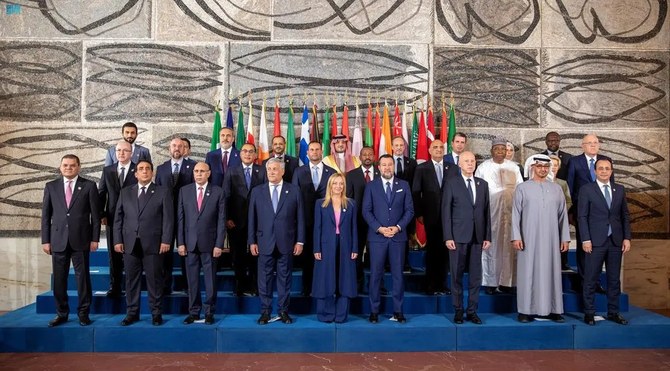

ROME: Pope Francis has appealed to European and African leaders “for urgent relief” for refugees, saying that help is needed for “these brothers and sisters” suffering while trying to reach Europe.
“May the Mediterranean never again be a theater of death and inhumanity. May the Lord enlighten the minds and hearts of all, arousing feelings of fraternity, solidarity and welcome,” the pope told worshippers in St. Peter’s Square on Sunday.
The pontiff’s comments come as top representatives of European, Mediterranean and Middle Eastern countries gather in the Italian capital to discuss tackling illegal migration, including extending an EU-backed deal with Tunisia to curb the flow of asylum-seekers to European shores.
Italian Prime Minister Giorgia Meloni on Sunday inaugurated a “dialogue of equals” forum on migration and development based on joint interests between Europe and countries in the broader Mediterranean region.
The conference, which seeks to address irregular migration and promote growth in North Africa, was announced by Meloni during one of her three trips to Tunisia in the past month.
EU Commission President Ursula von der Leyen and Tunisian President Kais Saied are among participants in the forum, which will be held at the Italian Ministry of Foreign Affairs amid high security.
High-ranking representatives from North African and Middle Eastern countries include the presidents of the UAE and Mauritania, and prime ministers from Algeria, Libya, Egypt, Ethiopia, Jordan, Lebanon, Malta and Niger.
Greece, Turkiye, Saudi Arabia and Kuwait have sent ministers to the talks.
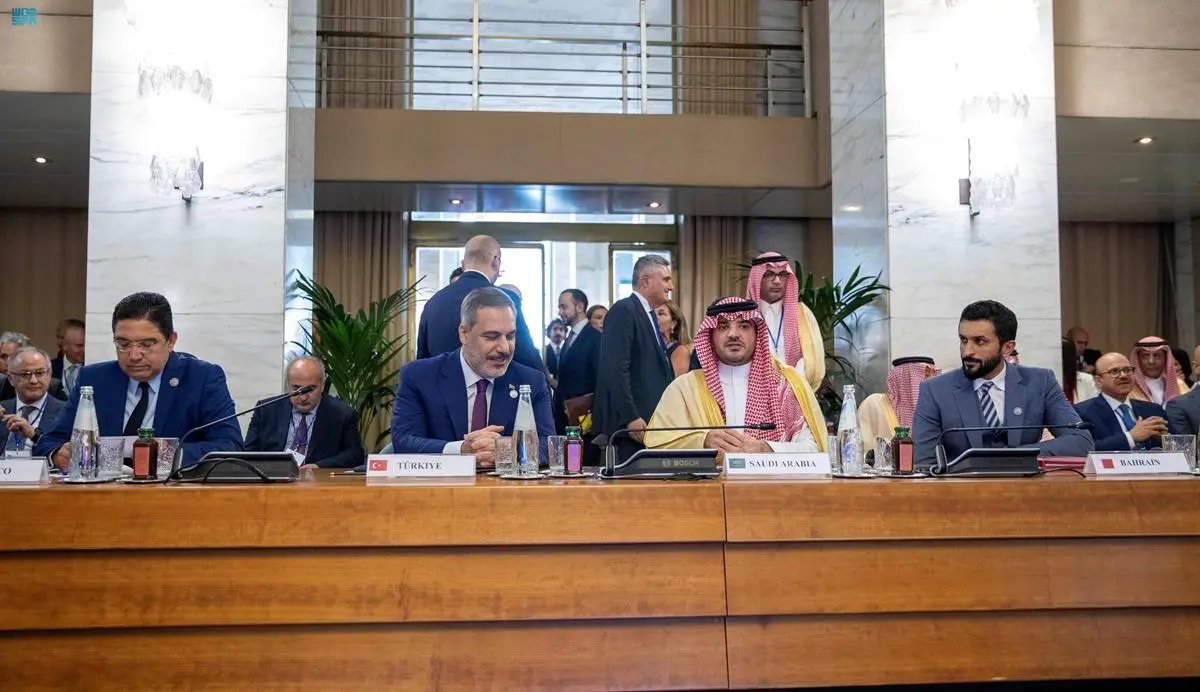
Top representatives of European, Mediterranean and Middle Eastern countries gathered in the Italian capital to discuss tackling illegal migration. (SPA)
Prince Abdulaziz bin Saud, the Saudi interior minister, represented the Kingdom at the conference.
Speaking on behalf of King Salman and Crown Prince Mohammed bin Salman, Prince Abdulaziz highlighted Saudi Arabia’s commitment to upholding human rights norms and advancing sustainable development.
He spoke of the Kingdom’s “unwavering firm stance in favor of international collaboration in addressing all common challenges.”
The prince also highlighted the Kingdom’s support for developing the regular and institutional structure of the national human rights system, labor systems and policies, and promoting labor rights and improving contractual relationships.
Italian Foreign Minister Antonio Tajani said that Italy wants the Mediterranean to be a “sea of peace and progress” rather than a graveyard for those seeking safety and a better life in Europe.
“What we are inaugurating today is, above all, a dialogue between equals, based on mutual respect,” Meloni said in her opening address to the international conference attended by Arab News.
The Italian leader said that between Europe and the larger Mediterranean “there cannot be a competitive or conflictual relationship, because in reality the interests are much more convergent than we ourselves recognize.”
She added: “Mass irregular migration harms everyone except criminal organizations, which use their strength to play with the lives of the most fragile people,” and called for “joint efforts and more cooperation to fight the network of traffickers.”
Meloni said that the international “partnership in tackling illegal migration” with countries of origin “must be equal, multidimensional and long-term,” and “based on respect and not on a paternalistic approach, on solidarity, on respect for each other’s sovereignty, on shared responsibility for upholding legality.”

Prince Abdulaziz bin Saudi with Italian PM Meloni. (SPA)
This “is the only serious way to strengthen our bond, to trust each other, and foster the development and prosperity of our peoples,” she said.
Sources in the prime minister’s office told Arab News that Tunisian leader Saied described the Rome conference as “the beginning of a positive path.”
Tunisia and Italy have a common future, he added.
Libyan Prime Minister Abdul Hamid Dbeibah praised the Italian government for organizing the talks.
“This is the right approach to the problem,” he said in his speech at the event.
Last week, the EU signed an agreement with Tunisia that will provide €105 million ($117 million) in direct European aid to prevent the departure of migrant boats and combat people smugglers.
The deal also provides for more illegal Tunisian immigrants to be repatriated and for sub-Saharan African migrants in Tunisia to be sent back to their countries of origin.
The Rome conference may open the door for the EU to sign a similar agreement with Egypt and Morocco.
“We want our agreement with Tunisia to be a model, a project for the future that can open the way to more partnerships with other countries in the region,” von der Leyen, the European Commission president, said.
“We want to adopt a pragmatic approach based on sharing common interests and values. We want to find tailor-made solutions for local realities.”
According to the UN, more than 100,000 migrants arrived in Europe by sea from the coasts of North Africa, Turkiye and Lebanon in the first six months of 2023.
There were more than 189,000 arrivals last year, with most landing in southern Italy.


