TUNIS: Migrants in Tunisia’s port city of Sfax who are aiming to make Europe their new home are now sharing the burden and the blame for escalating tensions deeply tinged with racism, amid the fears of European leaders who are trying to stanch the numbers of people arriving at their shores.
The antagonism that exploded in recent weeks in Sfax between Tunisians and mainly Black sub-Saharan migrants is widely seen as a turning point in how this North African nation deals with migration.
European leaders are offering millions to Tunisia amid the abuses, and activists fear a migration summit in Rome on Sunday will pursue an anti-migrant vision that puts the onus on Africa to keep Africans out of Europe.
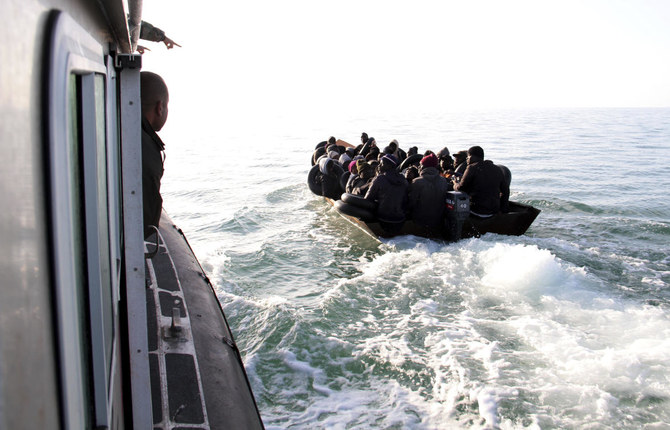
Hundreds of migrants have drowned at sea trying to reach Italy in fragile boats, but now migrants awaiting their chance to cross the Mediterranean cower in fear, some beaten or bused by authorities to new destinations, others dumped in the desert.
Musa Khalid from Congo was among a group of migrants expelled from Tunisia and found by Libyan border guards huddling in a barren zone last weekend. He said that Tunisian officials took their belongings and money before transferring them out of the Tunisian port city of Sfax and dropping them off without food or water.
“As we tried to enter Tunisia again, they beat us badly. They broke my hand and hit my head,” he told the Associated Press near the Al Assa border point in Libya, holding up a wrist wrapped in cloth. “We are in the desert now for several days. Sir, please.”
Human rights activists from North Africa, West Africa and Europe met in Tunis this week and denounced the upcoming Rome meeting, predicting that it will amount to a bartering of values for financial incentives to stave off migrants from European shores.
“Today, the Mediterranean’s calling is no longer to be a bridge between two shores, but a wall separating all of Europe from all of the African continent,” said the Tunisian Forum for Economic and Social Rights, which organized the Thursday meeting.
Italy is trying to decrease the number of migrant arrivals and stabilize Tunisia, in its worst economic crisis in a generation. Thousands of migrants have arrived in Sfax this year, but there’s no solid figure of how many are in the city, or how many have left since the anti-migrant campaign started.
Tunisia has become the main stepping stone to Italy, Europe’s gateway, replacing Libya, where widespread abuse of migrants has been reported. Of the 76,325 migrant arrivals in Italy so far this year until last Sunday, 44,151 took the sea route from Tunisia compared to 28,842 leaving from Libya, according to the UN High Commissioner for Refugees.
That is pushing up numbers in the reception center in Italy’s southernmost island of Lampedusa, with officials saying 2,500 people were at the site on Sunday following the arrival of 266 overnight.
President Kais Saied, Tunisia’s increasingly authoritarian leader, stoked racist reactions to migrants in February, saying that sub-Saharan Africans arriving in huge numbers are part of a plot to erase Tunisia’s Islamic identity. He has since tried to walk back such pronouncements, denying racist views and saying the migrant issue must be treated at its roots.
That’s one intent of the Rome conference, which will gather nearly 20 heads of state and government or ministers from the Middle East to the Sahel and North Africa, along with European Commission chief Ursula von der Leyen and an array of financial institutions.
The one-day summit is part of Italian Premier Giorgia Meloni’s efforts to position Italy at the center of issues impacting the Mediterranean. The conference aims to come up with concrete proposals to decrease migration numbers by addressing the root causes, while combating migrant trafficking. It will also discuss energy policies, including ways to diversify energy sources, and climate change.
It’s widely viewed by human rights advocates as a road map for what is to come.
The Rome summit comes a week after Saied signed a memorandum of understanding for a “comprehensive strategic partnership” in a meeting that included Meloni and von der Leyen. Financial details weren’t released, but the EU has held out the promise of nearly 1 billion euros ($1.1 billion) to help restart Tunisia’s hobbled economy, and 100 million euros ($111 million) for border control as well as search and rescue missions at sea and repatriating immigrants without residence permits.
Despite signing the deal, the Tunisian president has stressed in the past that Tunisia won’t become Europe’s border guard or serve as a land of resettlement.
Human rights organizations say that bartering money for lives is a betrayal of values. For some opponents, such deals are a new form of neo-colonialism.
“The EU risks not only perpetuating (human rights abuses) but also emboldening repressive rulers, who can brag about warmer relations with European partners while claiming credit for securing financial support for their failing economies,” New York-based Human Rights Watch said ahead of the Rome summit.
With high hopes smashed, migrants cower in fear of the anti-migrant backlash that has forced many from their shelters in Sfax and onto buses to unknown parts.
Tunisian security forces had dumped at least 500 migrants in the desert border zone with Libya earlier this month, but they were transferred July 10 to other regions of Tunisia, according to the Red Crescent.
Some were forgotten.
Libyan border guards said on June 16 that in the past few days they had found at least six men and women and children stranded under temperatures above 40 C (104 F). That is in addition to a group they came across that day, when they rescued migrants who had been huddling in the hot desert for several days near the Al Assa border point. The scene was filmed by The Associated Press.
“There are people affected as a result of the cruelty and beating ... by Tunisian border guards,” said commander of Al-Assa Desert Border Guard, Maj. Ayman Al-Qadri, carefully adding that he was citing migrants’ statements.


Migrants face misery in Tunisia

https://arab.news/6xs5h
Migrants face misery in Tunisia
- European leaders are offering millions to Tunisia amid the abuses
- Activists fear a migration summit in Rome on Sunday will pursue an anti-migrant vision that puts the onus on Africa to keep Africans out of Europe


Sudan defense minister dismisses ‘intelligence document’ as fabrication after convoy strike
- Gen. Hassan Kabroun tells Arab News claims that army hid weapons in aid convoy are “completely false”
RIYADH: Sudan’s defense minister has firmly denied reports attributed to Sudanese intelligence alleging that a convoy targeted in North Kordofan was secretly transporting weapons under the cover of humanitarian aid.
Gen. Hassan Kabroun described the claims as “false” and an attempt to distract from what he called a militia crime.
The controversy erupted after news reports emerged that a document attributed to Sudan’s General Intelligence Service claimed the convoy struck in Al-Rahad on Friday was not a purely humanitarian mission, but was instead carrying “high-quality weapons and ammunition” destined for Sudanese Armed Forces units operating in the state.
The report further alleged that the convoy had been outwardly classified as humanitarian in order to secure safe passage through conflict zones, and that the Rapid Support Forces had destroyed it after gathering intelligence on its route and cargo.
Kabroun categorically rejected the narrative.
“First of all, we would like to stress the fact that this news is false,” he told Arab News. “Even the headline that talks about the security of the regions, such as Al-Dabbah, is not a headline the army would use.”
He described the document as fabricated and politically motivated, saying it was designed to “cover up the heinous crime they committed.”
The minister affirmed that the area targeted by drones is under full control of the Sudanese Armed Forces and does not require any covert military transport.
“Second, we confirm that the region that was targeted by drones is controlled by the army and very safe,” Kabroun said. “It does not require transporting any military equipment using aid convoys as decoys because it is a safe area controlled by the army, which has significant capabilities to transport humanitarian aid.”
According to the minister, the Sudanese military has both the logistical capacity and secure routes necessary to move equipment openly when needed.
“The army is professional and does not need to deliver anything to Kadugli or Dalang on board aid convoys,” he said. “The road between Dalang and Kadugli is open. The Sudanese forces used that road to enter and take control of the region. The road is open and whenever military trucks need to deliver anything, they can do so without resorting to any form of camouflage.”
Kabroun further rejected any suggestion that the military uses humanitarian operations as cover.
“Aid is transported by dedicated relief vehicles to the areas in need of this assistance,” he said. “Aid is not transported by the army. The army and security apparatus do not interfere with relief efforts at all, and do not even accompany the convoys.”
He stressed that the Sudanese Armed Forces maintains a clear institutional separation between military operations and humanitarian work, particularly amid the country’s crisis.
“These are false claims,” he said. “This fake news wanted to cover up the heinous crime they committed.”
Sudan has been gripped by conflict since April 2023, when fighting broke out between the Sudanese Armed Forces and the Rapid Support Forces, plunging the country into what the United Nations has described as one of the world’s worst humanitarian disasters.
The latest dispute over the convoy comes amid intensified fighting in South Kordofan, a strategically sensitive region linking central Sudan with the contested areas of Darfur and Blue Nile.
The false report suggested that intelligence monitoring had enabled the RSF to strike what it described as a military convoy disguised as humanitarian aid. But Kabroun dismissed that version outright.
“The intelligence agency is well aware of its duties,” he said. “The Sudanese Army has enough weapons and equipment to use in the areas of operations. These claims are completely false.”
He argued that the narrative being circulated seeks to shift blame for attacks on civilian infrastructure and humanitarian movements.
“This shows that they are trying to cover up the atrocities,” he added, referring to the militia.
Kabroun maintained that the army has regained momentum on multiple fronts and remains fully capable of sustaining its operations without resorting to deception.
“The region is secure, the roads are open, and the army does not need camouflage,” he said. “We are operating professionally and transparently.”
“These claims are completely false,” Kabroun said. “The Sudanese Army does not use humanitarian convoys for military purposes.”