

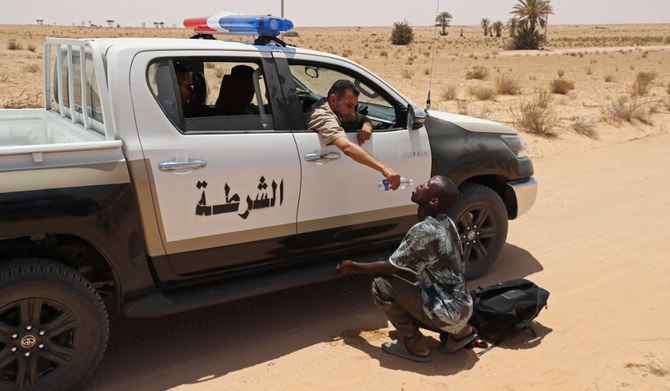

AL-ASSAH, Libya: Libyan border guards have rescued dozens of migrants who have been left in the desert by Tunisian authorities without water and food, and their numbers are “rising,” an officer said Sunday.
Hundreds of migrants from sub-Saharan African countries were forcibly taken to desert and hostile areas bordering Libya and Algeria after racial unrest in early July in Sfax, Tunisia’s second-largest city.
An AFP team at the Libyan-Tunisian border saw migrants who were visibly exhausted and dehydrated, sitting or lying on the sand and using shrubs to try and shield themselves from the scorching summer heat that topped 40 degrees Celsius (104 Fahrenheit).

Migrants from sub-Saharan African countries who claim to have been abandoned in the desert by Tunisian authorities without water or shelter, sit in an uninhabited area near Libya's border town of Al-Assah on July 16, 2023. (AFP)
The group were in an uninhabited area close to Al-Assah, a town near the Tunisia-Libya border, nearly 150 kilometers (93 miles) west of Tripoli.
“The number of migrants keep rising every day,” said Mohamad Abou Snenah of the border patrol unit, telling AFP they have rescued “50 to 70 migrants.”
“We offer them medical attention, first aid, considering the journey they have made through the desert.”
At a reception center, AFP correspondents saw a group of women and children, including toddlers, lying on mattresses and eating yogurt.
Ivorian migrant Abou Kouni, who arrived in Tunisia seven years ago, said he was apprehended on the street last week and put on a truck along with his wife.
He told AFP he was “hit” in the torso and back and that policemen had threatened to kill him.
Tunisia police, according to Abou Kouni, “said they are going to throw us in Libya” and told him: “We don’t need you in Tunisia.”
In a video posted online, one officer can be heard saying: “Do you see them? It’s sad. They are being expelled from Tunisia to Libya.”
The video also shows a migrant rescued from the border area on Saturday, saying that “Tunisian police deported us to Libya.”
Ibrahim, a Congolese migrant who used to live in the Tunisian city of Zarzis, told AFP he was stopped on the street on his way back from work.
“They dropped us in the desert,” he said. “We’ve been in the desert for many days. We saw a shepherd who gave us bread and water.”
Hundreds of migrants fled or were forced out of Tunisia’s Sfax after racial tensions flared following the July 3 killing of a Tunisian man in an altercation between locals and migrants.
The port of Sfax is a departure point for many migrants from impoverished and violence-torn countries seeking a better life in Europe by making a perilous Mediterranean crossing, often in makeshift boats.
In Libya, human traffickers have long profited from the chaos since the 2011 overthrow of strongman Muammar Qaddafi, and the country has faced accusations over migrant abuse.
Tunisian rights groups said on Friday that between 100 and 150 migrants, including women and children, were still stuck on the border with Libya.
The Tunisian Red Crescent said it has provided shelter to more than 600 migrants who had been taken after July 3 to the militarised zone of Ras Jedir north of Al-Assah on the Mediterranean coast.
In Tunisia’s west, near the Algerian border, about 165 migrants abandoned near the border with Algeria had been picked up, the Tunisian Forum for Economic and Social Rights (FTDES) said on Friday, without specifying by whom or where they were taken.


