

Kabul denies Daesh fighters making inroads into Afghanistan, warns Iran against raising ‘false alarms’

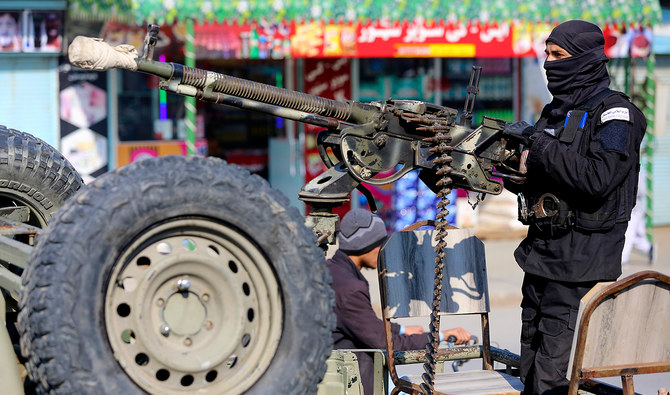
A Taliban soldier stands guard on a vehicle outside a mosque in Jalalabad on February 6, 2023. (AFP/File)
Short Url
Updated 22 July 2023
Follow

Kabul denies Daesh fighters making inroads into Afghanistan, warns Iran against raising ‘false alarms’

  • Development comes after Iranian FM said shifting of Daesh affiliates had become a challenge for Afghanistan’s Taliban rulers
  • Afghanistan’s foreign ministry spokesman asks Tehran to provide evidence to support claims, focus on constructive relations

KABUL: Afghanistan’s foreign ministry on Saturday denied Iranian allegations about the transfer of Daesh fighters to the landlocked country from Iraq, Syria and Libya, warning Tehran against raising “false alarms” with regard to Afghanistan.

The statement came a day after the Iranian foreign minister, Amir Hossein Abdollahian, said the shifting of Daesh leaders and fighters of Daesh, or the so-called Islamic State (IS), had become one of the main challenges of the interim Afghan government. He raised concerns that any instability in Afghanistan would directly affect the border region between the two countries.

Abdul Qahar Balkhi, a spokesman for the Afghan foreign ministry, rejected the Iranian foreign minister’s allegation and said Afghanistan’s Taliban authorities had meticulously fought against Daesh both during and after the end of Afghanistan’s “occupation” by the United States-led forces.

BACKGROUND

• The statement came a day after the Iranian foreign minister said the shifting of Daesh leaders and fighters had become one of the main challenges of the Afghan government.

• He also raised concerns that any instability in Afghanistan would directly affect the border region between the two countries.

“If Iran has any intelligence about the Daesh members moving to Afghanistan, we hope that it will share the same so that Afghan security forces can take necessary actions,” Balkhi said in a string of tweets.

“Iranian officials should rather focus on constructive economic, political and social relations between the two neighboring and friendly peoples and countries instead of raising false alarms about Afghanistan.”

Afghanistan would not allow anyone to threaten its national security or use its territory against any state, he reaffirmed.

In his comments, the Iranian foreign minister also voiced concerns about the entry of Afghan refugees into Iran. The comments came months after two Iranian border guards and a Taliban fighter were killed in a shooting near a border post on May 23, which further escalated tensions between the two countries already engaged in a dispute over water rights.

Reached for comment, Suhail Shaheen, who heads the Taliban’s political office in Doha, said the threat of Daesh had been greatly reduced in Afghanistan and group did not have “earthly presence” in the country.

“We also carried out major operations on them,” he told Arab News over the phone. “These talks are being done to create concern, if there are Daesh, then they (Iranian officials) should provide proof of their existence.”

He said the interim Afghan government was busy with the reconstruction of the war-torn country, which was being flocked by “thousands of tourists from different countries.”

“Their safety is our priority... these tourists assure the rest of the world about the peace of our country,” Shaheen said, adding that creating such nuisance was against the “principles of neighborliness.”

“If there is such a thing, they should provide us with evidence through political channels so that we can take serious steps about it and eliminate them.”


Hong Kong election turnout in focus amid anger over deadly fire

Updated 07 December 2025
Follow

Hong Kong election turnout in focus amid anger over deadly fire

  • Security tight as city holds legislative elections
  • Residents angry over blaze that killed at least 159

HONG KONG: Hong Kong’s citizens were voting on Sunday in an election where the focus is on turnout, with residents grieving and traumatized after the city’s worst fire in nearly 80 years and the authorities scrambling to avoid a broader public backlash.
Security was tight in the northern district of Tai Po, close to the border with mainland China, where the fire engulfed seven towers. The city is holding elections for the Legislative Council, in which only candidates vetted as “patriots” by the China-backed Hong Kong government may run.
Residents are angry over the blaze that killed at least 159 people and took nearly two days to extinguish after it broke out on November 26. The authorities say substandard building materials used in renovating a high-rise housing estate were responsible for fueling the fire.
Eager to contain the public dismay, authorities have launched criminal and corruption investigations into the blaze, and roughly 100 police patrolled the area around Wang Fuk Court, the site of the fire, early on Sunday.
A resident in his late 70s named Cheng, who lives near the charred buildings, said he would not vote.
“I’m very upset by the great fire,” he said during a morning walk. “This is a result of a flawed government ... There is not a healthy system now and I won’t vote to support those pro-establishment politicians who failed us.”
Cheng declined to give his full name, saying he feared authorities would target those who criticize the government.
At a memorial site near the burned-out residential development, a sign said authorities plan to clear the area after the election concludes close to midnight, suggesting government anxiety over public anger.
Beijing’s national security office in Hong Kong has said it would crack down on any “anti-China” protest in the wake of the fire and warned against using the disaster to “disrupt Hong Kong.”
China’s national security office in Hong Kong warned senior editors with a number of foreign media outlets at a meeting in the city on Saturday not to spread “false information” or “smear” government efforts to deal with the fire.
The blaze is a major test of Beijing’s grip on the former British colony, which it has transformed under a national security law after mass pro-democracy protests in 2019.
An election overhaul in 2021 also mandated that only pro-Beijing “patriots” could run for the global financial hub’s 90-seat legislature and, analysts say, further reduced the space for meaningful democratic participation.
Publicly inciting a vote boycott was criminalized as part of the sweeping changes that effectively squeezed out pro-democracy voices in Hong Kong. Pro-democracy voters, who traditionally made up about 60 percent of Hong Kong’s electorate, have since shunned elections.
The number of registered voters for Sunday’s polls — 4.13 million — has dropped for the fourth consecutive year since 2021, when a peak of 4.47 million people were registered.
Seven people had been arrested as of Thursday for inciting others not to vote, the city’s anti-corruption body said.
Hong Kong and Chinese officials have stepped up calls for people to vote.
“We absolutely need all voters to come out and vote today, because every vote represents our push for reform, our protection of the victims of  disaster, and a representation of our will to unite and move forward together,” Hong Kong leader John Lee said after casting his vote.
Hong Kong’s national security office urged residents on Thursday to “actively participate in voting,” saying it was critical in supporting reconstruction efforts by the government after the fire.
“Every voter is a stakeholder in the homeland of Hong Kong,” the office said in a statement. “If you truly love Hong Kong, you will vote sincerely.”
The last Legislative Council elections in 2021 recorded the lowest voter turnout — 30.2 percent — since Britain returned Hong Kong to Chinese rule in 1997.