

Monkey business in Pakistan court during smuggling case

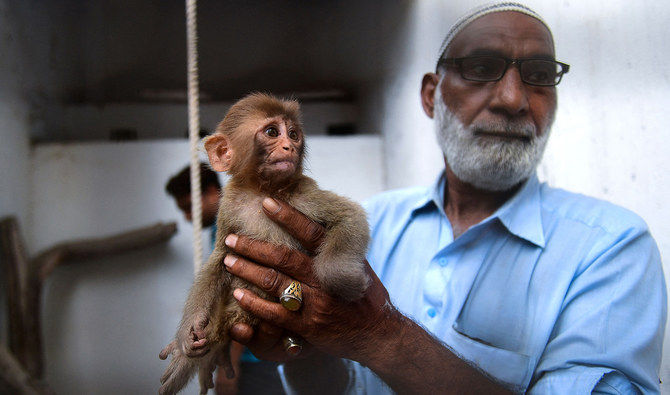
A caretaker holds a monkey at a zoo in Karachi on July 21, 2023, after being recovered from illegal traders. (AFP)
Short Url
Updated 22 July 2023
Follow

Monkey business in Pakistan court during smuggling case

  • Two men were intercepted outside Karachi Thursday trying to smuggle 14 baby monkeys in crates usually used to transport mangos
  • The trade or keeping of wild animals is illegal in Pakistan, but laws are routinely ignored and there is a lively market in exotic pets

KARACHI: A baby monkey caused chaos in a Pakistan court after escaping from a troop presented as evidence in a case of wildlife smuggling, officials said.

Two men were intercepted outside Karachi Thursday trying to smuggle 14 baby monkeys in crates usually used to transport mangos.

But when they were brought to court on Friday, one of the monkeys escaped — causing chaos as staff tried to tempt it down from a tree.

“The monkeys were kept in the boxes in a bad condition... they could hardly breathe,” said Javed Mahar, chief of Sindh Wildlife Department.

The trade or keeping of wild animals is illegal in Pakistan, but laws are routinely ignored and there is a lively market in exotic pets.

Monkeys are frequently kept by street entertainers to attract customers, and in some cases have been trained by criminals to enter houses to steal.

The smugglers were each fined 100,000 rupees (around $350) on Friday and the court ordered the monkeys to be handed over to Karachi Zoo — a step immediately criticized by wildlife officials.

“The monkeys should have been returned to their natural habitat from where they were captured,” Mahar said.

Pakistan’s zoos are notorious for their poor facilities and activists accuse them of disregarding animal welfare.

In 2020, a court ordered the only zoo in the country’s capital to close because of its decrepit state.


Pakistan, Azerbaijan call for de-escalation in the region amid widening Iran conflict

Updated 10 sec ago
Follow

Pakistan, Azerbaijan call for de-escalation in the region amid widening Iran conflict

  • PM Sharif condemns drone strike on the Nakhchivan exclave of Azerbaijan targeting civilians
  • He tells President Ilham Aliyev Pakistan stands in full solidarity with Azerbaijan and its people

PESHAWAR: Pakistan and Azerbaijan called for de-escalation in the region on Friday amid intensifying attacks on Iran by Israel and the United States, a day after drone strikes targeted civilians in Azerbaijan’s Nakhchivan exclave.

The appeal came during a telephone conversation between Prime Minister Shehbaz Sharif and Azerbaijan’s President Ilham Aliyev, according to an official statement, as tensions across the Middle East and the Gulf region continue to rise.

The call followed drone attacks on Thursday that wounded four people in Nakhchivan, an Azerbaijani exclave bordering Iran.

Baku accused Tehran of launching the drones and threatened retaliation, while Iran denied the allegation and blamed Israel — a close ally of Azerbaijan — for attempting to stage a provocation.

“During their conversation, the Prime Minister condemned, in the strongest terms, the drone attacks on Nakhchivan exclave of Azerbaijan yesterday that targeted innocent civilians,” said the statement released by Sharif office after the conversation. “He assured the Azerbaijani leadership that Pakistan stands in complete solidarity and support with the brotherly people of Azerbaijan at this difficult time.”

“The two leaders stressed on the need for de-escalation and restoration of peace in the region,” it added.

Sharif also briefed Aliyev on Pakistan’s diplomatic outreach following the crisis in Iran and the Gulf region.

Aliyev thanked the Pakistani leader for the call and appreciated the expression of solidarity from Pakistan, according to the statement.

Pakistan and Azerbaijan maintain close political and defense ties, with Islamabad also offering Azerbaijan and other Central Asian states connectivity to its southern ports to facilitate trade.

Pakistan has also repeatedly urged all sides involved in the escalating Iran confrontation to avoid further escalation and resolve disputes through dialogue and diplomacy.