

Pakistan, OIC envoys meet UN chief, stress need to outlaw desecration of holy books 

Pakistan and Organization of Islamic Cooperation (OIC) envoys meet UN Secretary-General António Guterres in New York, US, on July 21, 2023. (@OICatUN/Twitter)
Short Url
Updated 22 July 2023
Follow

Pakistan, OIC envoys meet UN chief, stress need to outlaw desecration of holy books 

  • The development comes after an Iraqi immigrant once again desecrated the holy book in Sweden on Thursday 
  • Muslim-majority nations expressed their outrage over the incident, with thousands attending protests on Friday 

ISLAMABAD: Pakistan’s permanent representative to the United Nations and envoys from the Organization of Islamic Cooperation (OIC) members have called on the UN Secretary-General António Guterres, where they stressed the need to outlaw “deliberate acts of provocation” like the desecration of the Holy Qur’an, Pakistan’s UN mission said on Saturday. 

The development came after an Iraqi immigrant, Salwan Momika, who burned the Qur’an outside a Stockholm mosque last month, once again desecrated the holy book on Thursday by stomping on it in a two-man rally outside the Iraqi embassy in Stockholm. 

Muslim-majority nations across the world expressed their outrage on Friday at the desecration of the Qur’an in Sweden, with hundreds of thousands attending street demonstrations following midday prayers to show their anger over the incident. 

Ambassador Munir Akram, Pakistan’s permanent representative, together with envoys from Saudi Arabia, Egypt, Bangladesh and Mauritania called on the UN chief to condemn the recurring act of desecration of the holy book. 

“Ambassador Akram conveyed to the Secretary General that the Parliament of Pakistan has recently adopted a Resolution condemning the despicable act of desecration of the Holy Qur’an in Sweden and handed over a copy of the Resolution,” Pakistan’s UN mission said in a statement. 

“He also underlined the need for those countries, in the light of the Resolution recently adopted by the Human Rights Council on the issue, to outlaw the deliberate acts of provocation such as burning of the Holy Qur’an, which can lead to violence.” 
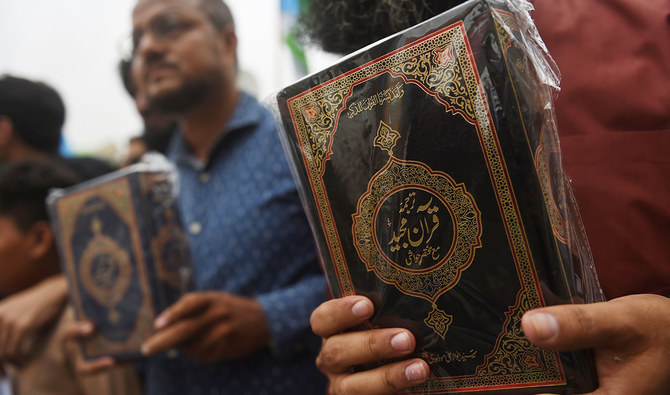


Activists of the right-wing religious Jamaat-e-Islami (JI) party hold copies of the Koran during an anti-Sweden demonstration in Karachi on July 5, 2023, following the burning of the Koran outside a Stockholm mosque that outraged Muslims around the world. (AFP)

The OIC wished for Guterres to adopt a plan of action against Islamophobia, the Pakistani permanent representative conveyed. 

The UN secretary-general referred to the acts of desecration of the Holy Qur’an as “condemnable” and agreed that the resolution adopted by the UN Human Rights Council should be implemented by all members states, according to the statement. 

The resolution, adopted this month, urged countries to “address, prevent and prosecute acts and advocacy of religious hatred” after incidents of Qur’an-burning in Sweden. It was strongly opposed by the US, European Union (EU) and other western countries, which argued that it conflicted with laws on free speech. 

Later, the OIC group met Security Council President Ambassador Barbara Woodward to convey the OIC’s concerns over the “despicable” act. 


Pakistan terms climate change, demographic pressures as ‘pressing existential risks’

Updated 06 December 2025
Follow

Pakistan terms climate change, demographic pressures as ‘pressing existential risks’

  • Pakistan has suffered frequent climate change-induced disasters, including floods this year that killed over 1,000
  • Pakistan finmin highlights stabilization measures at Doha Forum, discusses economic cooperation with Qatar 

ISLAMABAD: Pakistan’s Finance Minister Muhammad Aurangzeb on Saturday described climate change and demographic pressures as “pressing existential risks” facing the country, calling for urgent climate financing. 

The finance minister was speaking as a member of a high-level panel at the 23rd edition of the Doha Forum, which is being held from Dec. 6–7 in the Qatari capital. Aurangzeb was invited as a speaker on the discussion titled: ‘Global Trade Tensions: Economic Impact and Policy Responses in MENA.’

“He reaffirmed that while Pakistan remained vigilant in the face of geopolitical uncertainty, the more pressing existential risks were climate change and demographic pressures,” the Finance Division said. 

Pakistan has suffered repeated climate disasters in recent years, most notably the 2022 super-floods that submerged one-third of the country, displaced millions and caused an estimated $30 billion in losses. 

This year’s floods killed over 1,000 people and caused at least $2.9 billion in damages to agriculture and infrastructure. Scientists say Pakistan remains among the world’s most climate-vulnerable nations despite contributing less than 1 percent of global greenhouse-gas emissions.

Aurangzeb has previously said climate change and Pakistan’s fast-rising population are the only two factors that can hinder the South Asian country’s efforts to become a $3 trillion economy in the future. 

The finance minister noted that this year’s floods in Pakistan had shaved at least 0.5 percent off GDP growth, calling for urgent climate financing and investment in resilient infrastructure. 

When asked about Pakistan’s fiscal resilience and capability to absorb external shocks, Aurangzeb said Islamabad had rebuilt fiscal buffers. He pointed out that both the primary fiscal balance and current account had returned to surplus, supported significantly by strong remittance inflows of $18–20 billion annually from the Middle East and North Africa (MENA) and Gulf Cooperation Council (GCC) regions. 

Separately, Aurangzeb met his Qatari counterpart Ali Bin Ahmed Al Kuwari to discuss bilateral cooperation. 

“Both sides reaffirmed their commitment to strengthening economic ties, particularly by maximizing opportunities created through the newly concluded GCC–Pakistan Free Trade Agreement, expanding trade flows, and deepening energy cooperation, including long-term LNG collaboration,” the finance ministry said. 

The two also discussed collaboration on digital infrastructure, skills development and regulatory reform. They agreed to establish structured mechanisms to continue joint work in trade diversification, technology, climate resilience, and investment facilitation, the finance ministry said.