UN chief says the world is in a new era marked by the highest major power competition in decades

“The time to act is not when the divisions and fractures have engulfed us. The time to act is now,” says UN chief Antonio Guterres. (Reuters)
Short Url
Updated 21 July 2023
Follow

UN chief says the world is in a new era marked by the highest major power competition in decades

  • Guterres presented his grim view of the world in a policy paper outlining his “New Agenda for Peace” to diplomats
  • Says it is the UN’s attempt to address the new threats, and "the time to act is now"

UNITED NATIONS: Secretary-General Antonio Guterres told the world’s nations Thursday that the post-Cold War period is over and the world is moving toward a new multipolar era already marked by the highest level of geopolitical tensions and major power competition in decades.

He warned that these divisions are undermining the cornerstone of the United Nations – having all countries work together to solve global challenges.
The UN chief ticked off a host of challenges — more complex and deadly conflicts, re-emerging concerns about possible nuclear war, growing inequalities within and between countries, widespread terrorism, the climate emergency, mounting distrust in public institutions, and human rights under attack globally “including a pernicious pushback against women’s rights.”
The secretary-general said Russia’s February 2022 invasion of Ukraine has made it even more difficult to address these challenges. And without naming Russia he clearly criticized it, saying if every country fulfilled its obligations under the UN Charter — which include respecting the sovereignty and territorial integrity of all nations – “the right to peace would be guaranteed.”
Guterres presented his grim view of the world in a policy paper outlining his “New Agenda for Peace” to diplomats from the UN’s 193 member states. It is the UN’s attempt to address the new threats, he said.
The UN chief stressed the critical importance of preserving multilateralism, saying: “In our fractured, troubled world, it is incumbent upon states to preserve our universal institution, in which they have a stake.”
“The time to act is not when the divisions and fractures have engulfed us,” he said. “The time to act is now.”
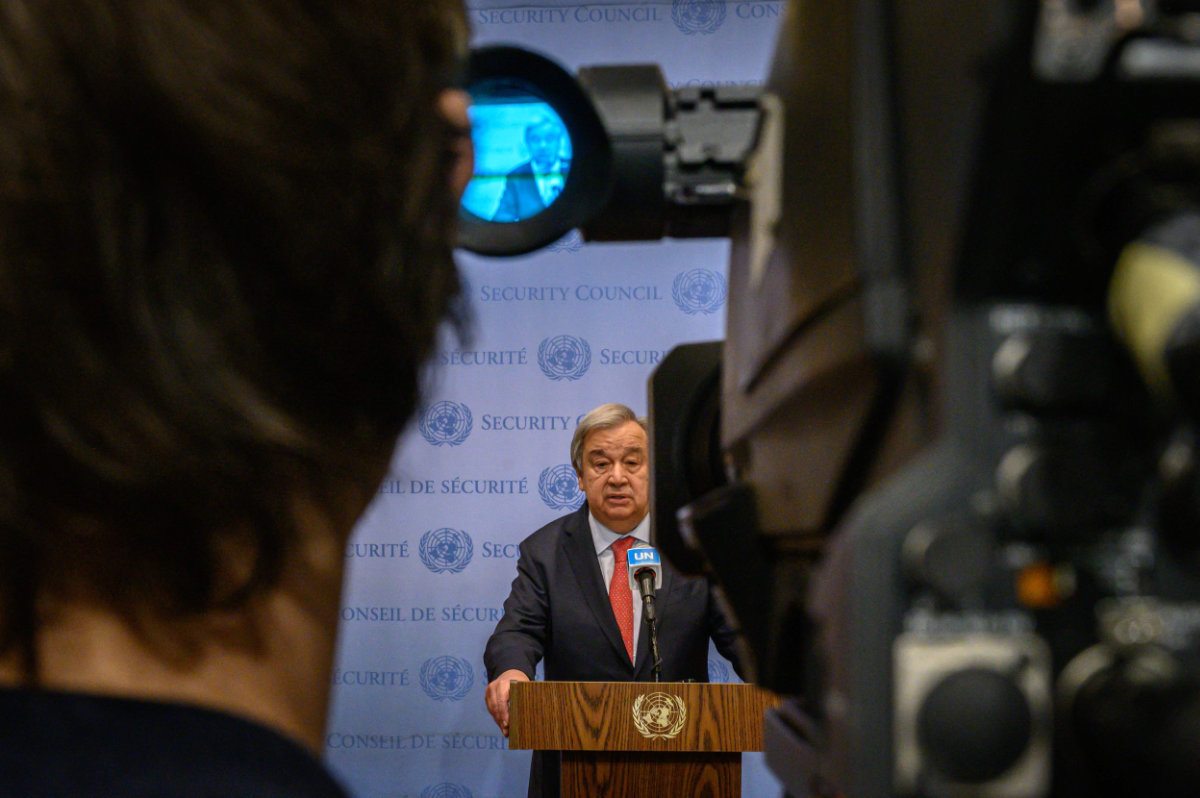


“In our fractured, troubled world, it is incumbent upon states to preserve our universal institution, in which they have a stake," UN chief Antonio Guterres says. (AP)

The original Agenda for Peace was presented by then UN secretary-general Boutros Boutros-Ghali in 1992 following the break-up of the Soviet Union and the end of its Cold War with the United States. It welcomed the end of “hostility and distrust” between the superpowers and outlined how the UN could step up its work on preventive diplomacy, peacekeeping and peacebuilding.
Richard Gowan, UN director for the International Crisis Group, said this vision “of an activist, interventionist UN” has been its underlying policy for the past three decades. But he said Guterres’ “New Agenda for Peace” stresses that “the driving force for a new multilateralism must be diplomacy.”
In an analysis of the new agenda, Gowan said it focuses on what member nations need to do, and on multilateral cooperation in an increasingly fragmented and unequal world “in which Guterres believes that the UN must adapt to facilitating international cooperation, not aim to lead it.”
One of the key areas this proposed new approach is evident is in the secretary-general’s views on the UN’s far-flung peacekeeping operations, especially following the Security Council’s vote on June 30 to immediately end its more than 15,000-strong mission in Mali as demanded by the country’s military junta which has brought in mercenaries from Russia’s Wagner Group to help fight an Islamist insurgency.
Guterres told diplomats that while peacekeepers have saved millions of lives, “longstanding unresolved conflicts, driven by complex domestic, geopolitical and transnational factors, and a persistent mismatch between mandates and resources, have exposed its limitations.” Put bluntly, he said, “peacekeeping operations cannot succeed when there is no peace to keep.”
His proposed peace agenda urges nations to move toward “nimble, adaptable” peacekeeping models with exit strategies, and to support “peace enforcement action by regional and sub-regional organizations,” mandated by the Security Council, paid for by UN member states, and backed by political efforts to promote peace.
“There is no continent in greater need of this new generation of peace enforcement missions than Africa,” Guterres said.
The “New Agenda for Peace” is one of several policy papers the secretary-general is urging all countries to consider before the Summit of the Future he has called in September 2024, where the UN hopes a new vision for the coming years reflecting the world today that preserves multilateralism will be adopted.
After Guterres’ presentation, many countries voiced initial reactions to the proposed agenda with generally strong support from the European Union and others. But Egypt said some proposals are too ambitious and Russia warned against interference in internal affairs and objecting to the agenda’s emphasis on human rights and calling its approach to climate controversial.


US intel did not suggest a preemptive strike from Iran before US-Israeli attacks, AP sources say

Updated 02 March 2026
Follow

US intel did not suggest a preemptive strike from Iran before US-Israeli attacks, AP sources say

  • The official said a variety of factors created a golden opportunity to take out much of Iran’s leadership

WASHINGTON: Trump administration officials told congressional staff in private briefings Sunday that US intelligence did not suggest Iran was preparing to launch a preemptive strike against the US, three people familiar with the briefings said.
The administration officials instead acknowledged there was a more general threat in the region from Iran’s missiles and proxy forces, two of the people said. The third person, however, said the administration emphasized that Iran’s missiles and proxy forces posed an imminent threat to US personnel and allies in the region.
The officials did not provide any clarity about what would happen next in Iran after the joint US-Israeli operation, the two people said. All three people insisted on anonymity to discuss details that have not been made public.
The information conveyed to the congressional staff contrasts with the message from President Donald Trump. “Our objective is to defend the American people by eliminating imminent threats from the Iranian regime. A vicious group of very hard, terrible people,” he said in a video message after launching strikes on Iran.
Senior Trump administration officials, who like others were not authorized to comment publicly and spoke on condition of anonymity, had told reporters Saturday that there were indicators that the Iranians could launch a preemptive attack.
The White House and Pentagon did not immediately reply to requests for comment on Sunday night. Details of the briefing were first reported by Politico.
On Tuesday, Secretary of State Marco Rubio, Defense Secretary Pete Hegseth, CIA Director John Ratcliffe and Gen. Dan Caine, chairman of the Joint Chiefs of Staff, will brief the full membership of Congress on the US military operation against Iran, the White House said Sunday. Rubio also was slated to brief Hill leadership Monday, the same day Hegseth and Caine are planning a press conference about the operation.
Three strikes, three locations, within a single minute
The military operation came after authorities from Israel and the US spent weeks tracking the movements of senior Iranian leaders, including Supreme Leader Ayatollah Ali Khamenei, and shared information that allowed the strikes to be carried out in a surprise daylight attack, according to an Israeli military official and another person familiar with the operation.
The eventual barrage of US-Israeli attacks on Iran came so quickly that they were nearly simultaneous — with three strikes in three locations hitting within a single minute — killing Khamenei and some 40 senior figures, including the head of the paramilitary Revolutionary Guard and the country’s defense minister, the Israeli military official said Sunday.
The official said a variety of factors created a golden opportunity to take out much of Iran’s leadership, like weeks of training and monitoring the movements of senior figures as well as intelligence in real-time before the attack began that key targets were gathered together.
Striking by day also gave an additional element of surprise, said the official, who said so many major, rapid-fire strikes were critical to keep key officials from fleeing after the first strike. The official said Israel closely cooperated with its US counterparts and had used a similar tactic at the beginning of last June’s war — which resulted in the killing of several senior Iranian figures.
The official also noted Khamenei having posted defiant tweets taunting President Donald Trump in the days before the attack.
The details about the strikes came as the conflict entered its second day, with Trump saying in a video message Sunday that he expected it would continue until “all of our objectives are achieved.” He did not spell out what those objectives were.
The Republican president also said the US military and its partners hit hundreds of targets in Iran, including Revolutionary Guard facilities, Iranian air defense systems and nine warships, “all in a matter of literally minutes.”
CIA had long tracked top Iranian leaders
Before the attacks, the CIA had for months tracked the movements of senior Iranian leaders, including Khamenei.
The intelligence was shared with Israeli officials, and the timing of the strikes was adjusted in part because of that information about the Iranian leaders’ location, according to the person familiar with the planning.
The intelligence-sharing between US and Israel reflects the preparation that went into the strikes, which threw the future of the Islamic Republic into uncertainty and raised the risk of escalating regional conflict.
The US regularly shares intelligence with allies including Israel. Those partnerships, and the accuracy of the intelligence they yield, is often critical not only to the success of a military operation but also to the public’s support for it.
Virginia Sen. Mark Warner, the senior Democrat on the committee, told The Associated Press that, historically, “our working relationship with the Mossad and Israel is really strong.” Mossad is the Israeli spy agency.
Warner said he has serious concerns about the justification for the strikes, Trump’s long-term plans for the conflict and the risks that US service members will face. The military announced Sunday that three American troops had been killed in the Iran operation.
“No tears will be shed over their leadership being eliminated, but always the question is: OK, what next?” Warner said.
Iran has signaled it’s open to talks with the US
A senior White House official said Iran’s “new potential leadership” has suggested it is open to talks with the United States. That official, who spoke on condition of anonymity to discuss internal administration deliberations, said Trump has indicated he’s “eventually” willing to talk but that for now the military operation “continues unabated.”
The official did not say who the potential new Iranian leaders are or how they made their alleged willingness to talk known. Separately, Trump told The Atlantic that he planned to speak with Iran’s new leadership.
“They want to talk, and I have agreed to talk, so I will be talking to them,” he said Sunday, declining comment on the timing.