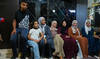
RIYADH: Saudi Arabia’s mathematics Olympiad team won six medals and two honorable mentions at the 35th Asia-Pacific Mathematical Olympiad, which was held online.
The Saudi team of 10 students, represented by the King Abdulaziz and His Companions Foundation for Giftedness and Creativity, known as Mawhiba, and the Ministry of Education, ranked 19 among 35 participating countries that sent 345 students to the event.
Last year, Saudi Arabia received three silver and four bronze medals and was ranked 13 among 35 participating countries.
Student Hadi Al-Aythan, from the Al-Ahsa Education Department, received a silver medal, while his colleagues Ali Al-Ramadan, Mahdi Al-Beik, Moaz Al-Qahtani, Iyad Al-Qatari, from the Eastern Province Education Department, received bronze medals. Mohammed Hafez from the Madinah Education Department received a bronze medal.
Secretary-General of Mawhiba Dr. Amal Al-Hazaa congratulated the students for their achievements and extended her gratitude to Education Minister Yousef bin Abdullah Al-Benyan for his continuous support to Mawhiba, the Saudi Press Agency reported.
Al-Hazaa said that the students in the Mawhiba International Olympiads program undergo intensive training for more than 1,000 hours per year.
Badr Al-Majrathi, Mawhiba’s competitions department manager, told Arab News that prior to the contest, students enroll in the annual Mawhoob science event.
He said they could pick from mathematics, physics, chemistry, biology, or science, and for a Mawhiba student to represent Saudi Arabia they must undertake three years of training.
“For the student to go from one level to the next, which is representing the country internationally, it requires at least three years of preparation. Students receive 800 to 1,000 hours of training per year,” he added.

Mawhiba’s aim was to create an environment for friendly competition and connect students with individuals from other nations who have similar interests.
Al-Majrathi said: “Students are given two tests that have a five-hour duration with four difficult questions per test. Therefore, students have this time to complete the tests that aim to raise competition.
“Its purpose is to link students who are passionate about a particular specialty with each other and introduce them to students from other countries who share the same interest.”
The training sessions are conducted throughout the year at the King Abdullah University for Science and Technology, the Royal Commission for Jubail and Yanbu, Prince Nourah Bint Abdulrahman University and King Saud University.
Mawhiba, in partnership with the Saudi Education Ministry and other bodies, trains gifted public school students in mathematics, physics, biology, chemistry and informatics.
International and local experts train Saudi students every year ahead of their involvement in the APMO.
Started in 1989, the APMO is an international competition that aims to support talented mathematics students in all countries of the Asia-Pacific region.