

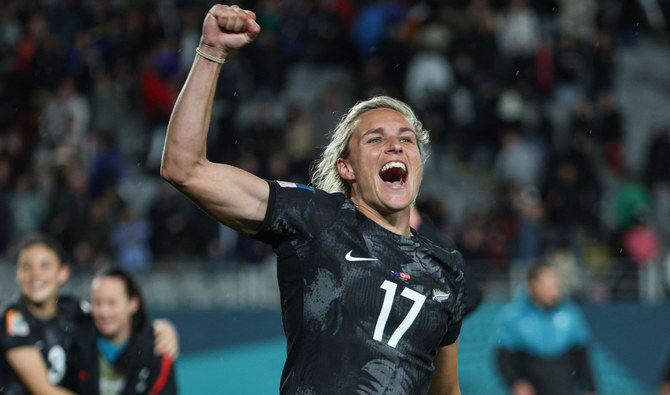

SYDNEY/AUCKLAND: Co-hosts Australia and New Zealand opened the ninth Women’s World Cup with wins and record crowds on Thursday, after a shooting near the Norwegian team hotel in Auckland that left three dead and six injured.
Police said the shooter was among those killed and the danger from the incident was over, while New Zealand Prime Minister Chris Hipkins said there was no risk to national security.
After an opening ceremony celebrating traditional Maori culture including the famous Haka war dance, a stunning goal from Hannah Wilkinson at Eden Park was the difference in the 1-0 victory over Norway.
The crowd of 42,137 bested the host nation’s previous record for an international soccer match.
Authorities deployed extra police and security outside the stadium following the shooting in New Zealand’s largest city.
“Seeing the heavier police presence, I feel a lot safer now knowing that they’re watching out,” said Isabella Beeortegui, a 22-year-old student attending the opening ceremony.
“I’m so excited. The energy is crazy. Everyone looks like they’re super stoked to be here.”
Australia’s Matildas began their campaign with a scrappy 1-0 win against Ireland in front of a crowd of 75,784 fans at Stadium Australia in Sydney — a record attendance for a women’s soccer match in the country.
They were dealt a blow before kickoff, however, when talismanic striker Sam Kerr, arguably the face of the tournament, was ruled out of the first two games with a
calf injury.
Women were banned from official facilities in England, the home of the game, until 1970, and female players faced similar discrimination in many other countries.
But the sport has achieved greater prominence in recent years, with large increases in female players and spectators globally.
Tracey Taylor, a professor of sports management at RMIT University in Melbourne, said many members of grassroots football clubs expected the tournament to have a transformative effect for participation in women’s sport in Australia.
“They say it’s such a game changer for them in positioning the sport, not only globally, but also within the local community and raising awareness,” she said.
Still, conditions for female footballers still remain well behind those for men in many countries.
The Matildas released a video this week criticizing the “disrespect” for the women’s game that forced teams to play on artificial pitches in the 2015 tournament and prize money that still lags the men’s World Cup.
Several participating nations, including tournament heavyweights England and Spain, have been in dispute with their administrators over working conditions and pay in recent months.
Players like Kerr are household names in sport-mad Australia, with tickets for matches involving the home nation selling out months in advance.
“I’m sure that the whole of Australia will be behind the team tonight,” Prime Minister Anthony Albanese said in a radio interview with state broadcaster ABC on Thursday.
“I think that Australians are really realizing just how big this event is.”


