

Ukrainian foreign minister in Islamabad on official visit

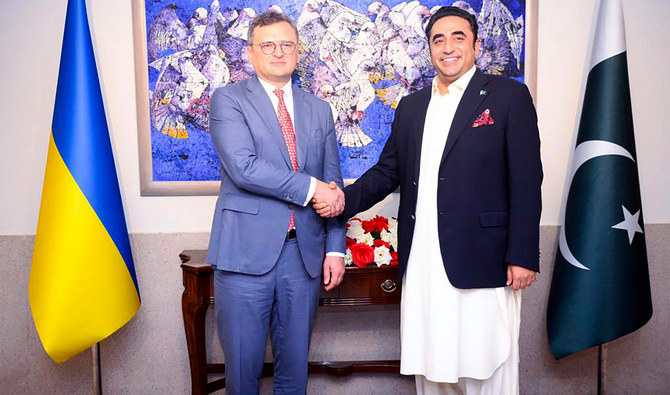
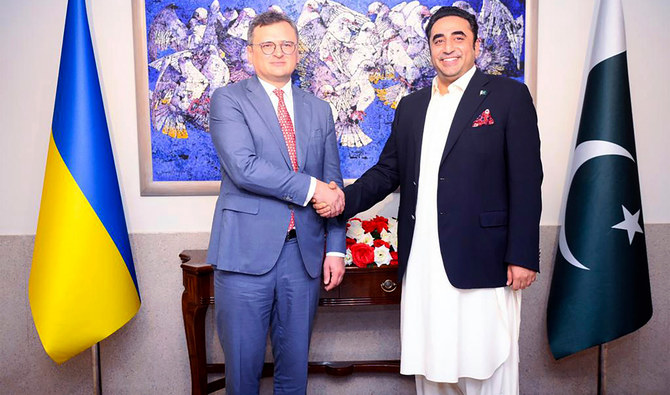
In this handout photo released by Pakistan Foreign Ministry Press Service, Pakistan's Foreign Minister Bilawal Bhutto Zardari, right, shakes hands with Ukraine's Foreign Minister Dmytro Kuleba in Islamabad, Pakistan, on July 20, 2023. (AP)
Short Url
Updated 20 July 2023
Follow

Ukrainian foreign minister in Islamabad on official visit

  • First ever ministerial visit from Ukraine since establishment of diplomatic ties with Pakistan in 1993
  • Pakistan has not condemned Russian invasion of Ukraine but has expressed concern about the war

ISLAMABAD: Foreign Minister of Ukraine, Dmytro Kuleba, on Thursday undertook an official visit to Islamabad, the Pakistani foreign office said and talked about the restoration of the Black Sea grain initiative to meet global food insecurity.

Pakistan has not condemned Russia since it invaded Ukraine last year, though it has expressed concern about the war and called on China and the Organization of Islamic Cooperation (OIC) to mediate the crisis.

“Kuleba will call on the Prime Minister and hold detailed talks with Foreign Minister Bilawal Bhutto Zardari,” FO said in a statement.

This is the first ever ministerial visit since the establishment of diplomatic ties between Pakistan and Ukraine in 1993.

“It is expected to contribute to further strengthening of bilateral ties between the two countries,” the FO said.

Then Pakistani Prime Minister Imran Khan was in Moscow to meet President Vladimir Putin the day Russian forces entered Ukraine on Feb. 24 last year. Both Khan’s administration and the current administration of Prime Minister Shehbaz Sharif, have expressed concern about the repercussions of the invasion but stopped short of condemning it. Khan also hit out at Islamabad-based Western envoys who last year urged Pakistan to condemn Russia’s actions in Ukraine.

Pakistan has also abstained from a UN General Assembly vote that condemned Russia’s aggression against Ukraine.


Pakistan PM briefs parliamentary leaders on Middle East tensions, Afghanistan fighting

Updated 6 sec ago
Follow

Pakistan PM briefs parliamentary leaders on Middle East tensions, Afghanistan fighting

  • Leaders of major parties attend meeting on regional security and Pakistan’s military campaign
  • Government is expected to update lawmakers on diplomatic efforts amid Gulf conflict escalation

ISLAMABAD: Prime Minister Shehbaz Sharif on Wednesday started briefing leaders of parliamentary parties on rising regional tensions, including fighting along the Pakistan-Afghanistan border and the escalating war in the Middle East, according to a statement by his office.

The meeting comes as Pakistan has intensified military operations against the Afghan Taliban and militant groups targeting its civilians and security forces along its western frontier while the wider region faces growing instability after recent US-Israeli strikes on Iran and subsequent attacks across the Gulf.

Sharif decided to convene the session to update political leaders on the security situation and Pakistan’s diplomatic outreach as tensions spread across the region.

“The prime minister will take parliamentary leaders into confidence regarding the Pakistan-Afghanistan situation and the recent tensions in the region, particularly in the Middle East and the Gulf,” Sharif’s office said in a statement.

“The meeting will also highlight Pakistan’s diplomatic efforts during the recent escalation,” it added.

Representatives of major political parties, including the ruling Pakistan Muslim League-Nawaz, Pakistan Peoples Party, Jamiat Ulema-e-Islam, Muttahida Qaumi Movement and other parliamentary groups are attending the meeting.

Pakistan has accused Afghanistan’s Taliban authorities of allowing militant groups such as the Tehreek-e-Taliban Pakistan (TTP) to operate from Afghan territory, allegations Kabul denies. Islamabad says it has targeted militant hideouts across the border after repeatedly raising the issue with Afghan officials.

The briefing also comes as the government closely monitors developments in the Middle East, where regional tensions have heightened concerns about energy supplies and broader security implications for the country.