

Canadian wildfires hit Indigenous communities’ land and culture

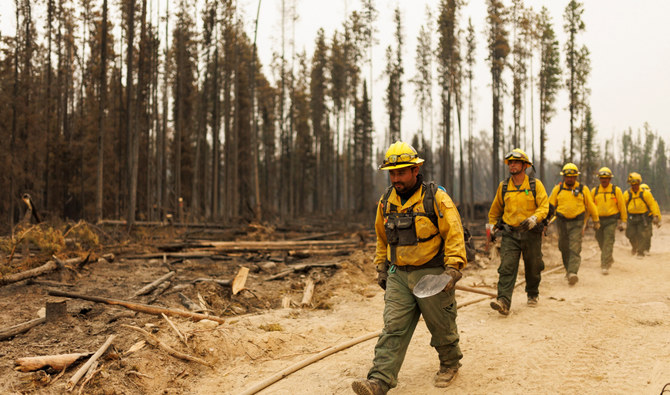
Firefighters from Mexico march along a fire guard as they battle wildfires in British Columbia, Canada, on July 13, that have scorched thousands of sqkm of land. (Reuters)
Short Url
Updated 19 July 2023
Follow

Canadian wildfires hit Indigenous communities’ land and culture

ALBERTA: Carrol Johnston counted her blessings as she stood on the barren site where her home was destroyed by a fast-moving wildfire that forced her to flee her northern Alberta community two months ago.

Her family escaped unharmed, though her beloved cat, Missy, didn’t make it out before a “fireball” dropped on the house in early May. But peony bushes passed down from her late mother survived and the blackened May Day tree planted in memory of her longtime partner is sending up new shoots — hopeful signs as she prepares to start over in the East Prairie Métis Settlement, about 385 kilometers northwest of Edmonton.

“I just can’t leave,” said Johnston, 72, who shared a home with her son and daughter-in-law. “Why would I want to leave such beautiful memories?”

The worst wildfire season in Canadian history is displacing Indigenous communities from Nova Scotia to British Columbia, blanketing them in thick smoke, destroying homes and forests and threatening important cultural activities like hunting, fishing and gathering native plants.

Thousands of fires have scorched more than 110,00 square kilometers across the country so far. On Tuesday, almost 900 fires were burning — most of them out of control — according to the Canadian Interagency Forest Fire Centre website.

Fires aren’t uncommon on Indigenous lands, but they’re now occurring over such a widespread area that many more people are experiencing them at the same time — and some for the first time — stoking fears of what a hotter, drier future will bring, especially to communities where traditions run deep.

“I’ve never seen anything like this,” said Raymond Supernault, chairman of the East Prairie Métis Settlement, where he said more than 85 percent of the 334-square-kilometer settlement burned in the first wildfire there in over 60 years.

Fourteen houses and 60 other structures were destroyed by the intense, fast-moving fire that led to the evacuation of almost 300 people and decimated forested land.

“In blink of eye, we lost so much … it was devastating. I can’t stress that enough,” said Supernault, who said he hasn’t seen any elk or moose, both important food sources, since the fire.

“We don’t just jump in the car and go to the IGA,” for groceries, Supernault said. “We go to the bush.”


’Starting anew’: Indonesians in disaster-struck Sumatra hold Christmas mass

Updated 3 sec ago
Follow

’Starting anew’: Indonesians in disaster-struck Sumatra hold Christmas mass

SOUTH TAPANULI: At a church in Sumatra, dozens of worshippers sang hymns at a Christmas mass, gathered together for their first service since deadly floods swept the Indonesian island.
The Angkola Protestant Church, in the hard-hit South Tapanuli district, was festooned on Wednesday with balloons and simple Christmas decorations.
Outside, the street leading to the building was buried under mounds of debris and foliage.
Many in the congregation are still sheltering at evacuation sites after the disaster wreaked havoc on the island four weeks ago.
Churchgoer Krismanto Nainggolan said this year’s Christmas service was “different,” even as he noted joy in the bittersweet moment.
“The feelings are mixed. Every word of the pastor’s sermon made us want to cry,” he told AFP after the Christmas mass.
“But the spirit of Christmas... gave us strength,” he added.
Krismanto lost his house in the flooding, while many of his neighbors were killed.
According to the National Disaster Mitigation Agency, 1,129 people died, and more than 170 others are still missing.
While the annual monsoon season often brings heavy rain to Indonesia, this month’s deluge was among the worst disasters to strike Sumatra since a magnitude-9.1 earthquake triggered a massive tsunami in 2004.
In South Tapanuli, churchgoer Mea Rosmawati Zebua said she had not expected to be able to celebrate Christmas this year.
“In past years, Christmas was a routine. Now, (we are) very grateful because God still gives us the breath of life,” the 54-year-old told AFP.
While Christmas mass is typically held in the evening, the Angkola church moved its service to Wednesday afternoon ahead of rain forecast in the evening, pastor Yansen Roberto Ritonga said.
To prepare for the first service since the disaster, the church had to remove towering heaps of mud that had been washed inside.
Soldiers and police had helped clear the debris and driftwood.
On Wednesday afternoon, a man rang the church’s bell before the pastor’s entrance, marking the start of the mass.
Around 30 worshippers, each of them holding a lit candle, sung Christmas hymns.
Yansen said this year’s Christmas served as a moment of “reflection” for the congregation.
Churchgoer Krismanto said that despite the widespread damage and the personal cost of the disaster, he chose to see it as a new beginning.
“Our hopes depend solely on God because we are now starting over... our lives are starting anew,” he said.