

Canadian wildfires hit Indigenous communities’ land and culture

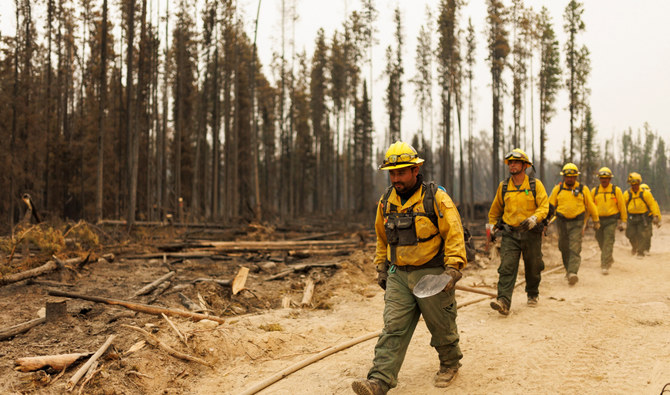
Firefighters from Mexico march along a fire guard as they battle wildfires in British Columbia, Canada, on July 13, that have scorched thousands of sqkm of land. (Reuters)
Short Url
Updated 19 July 2023
Follow

Canadian wildfires hit Indigenous communities’ land and culture

ALBERTA: Carrol Johnston counted her blessings as she stood on the barren site where her home was destroyed by a fast-moving wildfire that forced her to flee her northern Alberta community two months ago.

Her family escaped unharmed, though her beloved cat, Missy, didn’t make it out before a “fireball” dropped on the house in early May. But peony bushes passed down from her late mother survived and the blackened May Day tree planted in memory of her longtime partner is sending up new shoots — hopeful signs as she prepares to start over in the East Prairie Métis Settlement, about 385 kilometers northwest of Edmonton.

“I just can’t leave,” said Johnston, 72, who shared a home with her son and daughter-in-law. “Why would I want to leave such beautiful memories?”

The worst wildfire season in Canadian history is displacing Indigenous communities from Nova Scotia to British Columbia, blanketing them in thick smoke, destroying homes and forests and threatening important cultural activities like hunting, fishing and gathering native plants.

Thousands of fires have scorched more than 110,00 square kilometers across the country so far. On Tuesday, almost 900 fires were burning — most of them out of control — according to the Canadian Interagency Forest Fire Centre website.

Fires aren’t uncommon on Indigenous lands, but they’re now occurring over such a widespread area that many more people are experiencing them at the same time — and some for the first time — stoking fears of what a hotter, drier future will bring, especially to communities where traditions run deep.

“I’ve never seen anything like this,” said Raymond Supernault, chairman of the East Prairie Métis Settlement, where he said more than 85 percent of the 334-square-kilometer settlement burned in the first wildfire there in over 60 years.

Fourteen houses and 60 other structures were destroyed by the intense, fast-moving fire that led to the evacuation of almost 300 people and decimated forested land.

“In blink of eye, we lost so much … it was devastating. I can’t stress that enough,” said Supernault, who said he hasn’t seen any elk or moose, both important food sources, since the fire.

“We don’t just jump in the car and go to the IGA,” for groceries, Supernault said. “We go to the bush.”


Three Afghan migrants die of cold while trying to cross into Iran

Updated 2 sec ago
Follow

Three Afghan migrants die of cold while trying to cross into Iran

AFGHANISTAN: Three Afghans died from exposure in freezing temperatures in the western province of Herat while trying to illegally enter Iran, a local army official said on Saturday.
“Three people who wanted to illegally cross the Iran-Afghanistan border have died because of the cold weather,” the Afghan army official told AFP on condition of anonymity.
He added that a shepherd was also found dead in the mountainous area of Kohsan from the cold.
The migrants were part of a group that attempted to cross into Iran on Wednesday and was stopped by Afghan border forces.
“Searches took place on Wednesday night, but the bodies were only found on Thursday,” the army official said.
More than 1.8 million Afghans were forced to return to Afghanistan by the Iranian authorities between January and the end of November 2025, according to the latest figures from the United Nations refugee agency (UNHCR), which said that the majority were “forced and coerced returns.”
“These mass returns in adverse circumstances have strained Afghanistan’s already overstretched resources and services” which leads to “risks of onward and new displacement, including return movements back into Pakistan and Iran and onward,” UNHCR posted on its site dedicated to Afghanistan’s situation.
This week, Amnesty International called on countries to stop forcibly returning people to Afghanistan, citing a “real risk of serious harm for returnees.”
Hit by two major earthquakes in recent months and highly vulnerable to climate change, Afghanistan faces multiple challenges.
It is subject to international sanctions particularly due to the exclusion of women from many jobs and public places, described by the UN as “gender apartheid.”
More than 17 million people in the country are facing acute food insecurity, the UN World Food Programme said Tuesday.