Pakistan army chief arrives in Iran on maiden visit to discuss defense ties

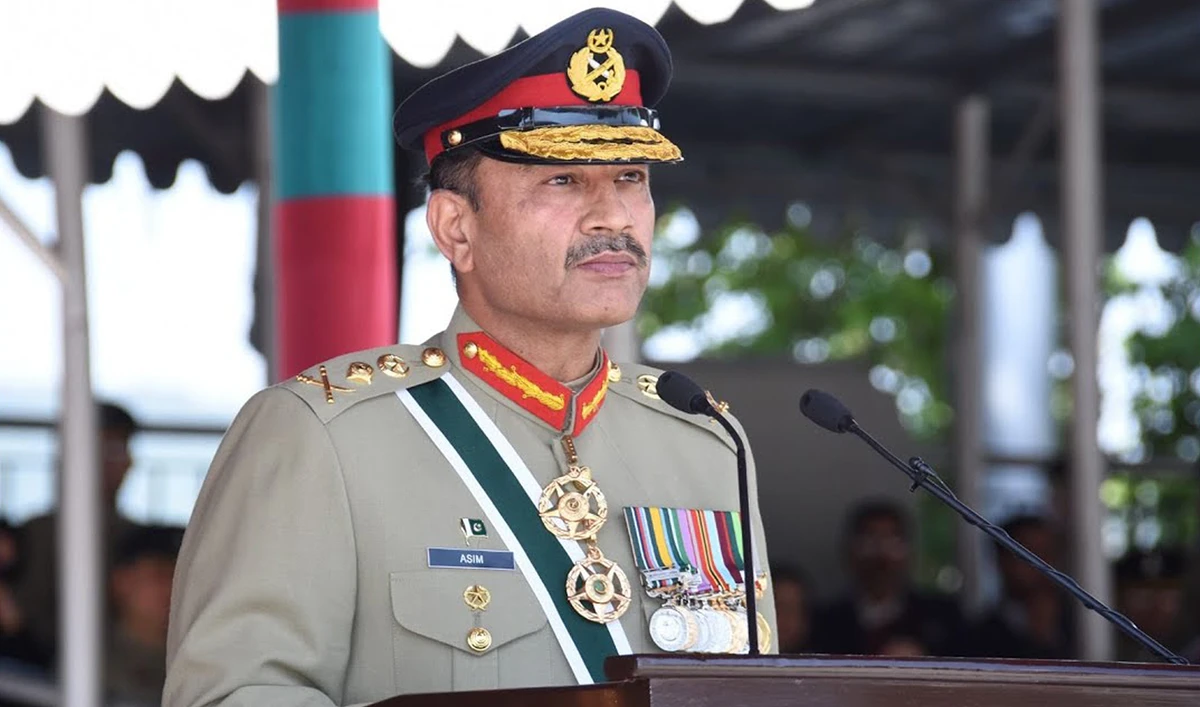
Pakistan army chief General Asim Munir addresses the passing out parade of cadets of the 147th PMA Long Course at the Pakistan Military Academy in Kakul, Pakistan, on April 29, 2023. (ISPR/File)
Short Url
Updated 15 July 2023
Follow

Pakistan army chief arrives in Iran on maiden visit to discuss defense ties

  • General Asim Munir will hold meetings with Iranian civilian and military during his first visit to the neighboring country 
  • This is General Munir’s fifth foreign trip ever since he assumed command of the Pakistan Army in November last year 

ISLAMABAD: Pakistan’s Chief of Army Staff (COAS) General Asim Munir arrived in Iran on Friday on a two-day official visit to discuss defense cooperation, the Pakistani military said. 

The army chief will hold meetings with Iranian civilian and military leadership during his first visit to the neighboring country since assuming office in November last year, according to the Inter-Services Public Relations, the military’s media wing. 

“During the visit, COAS will discuss bilateral matters related to defense and security cooperation,” the ISPR said in a statement. 

Pakistan and Iran share cordial relations based on religious, linguistic, cultural linkages, and spiritual affiliation. The Middle Eastern nation was the first country to recognize Pakistan after independence, while after the 1979 Islamic Revolution of Iran, Pakistan was one of the first countries to accept the new dispensation. 

This is General Munir’s fifth foreign trip ever since he took command of the Pakistan Army. It comes two months after he officially visited China, aiming to enhance bilateral military relations. 

Prior to that, the army chief undertook visits to Saudi Arabia, the United Arab Emirates (UAE) and the United Kingdom (UK). 

Planning minister says Pakistan to set up advanced technology centers to support economic growth

Updated 13 sec ago
Follow

Planning minister says Pakistan to set up advanced technology centers to support economic growth

  • Ahsan Iqbal says planned centers to focus on artificial intelligence, quantum computing and nanotechnology
  • He also cites satellite technology as key tool for climate monitoring, early warning and disaster management

ISLAMABAD: Pakistan plans to set up technology Centers of Excellence, including facilities focused on quantum computing and nanotechnology, as it seeks to benefit from rapid advances in artificial intelligence and emerging technologies, state media reported on Friday.

The announcement was made by Planning and Development Minister Ahsan Iqbal, who said the government aims to position Pakistan to compete in future technologies that are expected to drive economic growth and reshape global industries.

Quantum computing, which uses the principles of quantum mechanics to process information far more quickly than conventional computers, has applications ranging from complex data analysis and cryptography to climate modeling and materials science. Nanotechnology focuses on engineering materials at the molecular level and is widely used in energy storage, medicine and electronics.

Addressing a ceremony in Islamabad, Iqbal said countries that master artificial intelligence, robotics, quantum computing and space technologies would lead the global economy in the coming decades.

“During the address, the minister said Pakistan’s efforts to align itself with rapid advancements in artificial intelligence, robotics, space innovation and emerging technologies reflect the country’s ambition to participate confidently in shaping the future,” Radio Pakistan reported.

“Ahsan Iqbal further announced that the government plans to establish three Centers of Excellence, including a National Center for Quantum Computing and a National Center for Nanotechnology, aimed at upgrading the national economy,” it added.

He informed the ceremony that measures were underway to develop a new Silicon Valley in Pakistan “to promote cross-fertilization of ideas and innovation by bringing talent, research and industry together under one roof.”

The minister also highlighted the role of technology in tackling climate challenges, noting that satellite systems are increasingly used worldwide for disaster management, early warning systems and climate monitoring.

Pakistan, one of the world’s most climate-vulnerable countries, can benefit from satellite technology to track weather patterns, manage floods and improve disaster preparedness, he said, adding that more than 9,000 satellites currently orbit the Earth and are transforming how economies and governments operate.

Iqbal said the planned centers would support Pakistan’s broader “Uraan Pakistan” vision, which focuses on exports, digital development, energy and infrastructure, environmental resilience and social equity, Radio Pakistan reported.