

Rescuers evacuate 14,000 people from flood-hit villages in eastern Pakistan

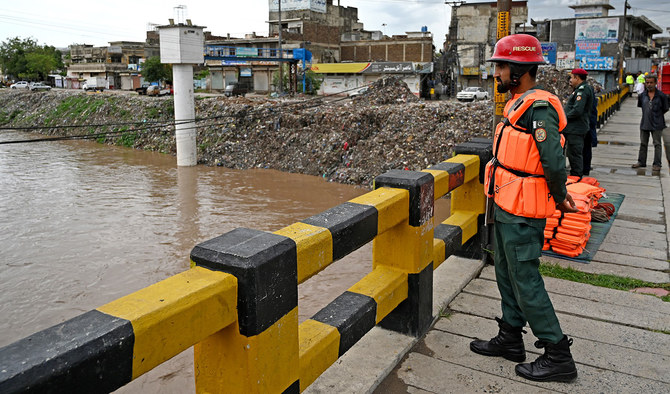
Rescue workers monitor the flood situation at a bridge over a stream in Rawalpindi, Pakistan, on July 7, 2023. (AFP)
Short Url
Updated 14 July 2023
Follow

Rescuers evacuate 14,000 people from flood-hit villages in eastern Pakistan

  • Monsoon rains began lashing the South Asian country in late June and have so far claimed at least 91 lives
  • Evacuations began earlier this week after India released water in the Ravi River which flows into Pakistan

LAHORE: Rescuers in boats evacuated 14,000 people over the past several days after floodwaters from two rivers swollen by monsoon rains inundated dozens of villages in eastern Pakistan, officials said Friday.

Monsoon rains began lashing the South Asian country in late June and since then, at least 91 people have died in weather-related incidents across the country.

Mohsin Naqvi, a top official in eastern Punjab province, tweeted Friday that he visited flood-hit areas. The evacuations began earlier this week after neighboring India diverted waters from dams into the Ravi River, which flows from India into Pakistan. An overflowing Sutlej River has also inundated villages in various parts of the province.

According to the national weather agency, rains will continue this week to lash the southwestern Balochistan and southern Sindh provinces, where thousands died in floods last summer.

The floods affected 33 million people and killed 1,739 in Pakistan. They also caused $30 billion in damage to the country’s economy.

The monsoon season began in July and will continue until September.


Pakistan plans $80 million seafood zone at Karachi harbor to target Gulf markets

Updated 45 min 51 sec ago
Follow

Pakistan plans $80 million seafood zone at Karachi harbor to target Gulf markets

  • Plan aims to move exports away from raw seafood toward higher-value processed products
  • Project will be developed under public-private partnership or build-operate-transfer model

KARACHI: Pakistan plans to develop a seafood processing and export zone at Karachi’s Korangi Fisheries Harbor that could cost up to $80 million to boost value-added exports and position the country as a supplier to the Gulf and other regional markets, Maritime Affairs Minister Muhammad Junaid Anwar Chaudhry said on Saturday.

The proposed 100-acre project aims to shift Pakistan away from exporting raw seafood by building modern processing, cold-chain and packaging infrastructure linked to international buyers, as Islamabad looks to expand its blue economy and deepen maritime trade ties with the region.

In a statement, Chaudhry said the zone would be developed, financed and operated under a public-private partnership or build-operate-transfer (BOT) model, with private investors running the facilities and the Qur’angi Fisheries Harbor Authority retaining regulatory oversight.

“The estimated project cost ranges between $60 million and $80 million, based on regional benchmarks from countries such as Vietnam, China and Ecuador, which have developed similar seafood parks,” Chaudhry said.

He said the facility would include 20 to 25 medium- to large-scale seafood processing units for fish, shrimp and cephalopods, alongside large-scale cold storage, blast freezing, packaging facilities, logistics and export terminals, and a wastewater treatment plant to ensure environmentally compliant operations.

“Packaging and labeling units would operate under international food safety and quality standards, including HACCP and ISO certifications, offering vacuum packing, modified atmosphere packaging and retail-ready solutions,” he said, referring to Hazard Analysis and Critical Control Points, a preventive food safety system.

ISO certification verifies that a company’s management systems meet international standards.

The minister said the zone would be used exclusively for commercial seafood processing, packaging, cold storage and export-oriented activities, with multi-temperature storage ranging from minus 18 to minus 40 degrees Celsius and ice plants capable of producing 50 to 100 tons daily.

Chaudhry said the preferred investment structure is a BOT concession under which the private partner would finance, develop and operate the project for an expected 20-year tenure, with ownership reverting to the harbor authority at the end of the concession period.

He added that the estimated internal rate of return was projected between 13 percent and 17 percent, with revenue generated through lease rentals, processing fees, logistics services and export-linked earnings.

“The project will position Pakistan as a key maritime trade and seafood export hub serving Gulf, East African and Asian markets,” Chaudhry said.