

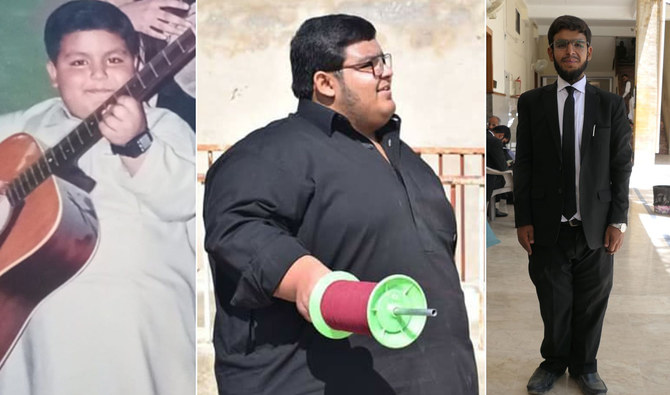
Pakistani lawyer sheds 100kg to fit into quintessential black coat

The undated photo collage shows Ahmed Yar Hamayun through different phases of his life. (Photo courtesy: Ahmed Yar Hamayun)
Short Url
Updated 14 July 2023
Follow

Pakistani lawyer sheds 100kg to fit into quintessential black coat

  • Ahmed Yar Hamayun lost the weight in 20 months through regime of diet and exercise
  • Hamayun started gaining weight at age five, put on so much it was difficult for him to walk 

QUETTA: Ahmed Yar Hamayun nodded and smiled as he interacted with lawyers at a district court in the southwestern Pakistani city of Quetta earlier this week, exuding calm and confidence in his well-fit black suit.

For most lawyers, wearing a black coat, widely considered a kind of uniform for attorneys, is nothing out of the ordinary. 

But for Hamayun, fitting into a tailor-made suit was the culmination of a long journey — one that required chasing a dream and losing 100 kilograms in 20 months to make it come true. 

“[While pursuing my law degree] in 2020, I saw my friends discussing the lawyers’ professional black uniform, but it made me depressed [that] how would I be able to wear the uniform with my excessive weight,” Hamayun, who used to weigh 165 kilograms, told Arab News.

“I was very much passionate about becoming a lawyer, and this profession brought a turning point in my life where I succeeded in shedding 100 kilograms to shape my body and carry my uniform.”

Hamayun started gaining weight when he was only five years old, putting on so much that it even hampered his ability to walk on his own. Fat shaming by classmates and neighborhood kids didn’t make things any easier.

“Some of his friends used to make fun of him,” Hamayun’s father Hamayun Sabir told Arab News. “Classmates and neighborhood boys used to tease him. So, definitely, we were under a little mental stress.”

Barrister Muzaffar Azam Umrani, who taught law at Quetta’s City School of Law, recalled how worried the young lawyer’s friends and teachers were about his weight hindering his professional life as it was difficult for him to even walk.

“Today, losing weight has become a tough practice for many people in our society but Ahmed Yar has worked really hard and set an example for us all, that if you stick to the correct diet,” Umrani said.

Indeed, though his family turned to doctors and religious scholars to find a solution to Hamayun’s weight problem, ultimately, the young man brought about the remarkable transformation himself by following a strict diet plan. 

He stuck to one meal a day on most days, did not eat wheat for over two years, went to the gym two hours daily and played badminton frequently. He downloaded a calories counter on his cellphone to track his food intake and also relied on fitness apps on his mobile phones, and turned to pages on Facebook and other social media platforms for guidance.

All of this, he said, was guided by the “burning desire” to one day fit into a lawyer’s coat. 

“Obviously, when I wear the lawyer’s uniform over my transformed body, I feel very blessed and I always say thanks to Allah, who helped me in achieving my goal,” he said.

And Hamayun isn’t the only one beaming with joy.

“Today, when I see my son wearing the lawyer’s uniform and going to court,” his father said, “it gives me immense pleasure.”


Pakistan top military commander urges ‘multi-domain preparedness’ amid evolving security threats

Updated 9 sec ago
Follow

Pakistan top military commander urges ‘multi-domain preparedness’ amid evolving security threats

  • Asim Munir says Pakistan faces layered challenges spanning conventional, cyber, economic and information domains
  • His comments come against the backdrop of tensions with India, ongoing militant violence in western border regions

ISLAMABAD: Pakistan’s top military commander Field Marshal Asim Munir on Tuesday stressed the need for “multi-domain preparedness” to counter a broad spectrum of security challenges facing the country, saying they ranged from conventional military threats to cyber, economic and information warfare.

Pakistan’s security environment has remained volatile following a brief but intense conflict with India earlier this year, when the two nuclear-armed neighbors exchanged missile and artillery fire while deploying drones and fighter jets over four days before a ceasefire was brokered by the United States.

Pakistan has also been battling militant violence in its western provinces of Khyber Pakhtunkhwa and Balochistan, where authorities say armed groups operate from across the border in Afghanistan and receive backing from India. Both Kabul and New Delhi have rejected claims.

The military has also warned that disinformation constitutes a new form of security threat, prompting tighter regulations that critics say risk suppressing dissent. Munir also pointed to a “complex and evolving” global, regional and internal security landscape while addressing participants in the National Security and War Course at the National Defense University (NDU).

“These challenges span conventional, sub-conventional, intelligence, cyber, information, military, economic and other domains, requiring comprehensive multi-domain preparedness, continuous adaptation and synergy among all elements of national power,” he said, according to a military statement.

“Hostile elements increasingly employ indirect and ambiguous approaches, including the use of proxies to exploit internal fault lines, rather than overt confrontation,” he continued, adding that future leaders must be trained and remain alert to recognize, anticipate and counter these multi-layered challenges.

Munir also lauded the NDU for producing strategic thinkers who he said were capable of translating rigorous training and academic insight into effective policy formulation and operational outcomes.