Steadfast implementation of policies ‘critical’ for Pakistan to reduce financing gaps — IMF 

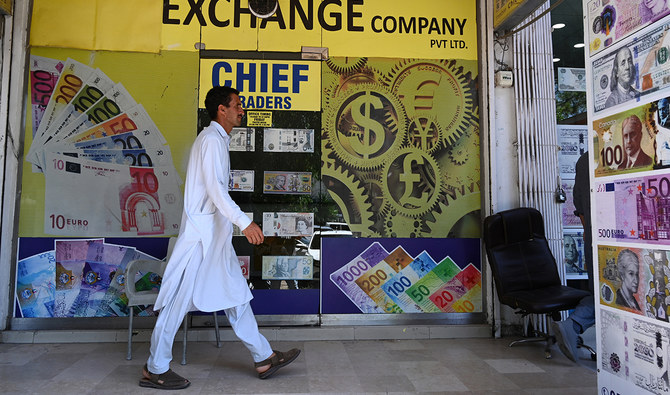
A man walks past foreign currency exchange market in Islamabad on July 11, 2023. (AFP/File)
Short Url
Updated 14 July 2023
Follow

Steadfast implementation of policies ‘critical’ for Pakistan to reduce financing gaps — IMF 

  • The South Asian country has been witnessing an economic meltdown for more than a year 
  • The $4.2 billion inflows from IMF, Gulf states this week provided Pakistan much-needed relief 

ISLAMABAD: The International Monetary Fund (IMF) said on Friday that steadfast implementation of policies was “critical” for Pakistan to stabilize its economy and balance of payments needs, days after the South Asian country negotiated a $3 billion deal with the global lender to avoid a default on its loan obligations. 

Pakistan on Thursday received $1.2 billion from the IMF after the lender approved the crucial bailout that had been stalled since November last year. 

The recent approval of the agreement by the IMF executive board came as a sigh of relief for the cash-strapped South Asian nation, amid concerns that it might default on its external financial obligations. 

But IMF spokesperson Julie Kozack said the stand-by arrangement (SBA) between Pakistan and the IMF came at a challenging juncture and required steadfast implementation of fiscal policies. 

“It (SBA) aims to stabilize the economy & address the needs of the Pakistani people,” she said on Twitter. “Steadfast implementation is critical to address its large financing needs & support the most vulnerable.” 


Along with the IMF funds, Pakistan this week received $2 billion deposits from Saudi Arabia and $1 billion from the UAE on Tuesday and Wednesday, respectively. 

After the latest inflows, Pakistan’s overall foreign exchange reserves are expected to hit the $13-14 billion mark from the $9.8 billion figure recorded on July 7. Pakistan’s official reserves are expected to increase to $8-9 billion. 

Kozack said the relatively shorter program provided time for Pakistan to implement the policies to strengthen its domestic and external economic situation, while supporting sustainability. 

“Of course, resolving Pakistan’s structural challenges will likely require continued reforms over the medium term, underpin the needed economic transformations to strengthen inclusive growth prospects, and to create an environment conducive to renewed private capital inflows,” 

“We, at the IMF, we always stand ready to work with Pakistan and the Pakistani government on these efforts to restore sustainability and economic stability.” 

The South Asian country has been witnessing an economic meltdown for more than a year, with its currency depreciating to record lows against the dollar owing to the low forex reserves. 

Pakistan last year banned imports to prevent the outflow of dollars in a bid to keep the frail economy afloat. 

However, Pakistan’s currency, bonds and stocks rallied on Thursday after the South Asian country managed to secure the much-needed $4.2 billion in funds from the IMF and Gulf states, reflecting a boost in local and international investors’ confidence in Pakistan. 

Pakistan vaccinates over 44 million children as nationwide anti-polio drive enters last day

Updated 4 sec ago
Follow

Pakistan vaccinates over 44 million children as nationwide anti-polio drive enters last day

  • Pakistan kicked off seven-day nationwide anti-polio campaign on Feb. 2 to vaccinate over 45 million children
  • Pakistan reported 31 polio cases in 2025, a significant drop from the alarming 74 cases it reported in 2024

ISLAMABAD: Pakistani health volunteers have vaccinated over 44.1 million children against poliovirus in six days so far, the National Emergency Operations Center (NEOC) said on Sunday as the nationwide campaign entered its last day. 

Pakistan kicked off the seven-day anti-polio campaign on Feb. 2 to vaccinate over 45 million children under the age of five against poliovirus. 

In Punjab, health workers have vaccinated over 22.9 million children, in Sindh 10.4 million, in Khyber Pakhtunkhwa (KP) 7.1 million, in Balochistan 2.324 million, in Islamabad over 455,000, in Gilgit-Baltistan over 261,000 and in Azad Kashmir over 673,000 in the last six days, the NEOC said. 

“In six days, vaccination of more than 44.1 million children has been completed across the country,” the NEOC said in a statement. 

It said over 400,000 trained polio workers are going door-to-door to administer polio drops to children.

“Open your doors for polio workers and ensure your children receive polio drops,” the NEOC said. “Parents and communities are urged to fully cooperate with polio workers.”

Pakistan and Afghanistan remain the only two countries worldwide where polio remains endemic. The NEOC said the anti-polio drive was being conducted simultaneously in both countries. 

Last year, Pakistan reported 31 polio cases, a significant drop from the alarming 74 cases reported in the country in 2024. The South Asian nation reported six cases in 2023 and only one in 2021, but saw a sharp resurgence in 2024.

Pakistan’s polio program began in 1994, but efforts to eradicate the virus have been repeatedly undermined by vaccine misinformation and resistance from some religious hard-liners who claim that immunization is a foreign plot to sterilize Muslim children or a cover for Western espionage.

Militant groups have also frequently targeted polio vaccination teams and the security personnel assigned to protect them, often resulting in deadly attacks, particularly in KP and Balochistan.