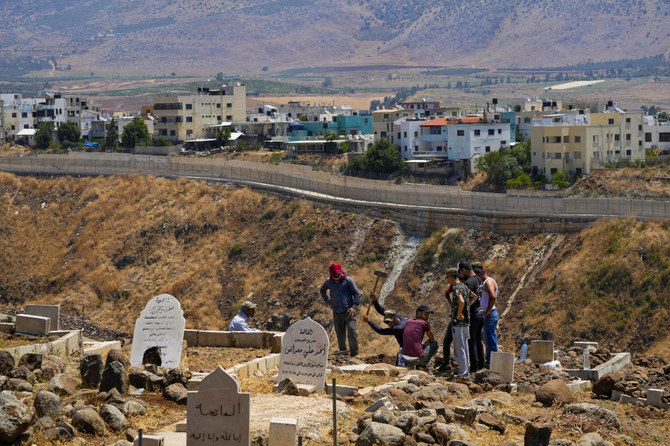
KFAR CHOUBA, Lebanon: The little village of GHajjar has been a sore point between Israel and Lebanon for years, split in two by the border between Lebanon and the Israeli-occupied Golan Heights. But after a long period of calm, the dispute has begun to heat up again.
Israel has been building a wall around the half of the village in Lebanese territory, triggering condemnation from the Lebanese militiant force Hezbollah, accusing Israel of moving to annex the site. A recent exchange of fire in the area raised alarm that the dispute could trigger violence.
The growing tensions over GHajjar add to the jitters along the Lebanese-Israeli border, where Israel and Iranian-backed Hezbollah fought a destructive 34-day war in the summer of 2006. The two sides have studiously avoided outright battle ever since, despite frequent flare-ups of tension — but each constantly says a new conflict could erupt at any time.
The dispute over a small village in the green hills where Lebanon, Israel and Syria meet brings a new point of worry amid broader unrest. The West Bank has seen increased bloodshed the past week, with a major two-day offensive that Israel says targeted Palestinian militants. Within Israel, moves by the hard-right government to overhaul the judicial system have sparked large anti-government protests.
“This is Lebanese land, not Israeli,” said Lebanese shepherd Ali Yassin Diab, pointing to the half of GHajjar being enclosed by the Israeli wall as he grazed his sheep and goats nearby. Members of the UN peacekeeping force UNIFIL watched from a distance. In the early 2000s, Yassin used to take his herds to drink at a pond there but has since been cut off.
The village’s division is an unusual byproduct of the decades of conflict between Israel and its neighbors.
GHajjar was once part of Syria but was captured by Israel in the 1967 Mideast war as part of Syria’s Golan Heights, which Israel occupied and later annexed, with little world recognition.
In the 1980s and 1990s, GHajjar’s population expanded north into nearby Lebanese territory, held by Israel in its 18-year occupation of southern Lebanon. When Israel withdrew from Lebanon in May 2000, UN surveyors delineating temporary borders ruled that GHajjar’s northern part was in Lebanon, its southern part in the Golan, dividing it in two.
Six years later, Israeli troops moved into the northern part of GHajjar during the Israel-Hezbollah war. They have occupied it since and a fence was installed preventing people from entering it from Lebanon. Under the truce that ended the 2006 fighting, Israel agreed to withdraw from GHajjar, but it wanted to clinch an arrangement to keep Hezbollah from entering the village.
In a statement to the Associated Press on Friday, the Israeli Foreign Ministry said Israel recognizes the line dividing the village in 2000 but said that following the division, “Hezbollah established itself in the village” and attempted an abduction of an Israeli soldier.
Most of GHajjar’s around 3,000 residents hold Israeli nationality — some of them alongside Lebanese — and they largely identify as Syrians.
Last year, Israel started erecting a concrete wall around the northern part of the village. It also began encouraging Israeli tourism to the village. In its statement, the foreign ministry said that the wall “is on the same route as the fence that was in place before” around the village.
In apparent reply to the near finishing of the wall, Hezbollah set up two tents nearby, including one in the area of Chebaa Farms, which both Israel and Lebanon claim as its territory. It is not clear what is inside the tents.
Israel filed a complaint with the United Nations, claiming the tents were several dozen meters (yards) inside of Israeli territory. Hezbollah says the tents are in Lebanese territory.
On Monday, UNIFIL’s commander relayed an Israeli request to Lebanon’s caretaker prime minister and parliament speaker to remove the tent. They responded that Israel should withdraw its troops from the Lebanese part of GHajjar, according to Lebanese Foreign Minister Abdallah Bouhabib.
Hezbollah leader Sayyed Hassan Nasrallah said in a speech Wednesday night that Israel cordoned off GHajjar before Hezbollah set up its tents.
“Over the past days, it became clear that they (Israel) have annexed it,” Nasrallah said. He added: “The land of GHajjar will not be left for Israel, and certainly not Chebaa Farms and Kfar Chouba,” another border area claimed by both countries.
A female resident of GHajjar, speaking to the AP on condition of anonymity due to security concerns, said the villagers consider themselves Syrian but their main concern “is to stay in GHajjar, in this village, living in peace and security. No matter under who rules.”
“There is a (border) line that was drawn by the United Nations. Why are they allowed to cross it while we as Lebanese citizens cannot?” Mohammed Rammal, the mayor of the nearby Lebanese border village of Oddeissi, said of Israel’s presence in GHajjar.
Last week, an anti-tank missile was fired from Lebanon near GHajjar, with some fragments landing in Lebanon and others inside Israeli territory. Israel fired shells on the outskirts of the nearby village of Kfar Chouba.
On Wednesday, an explosion elsewhere near the border slightly wounded at least three Hezbollah members. Nasrallah said the case is still under investigation. Late last month, Hezbollah said it shot down an Israel drone flying over a village in southern Lebanon.
On Monday, Prime Minister Benjamin Netanyahu met with President Joe Biden’s special envoy for energy, Amos Hochstein, during which they discussed “regional issues,” according to the Israeli prime minister’s office.
Some Israeli media said Netanyahu and Hochstein, who helped last year broker a maritime border deal between Israel and Lebanon, discussed tensions along the border with Lebanon.
“We continue to monitor and engage with authorities in Lebanon and Israel on the issue of GHajjar,” UNIFIL spokeswoman Kandice Ardiel said. She added that UNIFIL has repeatedly called on Israel to stop its works north of the line and that Israel’s occupation of northern GHajjar violates the UN Security Council resolution that ended the 2006 war.
Israel considers Hezbollah its most serious immediate threat, estimating it has some 150,000 rockets and missiles aimed at Israel.
During a tour by an Associated Press team near GHajjar this week, more patrols by UN peacekeepers and the Lebanese army along the border were visible. Residents in nearby villages appeared defiant and going on with life as usual during the summer season, when many expatriates come to spend time with their families.
In Lebanese media, many analysts say neither side wants a new war. But Lebanese political analyst Faisal Abdul-Sater warned that the situation is very dangerous as Israel and Hezbollah are on alert.
“Whoever fires the first shot will bear the responsibility for the consequences,” he said.
___
AP correspondent Josef Federman contributed to this report.


Moves at a small border village hike Israel-Hezbollah tensions at a time of regional jitters
https://arab.news/8uudy
Moves at a small border village hike Israel-Hezbollah tensions at a time of regional jitters

- The growing tensions over GHajjar add to the jitters along the Lebanese-Israeli border


Israel agrees to reopen Rafah crossing only for Gaza pedestrians
- The announcement came after visiting US envoys reportedly pressed Israeli officials to reopen the crossing, a vital entry point for aid into Gaza
JERUSALEM: Israel said Monday it would only allow pedestrians to travel through the Rafah crossing between Gaza and Egypt as part of its “limited reopening” once it has recovered the remains of the last hostage in the Palestinian territory.
Reopening Rafah, a vital entry point for aid into Gaza, forms part of a truce framework announced by US President Donald Trump in October, but the crossing has remained closed since Israeli forces took control of it during the war in the Palestinian territory.
Visiting US envoys had reportedly pressed Israeli officials to reopen the crossing during talks in Jerusalem over the weekend.
World leaders and aid agencies have repeatedly pushed for more humanitarian convoys to be able to access Gaza, which has been left devastated by more than two years of war and depends on the inflow of essential medical equipment, food and other supplies.
Prime Minister Benjamin Netanyahu’s office said on Monday that Israel had agreed to a reopening “for pedestrian passage only, subject to a full Israeli inspection mechanism.”
The move would depend on “the return of all living hostages and a 100 percent effort by Hamas to locate and return all deceased hostages,” it said on X.
It remained unclear whether the reopening would allow medical patients to leave Gaza for treatment in Egypt or other countries.
The Israeli military said it was searching a cemetery in the Gaza Strip on Sunday for the remains of the last hostage, Ran Gvili.
“Upon completion of this operation, and in accordance with what has been agreed upon with the US, Israel will open the Rafah Crossing,” said Netanyahu’s office.
The announcement came after Gaza’s newly appointed administrator, Ali Shaath, said the crossing would open “in both directions” this week.
“For Palestinians in Gaza, Rafah is more than a gate, it is a lifeline and a symbol of opportunity,” Shaath said at the World Economic Forum in Davos on Thursday.
Israeli media had also reported that US envoys Steve Witkoff and Jared Kushner had urged Netanyahu to reopen Rafah during their Jerusalem talks.
Before the war erupted in October 2023, Rafah had been the only gateway connecting Gazans to the outside world and enabling international humanitarian aid to enter the territory, home to 2.2 million people living under Israeli blockade.
Last hostage
A spokesman for Hamas’s Ezzedine Al-Qassam Brigades, Abu Obeida, said on Sunday that the group had “provided mediators with all the details and information in our possession regarding the location of the captive’s body,” referring to Gvili.
Obeida added that “the enemy (Israel) is currently searching one of the sites based on information transmitted by the Al-Qassam Brigades.”
Except for Gvili, all of the 251 people taken hostage during Hamas’s October 7, 2023 attack on Israel have since been returned, whether living or dead.
A non-commissioned officer in the Israeli police’s elite Yassam unit, Gvili was killed in action on the day of the attack and his body was taken to Gaza.
The first phase of the US-backed ceasefire deal had stipulated that Hamas hand over all the hostages in Gaza.
Gvili’s family has expressed strong opposition to launching the second phase of the plan, which includes reopening Rafah, before they have received his remains.
“First and foremost, Ran must be brought home,” his family said in a statement on Sunday.
The Gaza war was sparked by Hamas’s October 7, 2023 attack on Israel, which resulted in the deaths of 1,221 people, according to an AFP tally based on official Israeli figures.
The Israeli retaliation flattened much of Gaza, a territory that was already suffering severely from previous rounds of fighting and from an Israeli blockade imposed since 2007.
The two-year war between Israel and Hamas has left at least 71,657 people dead in Gaza, according to the territory’s health ministry, figures considered reliable by the United Nations.


