WASHINGTON: Wagner mercenaries are no longer participating in “any significant capacity” in combat operations in Ukraine, the Pentagon said Thursday, more than two weeks after the group’s aborted mutiny in Russia.
“At this stage, we do not see Wagner forces participating in any significant capacity in support of combat operations in Ukraine,” Pentagon press secretary Pat Ryder told a news briefing.
The armed group, which played a key role in the Ukraine offensive, sought to topple Russia’s military leadership during the brief rebellion, before backing down.
The whereabouts of its founder Yevgeny Prigozhin are largely unknown in the wake of an agreement with the Kremlin that allowed for him to be exiled to neighboring Belarus.
Ryder said the the United States assessed that “the majority” of Wagner fighters were still in areas of Russian-occupied Ukraine.
Russian army chief of staff Valery Gerasimov Gerasimov and Defense Minister Sergei Shoigu had for months been the targets of fierce criticism from Prigozhin, leading up to the attempted rebellion.
Since the failed mutiny, speculation has been rife that there could be a reshuffle among Russia’s military leadership, while details about the deal that ended the Wagner rebellion remain uncertain.
The Kremlin has said that President Vladimir Putin met with Prigozhin during an hours-long meeting in Moscow days after the mutiny.
On Wednesday, Russia announced that its army had received more than 2,000 pieces of military hardware, including tanks, from Wagner, following the rebellion.

Wagner not participating in Ukraine fighting in any significant way: Pentagon

https://arab.news/9eg3e
Wagner not participating in Ukraine fighting in any significant way: Pentagon
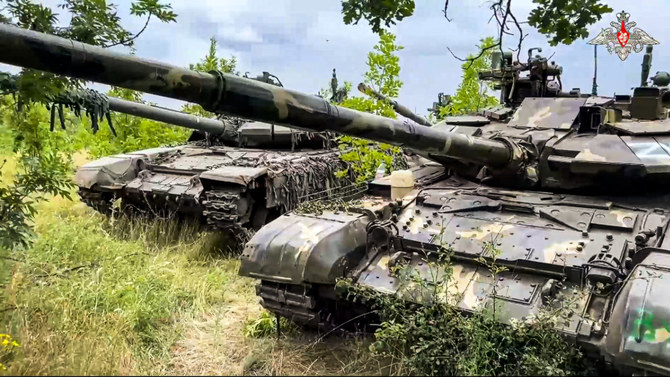
- The armed group, which played a key role in the Ukraine offensive, sought to topple Russia’s military leadership during the brief rebellion, before backing down
Uganda partially restores internet after president wins 7th term
- “The internet shutdown implemented two days before the elections limited access to information, freedom of association, curtailed economic activities ... it also created suspicion and mistrust on the electoral process,” the team said in their report
KAMPALA: Ugandan authorities have partially restored internet services late after 81-year-old President Yoweri Museveni won a seventh term to extend his rule into a fifth decade with a landslide victory rejected by
the opposition.
Users reported being able to reconnect to the internet and some internet service providers sent out a message to customers saying the regulator had ordered them to restore services excluding social media.
“We have restored internet so that businesses that rely on internet can resume work,” David Birungi, spokesperson for Airtel Uganda, one of the country’s biggest telecom companies said. He added that the state communications regulator had ordered that social media remain shut down.
The state-run Uganda Communications Commission said it had cut off internet to curb “misinformation, disinformation, electoral fraud and related risks.” The opposition, however, criticized the move saying it was to cement control over the electoral process and guarantee a win for the incumbent.
The electoral body in the East African country on Saturday declared Museveni the winner of Thursday’s poll with 71.6 percent of the vote, while his rival pop star-turned-politician Bobi Wine was credited with 24 percent
of the vote.
A joint report from an election observer team from the African Union and other regional blocs criticized the involvement of the military in the election and the authorities’ decision to cut
off internet.
“The internet shutdown implemented two days before the elections limited access to information, freedom of association, curtailed economic activities ... it also created suspicion and mistrust on the electoral process,” the team said in their report.
In power since 1986 and currently Africa’s third longest-ruling head of state, Museveni’s latest win means he will have been in power for nearly half a century when his new term ends in 2031.
He is widely thought to be preparing his son, Muhoozi Kainerugaba, to take over from him. Kainerugaba is currently head of the military and has expressed presidential ambitions.
Wine, who was taking on Museveni for a second time, has rejected the results of the latest vote and alleged mass fraud during the election.
Scattered opposition protests broke out late on Saturday after results were announced, according to a witness and police.
In Magere, a suburb in Kampala’s north where Wine lives, a group of youths burned tires and erected barricades in the road prompting police to respond with tear gas.
Police spokesperson Racheal Kawala said the protests had been quashed and that arrests were made but said the number of those detained would be released later.
Wine’s whereabouts were unknown early on Sunday after he said in a post on X he had escaped a raid by the military on his home. People close to him said he remained at an undisclosed location in Uganda. Wine was briefly held under house arrest following the previous election in 2021.
Wine has said hundreds of his supporters were detained during the months leading up to the vote and that others have been tortured.
Government officials have denied those allegations and say those who have been detained have violated the law and will be put through due process.


