


LONDON: Nigeria and South Africa were drawn in the same World Cup qualifying group on Thursday in a re-shaped African competition that will lead to at least nine teams at the 2026 showpiece in the US, Canada and Mexico.
The enlarged 48-team World Cup in three years’ time means Africa’s places are up from five to nine, with the possibility of a 10th African team making it through an inter-continental playoff.
In the new African format, just the winners of the nine six-team groups are guaranteed a place at the World Cup. The four best second-place teams enter African playoffs and the one that comes through those makes it to an inter-continental mini-tournament, where the two final teams at the World Cup will be decided.
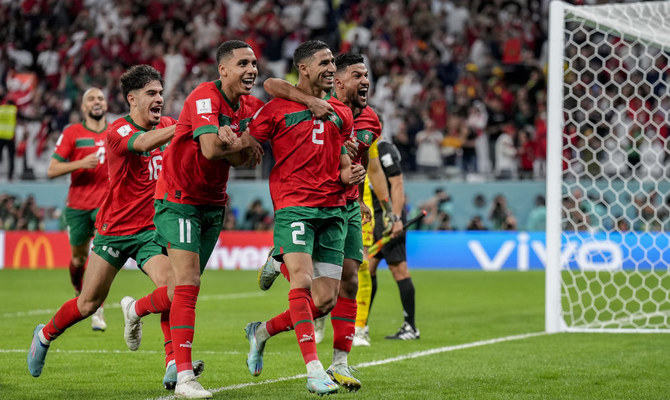
World Cup semifinalists Morocco, the first African or Arab team to make the last four after their surprising run in Qatar last year, are in a group where their sternest tests will likely come from 2012 African champions Zambia and Niger.
The African qualifiers will be played from November to October 2025.
Benin, Zimbabwe, Rwanda and Lesotho are the other teams in Group C with Nigeria and South Africa. Zimbabwe were included in the draw after FIFA lifted an international ban on the country on Tuesday. Zimbabwe were suspended in February 2022 because of government interference in their soccer federation.
Morocco, Zambia and Niger are in Group E with Republic of Congo, Tanzania and Eritrea, which are ranked 200 out of FIFA’s 211 teams.
The draw followed the Confederation of African Football’s general assembly in Abidjan, Ivory Coast, the West African country that will host the next African Cup of Nations in January-February.
Defending African champions Senegal will play Congo, Mauritania, Togo, Sudan and South Sudan in Group B. The Sudanese neighbors will play each other in World Cup qualifying having split into independent states in 2011 after decades of civil war.
Egypt are in Group A and is expected to be pushed by Burkina Faso for the qualifying place there. Egypt played at the 2018 World Cup in Russia after an 18-year absence but missed Qatar.
Morocco, Senegal, Tunisia, Cameroon and Ghana were the five teams from Africa to qualify for the World Cup last year. While Morocco made history to get to the semis, Senegal lost in the last 16 and the other three didn’t get past the group stage.
Ghana face a tough qualifying path in Group I against Mali, Madagascar, Central African Republic, Chad and Comoros, the tiny island archipelago that beat the Ghanaians in the group stage of the last African Cup and sent them to an early and embarrassing elimination.
Tunisia are with Equatorial Guinea, Namibia, Malawi, Liberia and Sao Tome and Principe in Group H.
Cameroon face Cape Verde, Angola, Libya, Eswatini and Mauritius in Group D.
Algeria are with Guinea, Uganda, Mozambique, Botswana and Somalia in Group G.
At CAF’s general assembly, FIFA President Gianni Infantino announced a new African Football League featuring eight clubs from across the continent would kick off on Oct. 20.
The African league was meant to be launched in August with 24 teams and prize money of $100 million but was delayed and has been reduced to a much smaller competition.
Infantino said it would eventually evolve into a “big version” but didn’t give any details on which clubs would initially take part or if it would still be the richest tournament in Africa, as CAF President Patrice Motsepe promised at last year’s general assembly in Tanzania.


