

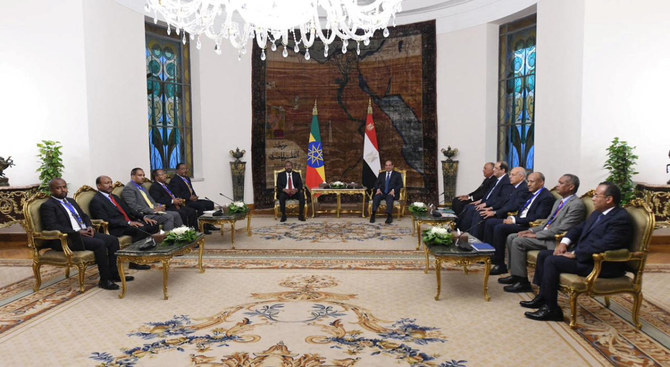

CAIRO: Leaders from Sudan’s six neighboring countries met in Cairo on Thursday for the most high-profile peace talks since the conflict erupted across the northeastern African country in mid-April.
The meeting, hosted by Egyptian President Abdel Fattah El-Sisi, was attended by the leaders of Ethiopia, South Sudan, Chad, Eritrea, the Central African Republic and Libya.
Sudan has been rocked by violence since April 15, when tensions between the military and the paramilitary Rapid Support Forces burst into open conflict.
Leaders at the summit acknowledged the threat the conflict poses to the region as a whole and urged the warring parties to commit to an immediate ceasefire.
They expressed deep concern over the military operations, and a sharp deterioration in Sudan’s security and humanitarian situation.
El-Sisi said the summit attendees underlined their respect for the sovereignty and unity of Sudan, as well as non-interference in its internal affairs and the need for an inclusive dialogue.
They agreed to facilitate the entry of humanitarian aid through neighboring countries, and to establish a foreign ministers’ working group to solve to the crisis through direct communication with the various Sudanese parties.
The group will present the results of its meetings and recommendations at the next summit on Sudan.
“This summit is held at a defining moment in the history of Sudan, during which the country is passing through a profound crisis that has negative repercussions on the security and stability of the region, the world, and, in particular, Sudan’s neighboring countries,” El-Sisi said.
The Egyptian leader said that fighting had resulted in the deaths of hundreds of civilians and the displacement of millions to safe areas inside the country or in neighboring countries.
“This is in addition to the formidable material damage to public and private property, and the destruction of numerous vital facilities in the country,” he added.
El-Sisi said that Egypt “will exert its utmost efforts, in collaboration with all parties, to stop the spilling of precious Sudanese blood, preserve the gains of the great people of Sudan, and help realize its people’s aspirations, which were voiced by millions of its sons during their glorious revolution, to live with security, freedom, peace, and justice in their homeland.”
Arab League Secretary-General Ahmed Aboul Gheit stressed the need to preserve Sudanese state institutions and highlighted the organization’s opposition to any external interference in Sudanese internal affairs.
The Arab League is keen to coordinate and cooperate with the UN and African Union to end the conflict, he said.
Aboul Gheit called for stronger Arab, regional and international efforts to prevent the collapse of food security in Sudan.
Mohammad Al-Manfi, head of the Libyan Presidential Council, threw his weight behind the outcomes of the Arab summit held in Saudi Arabia in May, urging the Sudanese parties to unite as an important step to end the conflict.
Ethiopian Prime Minister Abiy Ahmed said that Sudan’s neighbors will continue to suffer if the warring parties fail to respond to peace efforts.
The effects of the conflict are being felt by all neighboring countries, especially the Horn of Africa, which has seen waves of displacement, he said.
Ahmed called for an immediate and sustainable ceasefire.
“Sudan is bleeding. Ethiopia is doing its best to help it. In 2020, we celebrated a new beginning for democracy, but its joy has now faded, especially as we are witnessing a violent political conflict that has led to the loss of hundreds of lives, destruction and a lot of displacement,” he said.
However, Ahmed said he hoped things “will not be left to deteriorate in Khartoum, and this conflict must be contained in one way or another.”
Faustin Archange Touadera, president of the Central African Republic, warned of a proliferation of weapons due to poor border controls.
He called on the warring parties to come to the dialogue table, and urged neighboring countries to play a mediating role in order to achieve security and stability in Sudan.
With Reuters


