

Violence erupts in Yemen as riyal hits record low

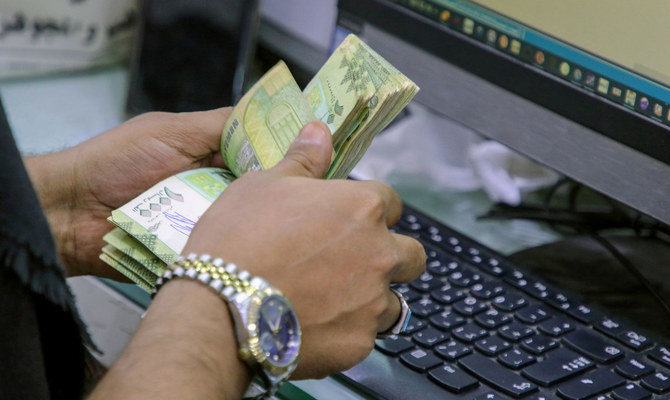
The riyal sank to 1,500 per dollar in Aden and other cities, plummeting from the May figure of 1,300 and ending months of stability. (Reuters/File)
Short Url
Updated 13 July 2023
Follow

Violence erupts in Yemen as riyal hits record low

  • Local traders told Arab News on Wednesday that they will stop buying and selling items until the Yemeni riyal stabilizes, adding that only large retailers accept the Saudi riyal

AL-MUKALLA: Protests erupted in many Yemeni cities controlled by the internationally recognized government on Wednesday, as the Yemeni riyal fell to a new low.

The riyal sank to 1,500 per dollar in Aden and other cities, plummeting from the May figure of 1,300 and ending months of stability. 

Angry demonstrators blocked key roads and set tires on fire in Aden and Al-Mukalla, while businesses, exchange firms and shops closed their doors in protest at the currency’s depreciation.

Local trade unions and social media users have called for widespread protests and civil disobedience in government-controlled areas until the Yemeni government intervenes to halt the riyal’s decline.

Several people were killed in previous demonstrations in Al-Mukalla and Aden after protesters clashed with local security forces over the deteriorating economic situation and falling riyal.

Since early 2022, when the Presidential Leadership Council was formed and the government returned to Aden, the Yemeni riyal had been trading at 1,200 per dollar.

The currency received a further boost after Saudi Arabia announced a $1 billion deposit with the state bank. 

However, in May, the riyal began to decline in value, reaching a low of 1,300 per dollar after peace efforts in Yemen stalled and the presidential council was unable to remain at home.

Rashad Al-Alimi, the council chairman, on Wednesday pledged to halt the riyal’s fall and regulate the exchange markets. 

Without elaborating on his government’s plans, Al-Alimi told a meeting with the French Ambassador to Yemen, Jean-Marie Safa, in Riyadh that the government will “urgently” act to halt the riyal’s depreciation.

During earlier rounds of currency depreciation, the central bank in Aden shuttered unlicensed money exchange shops, threatened to suspend enterprises that did not follow the bank’s laws, and offered dollars to local traders to import products and fuel.

Local traders told Arab News on Wednesday that they will stop buying and selling items until the Yemeni riyal stabilizes, adding that only large retailers accept the Saudi riyal.

Prices for essential items, including flour, sugar and cooking oil, have risen by 20 percent.

“If I bought goods now, I’d be a loser with no profit. I should wait awhile,” Abdullah, who owns a small grocery store in Al-Mukalla, told Arab News.

Experts say that Houthi drone attacks on oil facilities and a halt to oil exports have brought the government to the brink of bankruptcy, and it has only limited options to address the currency crisis, including requesting a new financial package from Saudi Arabia and international donors. 

The Houthis recently deprived the government of Marib gas and tax money from ports after forcing local traders to import items through Hodeidah. The militia also banned gas tankers from entering their territory from government-controlled Marib.


Iraq announces complete withdrawal of US-led coalition from federal territory

Updated 3 sec ago
Follow

Iraq announces complete withdrawal of US-led coalition from federal territory

  • The vast majority of coalition forces had withdrawn from Iraqi bases under a 2024 deal between Baghdad and Washington
  • US and allied troops had been deployed to Iraq and Syria since 2014 to fight the Daesh group

BAGHDAD: Iraq said on Sunday US-led coalition forces had finished withdrawing from bases within the country’s federal territory, which excludes the autonomous northern Kurdistan region.
“We announce today... the completion of the evacuation of all military bases and leadership headquarters in the official federal areas of Iraq of advisers” of the US-led coalition, the military committee tasked with overseeing the end of the coalition’s mission said.
With the withdrawal, “these sites come under the full control of Iraqi security forces,” it said in the statement, adding that they would transition to “the stage of bilateral security relations with the United States.”
The vast majority of coalition forces had withdrawn from Iraqi bases under a 2024 deal between Baghdad and Washington outlining the end of the mission in Iraq by the end of 2025 and by September 2026 in the Kurdistan region.
US and allied troops had been deployed to Iraq and Syria since 2014 to fight the Daesh group, which had seized large swathes of both countries to declare their so-called “caliphate.”
The militant group, also known as “Islamic State,” was territorially defeated in Iraq in 2017 and in Syria in 2019, but continues to operate sleeper cells.
The vast majority of coalition troops withdrew from Iraq over previous stages, with only advisers remaining in the country.
The military committee on Sunday said Iraqi forces were now “fully capable of preventing the reappearance of IS in Iraq and its infiltration across borders.”
“Coordination with the international coalition will continue with regards to completely eliminating IS’s presence in Syria,” it added.
It pointed to “the coalition’s role in Iraq offering cross-border logistical support for operations in Syria, through their presence at an air base in Irbil,” the capital of Iraq’s Kurdistan region.
In December, two US soldiers and a civilian interpreter were killed in Syria in an attack blamed on IS, sparking fears of a resurgence in the country.
The statement added that anti-IS operations would be coordinated with the coalition through the Ain Assad base in Anbar province in western Iraq.
IS attacks in Iraq have massively declined in recent years, but the group maintains a presence in the country’s mountainous areas.
A UN Security Council report in August said: “In Iraq, the group has focused on rebuilding networks along the Syrian border and restoring capacity in the Badia region.”